
X-Men Generations (Part 3)
The Gnarly Nineties
Preamble here, part one here, part two here.
Against my better judgement, I kept this as one gigantic post instead of doing the sensible thing and splitting it up into four. You can use the handy little ghost buttons off to the left to navigate between sections.
The seasonal-affective gloom has passed. I’ve gotten the yen to write about pop-cultural schlock out of my system and am very eager to do something else. If I return to this, it probably won’t be until the end of the year, when the days are getting shorter again. For now, I can only hope that a guided tour through a happier decade’s superhero ephemera will help to cheer a few people up as the world plunges into madness.
THE 1990s
Ah, the 1990s. And ugh, the 1990s. For American comic books, it was the best of times and then the worst of times.
Some contextual highlights:
(1) The Vibe.
We mentioned last time that the 1990s were a weird decade for superhero comics. The analogy that comes most immediately to mind is dubstep. Are you old enough to remember when dubstep took over electronic dance music?1 You couldn’t escape it. Everyone seemed to be into it; everyone was doing it. It seeped into and infected whatever it came into contact with. Everything got wub-wub-wubby and bwaaaaaammmmpy and redolent of bong rips and flatulence for a few years. Similarly, mainline American comic books in the 1990s adopted—or got sucked into—a gnarly aesthetic craze of their own.
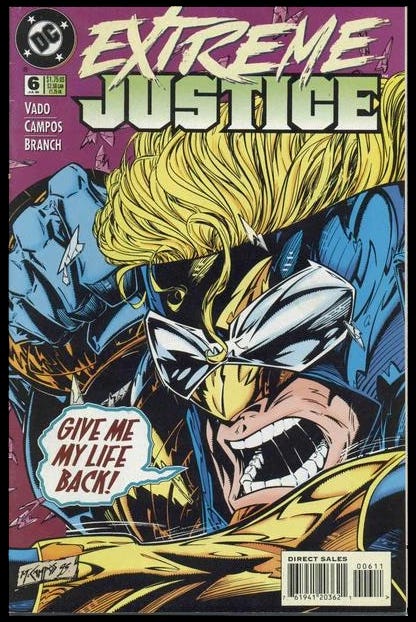
I’m obliged to trot out a few lines about Alan Moore’s iconoclastic Watchmen and Frank Miller’s epic The Dark Knight Returns popularizing both the Grim & Gritty super-antihero and “mature” (read: dark, violent) comic book storytelling in the late 1980s—but the fact is that artists like Jim Lee, Rob Liefeld, Todd MacFarlane, et al. were just as instrumental in determining the overall look and the vibe of mainline hero comics in the early 1990s. The influence they exerted upon the scene was enormous, especially with regard to design. Everyone wanted their books’ characters to look like how MacFarlane, Lee, or Liefeld might have imagined them. You can examine the results for yourself: open your search engine of choice and punch in something along the lines of “worst 1990s superhero designs.” (Here, I’ll save you the trouble. All the content mill articles topping the results will be variations of each other anyway.)2
The epitome of the early 1990s comic book superhero is, I think, Jake Gallows from Punisher 2099. I could be mistaken, but I’m pretty sure he wasn’t written tongue-in-cheek.
(2) Marvel Goes Public.
In 1989, Marvel was purchased by a wealthy ghoul by the name of Ron Perelman. In late 1991, he put Marvel on the stock market—and let’s pause for a moment to remember it wasn’t so long ago that a company that made most of its money selling print matter could announce an IPO and be taken seriously. Ryan Lambie of Den of Geek sums up how it all went down:
While the comics were flying off the shelves, Marvel attracted the interest of a man named Ron Perelman. Often pictured with a broad grin and a huge cigar in his hand, Perelman was a millionaire businessman with a variety of interests: in 1985, he’d made a huge deal for cosmetic firm, Revlon through his holding company, MacAndrews & Forbes. In early 1989, Perelman spent $82.5 million on purchasing the Marvel Entertainment Group, then owned by New World Pictures.
Within two years, Marvel was on the stock market, and Perelman went on a spending spree: he bought shares in a company called ToyBiz, snapped up a couple of trading card companies, Panini stickers, and a distribution outfit, Heroes World. All told, those acquisitions cost Marvel a reported $700 million.
Through the early ’90s, Marvel was buoyed by the success of Spider-Man and X-Men, which were selling in huge numbers. Sales of a new comic, X-Force, were similarly huge, thanks in part to a cunning sales gimmick: the first issue came in a polybag with one of five different trading cards inside it. If collectors wanted to get hold of all five cards, they – you guessed it – had to buy multiple copies of the same comic. With the boom still in full swing, that’s exactly what collectors did – as former Comics International news editor Phil Hall recalls, fans were buying five copies to keep pristine and unopened, and a sixth to tear into and read…
“[Perelman] reasoned, quite correctly, that if he raised prices and output, that hardcore Marvel fans would devote a larger and larger portion of their disposable income toward buying comics,” wrote Chuck Rozanski, CEO of Mile High Comics. “Once he had enough sales numbers in place to prove this hypothesis, he then took Marvel public, selling 40% of its stock for vastly more than he paid for the entire company. The flaw in his plan, however, was that he promised investors in Marvel even further brand extensions, and more price increases. That this plan was clearly impossible became evident to most comics retailers early in 1993, as more and more fans simply quit collecting due to the high cost, and amid a widespread perception of declining quality in Marvel comics.” [emphasis mine]
(3) The Speculation Bubble.
It’s difficult to say exactly where the hype bubble ended and the speculation bubble began. The one was predicated on the other: the higher the pitch of contemporary excitement, the thinking went, the more likely a copy of a “landmark” issue would appreciate in value. If perhaps a title like X-Force seemed poised to run for decades, sell millions of copies, and leave a deep and lasting pop-cultural footprint, the savvy collector ought to get in on the ground floor and hang onto a mint-condition copy of issue #1.
There had been publicized instances of very old comic books—say, Action Comics #1 from 1938—selling for tens of thousands of dollars at auction. People got it into their heads that their comic book collections might put their kids through college someday. Publishers boosted sales by lending credence to the notion that buying issue #1 of a new series, gathering a complete set of special holographic cover variants, or just buying anything with COLLECTOR’S ITEM! printed on the front was a financial investment—provided the product remain in pristine condition.
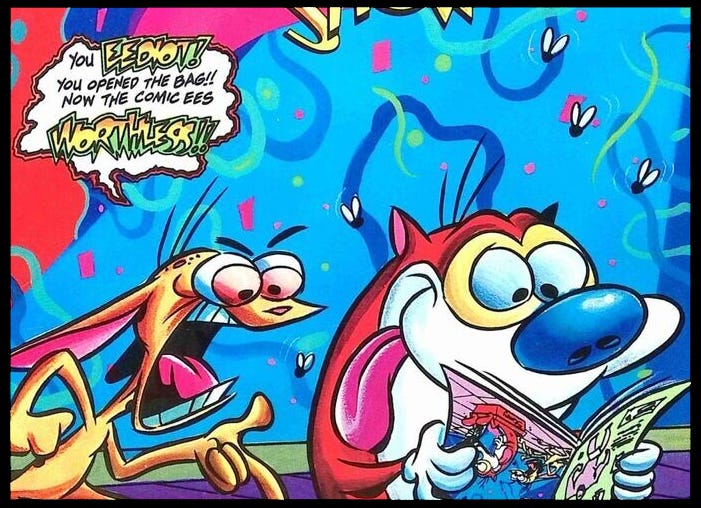
The long and short of it: publishers (especially Marvel) were cranking and cranking out material that sold like heart-shaped boxes of chocolate on Valentine’s Day, not necessarily because people were interested in reading it, but because they expected it to accrue in value. (For a little while it did, and sometimes impressively, precisely because everyone was expecting it to.) Small retailers wanting to get in on the action exacerbated the bubble’s inflation by opening up more comic book shops than anyone needed, ordering more product than there were readers for it, and fooling publishers into taking an unrealistically rosy outlook on the future.
A comment in an old message board conversation about the bubble puts the matter succinctly:
It started when people were buying new #1 comics on Wednesday at their LCS [local comic shop], then selling them on Thursday for $20 to $40 each.
It ended when the speculators stopped buying the Thursday comics.
Comic books were the NFTs of the early 1990s.
(4) The Bubble Pops.
One Jesse Stillman believes the comic book industry’s Lehman Brothers moments were the shambolic rollout of Deathmate, an inter-company collaboration series between hot new publishers Image and Valiant where every issue was basically a #1 collector’s item, and the revelation that reports of Superman’s death had been greatly exaggerated. In the one instance, Deathmate (1993–94) not only failed to live up to its own hype, but failed even to ship on time. Shops were left with heaps of Deathmate issues after everyone got tired of waiting and lost interest—and comics that nobody cares about not only don’t get bought, but will never be worth more than the paper they’re printed on. In the second case, when DC Comics resurrected Superman in 1993 (about a year after Doomsday beat him lifeless), issue #75 was expected to expected to depreciate in value because it no longer marked the final appearance of Clark Kent. Speculator-collectors tried to sell off their mint-condition bagged & boarded copies en masse, and nobody wanted them.3
“Just [printing] ‘Collectible Issue’ on the cover does not make it collectible or rare,” Stillman states the obvious. “Some estimates have the print run on Superman #75 in the 3-4 million copy range.” Thirty years later, you can go on eBay and buy a sealed copy for about ten bucks.
In any event, the bubble deflated. The market shook. The more extreme reports claim that nine out of ten comic book shops in the United States went out business. Smaller publishers threw in their towels. All but one distributor shut down. Marvel’s sales dropped by 70 percent, and the value of its shares plummeted. The company filed for chapter 11 bankruptcy in late 1996, and was a shambles for the rest of the decade. (This was one of those rare times when it was incontestably better to be a DC devotee than a Marvel true believer.) You can read about it in more detail elsewhere—but bear in mind that all of this is looming in the background of the series we’ll be looking at today, and that the American comic book industry never fully recovered from the crash.
To return to the start of the decade…
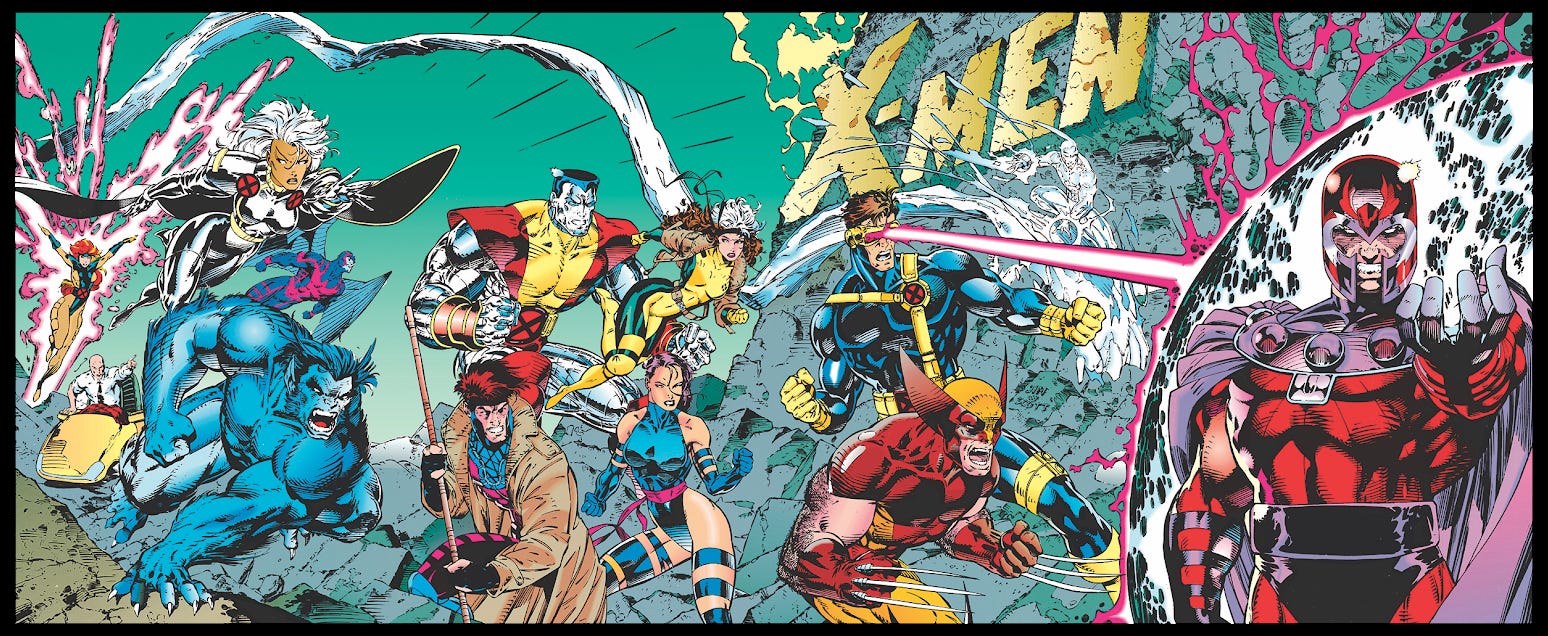
Perhaps the stature of the X-Men brand reached its peak with the release of the Bryan Singer films in the early 2000s, but the apogee of X-Men comics as a pop-cultural force was 1991. If, perhaps, you’re more familiar with television cartoons than comic books, you might recall that the X-Men animated series made its splash debut in 1992. Want to guess why they were chosen for a fresh new Saturday morning adaptation instead of the Avengers, the Fantastic Four, or any other Marvel property we might name? Answer: at the time, a whole lot more people cared a whole lot more about the X-Men than any of those other characters and their comics. It’s kind of amazing in retrospect, given how things shook out over the next couple of decades—but during the 1990s, nobody gave a shit about the Avengers. The X-Men altogether eclipsed them as Marvel’s primo superteam.
1991 was the year the X-Men were reassembled, redesigned, and soft-rebooted. After writing Uncanny X-Men for sixteen years, Chris Claremont was on his way out. Through editorial prodding, the overarching story had contrived to return the X-Men to a more familiar status quo. Professor Xavier returned from outer space (don’t ask), and was back in a wheelchair (or, rather, a snazzy Jim Lee-designed hoverchair). Cyclops no longer had a baby son in need of attention. Storm got re-powered. The members of X-Factor rejoined the X-Men, and they all moved back into a rebuilt X-Mansion.
In 1981, the X-Men had a single monthly comic book to their name. Let’s review how things looked in the fall of 1991, ten years later:
Uncanny X-Men. The ongoing original series. Whilce Portacio is on pencils and plotting, and John Byrne writes the dialogue and narration. The X-Men and X-Factor have been consolidated into one mega-group, split into “Blue” and Gold” teams. Uncanny follows the Gold Team, and would be the book you’d read if you liked X-Factor’s characters (three of five of them are here), were a fan of the ever-popular Storm, and were intrigued by Portacio’s debut character Bishop.
X-Men. Newly launched. Often referred to as “Adjectiveless X-Men.” Jim Lee on pencils and plotting. The first three issues will be Chris Claremont’s swan song, and then John Byrne will step in. This one follows the Blue Team, and is the one you’d pick up if you thought Gambit, Psylocke, and Wolverine were cool—and who didn’t? It must be mentioned that X-Men #1 remains the best-selling issue of any American comic book in history, having moved something in the neighborhood of eight million(!!!!!!) copies.
X-Factor. All-New, All-Different. Written by Peter David, drawn by Larry Stroman. This will be the more lighthearted, self-aware, sitcom-tinctured X-book, featuring a team of preexisting C and B-list X-characters working as a government-sponsored superteam. Underrated, but nobody knows it yet.
X-Force. Formerly New Mutants. Drawn and plotted by Rob Liefeld; word bubbles and boxes by Fabian Nicieza. Guns, swords, blood, testosterone, dubious ethics. Overrated, but nobody knows it yet.
Wolverine. The most popular X-Man’s solo series. Written by G.I. Joe alum Larry Hama and penciled by Marc Silvestri.
Excalibur. After some creative shuffling, co-creator Alan Davis is drawing and writing the series. It was unaffected by the reorientation, and will continue doing its own thing as Uncanny X-Men’s weird cousin across the pond until Davis takes his leave in 1993. Excalibur will afterwards fall under the supervision of Marvel’s X-Office and formally become “X-Men UK.”
The publication of Adjectiveless X-Men #1 and the linewide reorientation coinciding with its release consummated the X-Men’s transformation into a franchise within a franchise. From here on out, “X-Men comics” are going to be the “the X-Books.” Scores of new titles and volumes involving lord knows how many different artists and writers will debut and die out over the next three decades.
The material published during short tenure of the Image artists (we’ll get to that in a second) as the books’ main creative agents hasn’t aged altogether well. One might get the impression that the illustrators were overflowing with ideas for cool things to draw, and unwilling to let certain fundamentals of storytelling—like pacing, for instance—impede them. But the comics certainly looked great, and there was so much general hype surrounding the X-Men that questions about quality were almost beside the point.4
Let’s try to briefly sum up the dramatic story of the Image Exodus of 1992 and its effect on the X-Books:
>Be Bob Harras, editor.
>Be in charge of managing Marvel Comics’ hottest property, written for years by a pair of reliable and passionate workhorse authors (Chris Claremont, Louise Simonson).
>Assign a group of crowd-pleasing new pencillers (Jim Lee, Rob Liefeld, Whilce Portacio) to draw the X-Books. Notice that the artwork is stoking fans’ enthusiasm to a febrile pitch.
>Decide the pencillers are your golden goose. Do everything you can to make them comfortable and excited to work for you. Give them more than the usual say over the creative direction of their books. Give them veto power over the writers’ story ideas. Give them more flexibility with regard to deadlines; if the writers have to rush because the pencillers are taking their time turning in pages and changing up the books’ agreed-upon stories mid-issue, so be it. When the writers complain, brush them off.
>Grant your golden goose pencillers total control over their books when the alienated writers quit. Don’t give the outgoing writers a send-off in your publications’ editorial “bullpen” columns, thanking them for their many years of work on the company’s biggest franchise. Altogether omit mention of their departure. Out with the old, in with the fucking new. Perhaps give your favorite new pencillers cause to wonder what might happen if—or when—they fall out of favor with you. In the meantime, bring in a comic-world veteran with solid credentials (John Byrne) to script the words for the artists’ panels in your franchise’s two flagship titles.
>Drop your big-name scriptwriter after less than a year when he comes to you with the same complaints you heard from the books’ former authors.5 Replace him with an ambitious but undistinguished new writer (Scott Lobdell) already in your employ.
>Look shocked when the superstar pencillers on whom you staked so much suddenly follow sensational Spider-Man artist Todd MacFarlane out the door to found Image Comics, where they’ll be their own bosses and retain the rights to the IPs they develop. Scramble to find artists to replace them on Uncanny X-Men, Adjectiveless X-Men, and X-Force.6 Promote those books’ scriptwriters (Scott Lobdell and Fabian Nicieza) to regular writing/plotting roles. They’re good enough, probably, and they’re already here, so whatever.
A few things we can say about Scott Lobdell and Fabian Nicieza: together they were, more or less, the new Chris Claremont and Louise Simonson, constituting the authorial core of the X-Books from 1992 to 1995. They were, for the most part, perfectly adequate writers. Neither was anywhere near the level of Chuck Austen, whose 2002–2005 run became a popular yardstick against which unexciting, sloppy, or outright terrible authorial tenures could be measured. By a fairly wide margin, Nicieza was the better of the pair—so it probably shouldn’t shock anyone that Bob Harras liked Lobdell better, and that Lobdell outlasted Nicieza by a couple of years. I recently skimmed an old Reddit thread where someone remarked that Lobdell and Nicieza were the last X-Book writers who tried to write them the way Claremont had done, and I think that’s a fair observation.
Still—for the rest of the decade, the X-Books were running mostly on leftover momentum from Claremont, Simonson, and the artists involved in the Image Exodus, while receiving annualized hype injections from the EVENT cycle.
What I think went missing after the changeover was some of the optimism that defined the X-Men during their rise to fame in the 1970s and 1980s. These were heroes who went through difficult times and often had their backs to the wall, but Claremont kept the mood hopeful, if not always buoyant. In the 1990s, the background situation regarding human/mutant relations grows bleaker and bleaker. To begin with, X-Force’s bête noire Stryfe releases an engineered plague called the Legacy Virus, which targets mutants, is invariably fatal, and lacks any subtlety as a metaphor for HIV’s baleful impact on the gay and lesbian community. The 1995 one-shot X-Men Prime features a story that could be about a murder driven by homophobia if “mutie” were substituted for the real-world slur of your choice. Not long afterwards, Professor Xavier grows so overwhelmed by the manifest hopelessness of his life’s cause that he actually snaps and turns into a monster that he gives birth to a psychic monster made of his despair and rage wait what does happen here? that the Onslaught EVENT happens. Afterwards, in the half-baked Operation: Zero Tolerance EVENT, the United States government declares open season on mutants. Nobody was calling the X-Men “Marvel’s Merry Mutants” anymore, I don’t think.
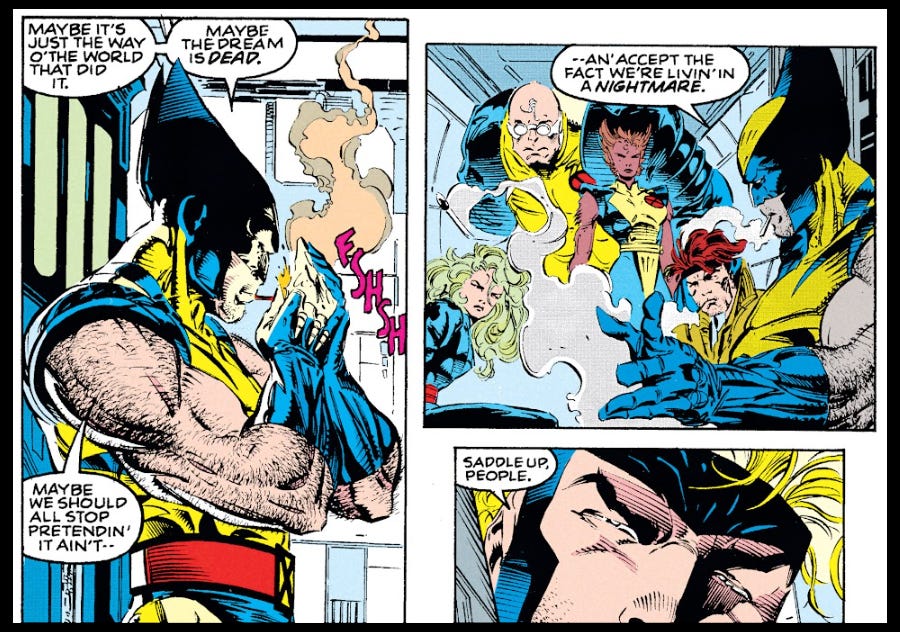
The overlap between the edginess of early 1990s comic books and the introspective pessimism of the zeitgeist is fairly obvious, in retrospect. There’s a moment (see above) where Fabian Nicieza has the X-Men and X-Factor asking each other how and why in the world Xavier’s teenaged former students agreed to join Cable’s superpowered militia cell. Maybe, Wolverine speculates, the times have changed, and the X-Force kids are a meaner, harder breed of youth for a meaner, harder world. (It’s almost like Nicieza was a little embarrassed by how New Mutants’ goofy switchover into X-Force played out, and saw an opportunity to gloss it in a way that made it seem like there was a deeper intent and design to it than “Rob wants to draw what he wants to draw.”)
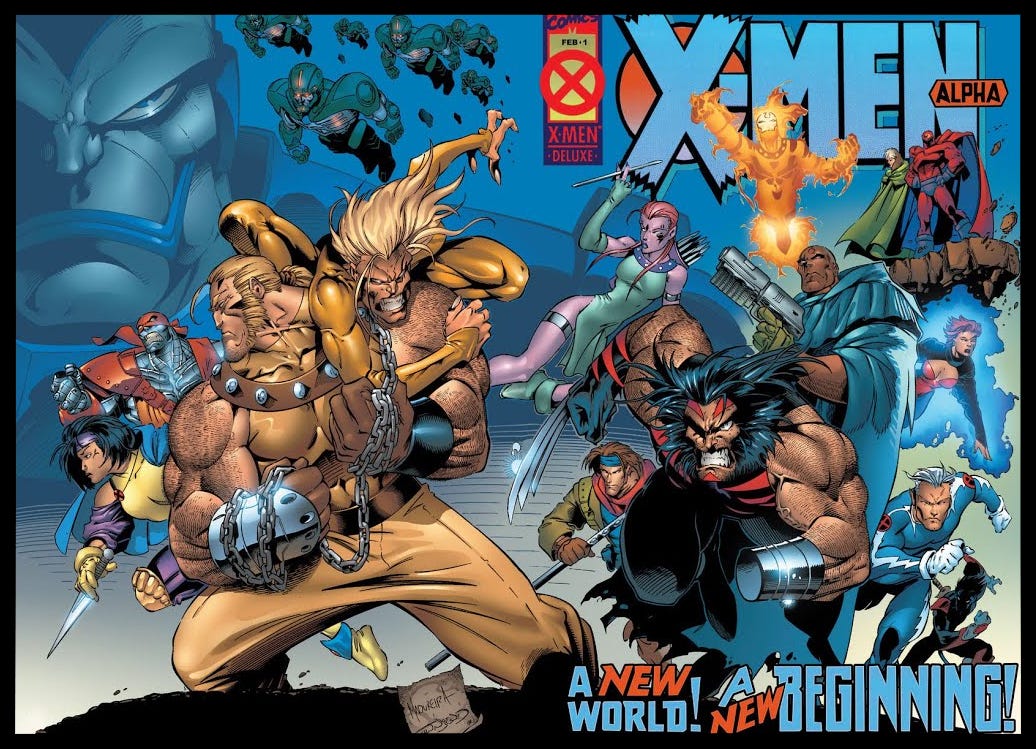
We can’t talk about 1990s X-Mania without bringing up the epochal Age of Apocalypse EVENT of 1995. As far as gimmicky marketing stunts go, this one was even more radical than killing off Superman. Professor Xavier’s god-mutant son Legion (introduced in New Mutants, remember) decides to do his father a solid by going back in time to murder Magneto before he breaks bad. And, whoops—Legion accidentally erases his own existence and changes history by killing his dad instead.
All of the X-Books were “cancelled” and replaced with a new set of titles set in a war-torn hellscape where Apocalypse, nemesis to the 1980s iteration of X-Factor, rose to power unchecked and conquered the United States. Obviously the books were going to resume as normal after a few months, once the alternate-universe version of the X-Men set the timeline aright—but if you happened to be an uncynical elementary schooler at the time (as I was), this was earth-shattering. Like the rubes who actually believed that Superman was going to stay dead or that Bruce Wayne would be in a wheelchair for the rest of his life after losing his fight with Bane, I really did take the promotional material at face value and supposed that this was it, this was just how X-Men comics were going to be from there on out.
It was a brilliant hype-generating trick and a great storytelling idea that could only really work just once. As we shall see later on, that didn’t stop the X-Books’ stewards from trying it again and again and again and again and again.
Age of Apocalypse was the X-Men’s last hurrah of the decade. As soon as it was over, little time was wasted building up to the unmitigated creative disaster of the Onslaught EVENT. If you desire to truly understand why a significant proportion of comic book nerds speak dismissively of 1990s Marvel, go find and read one of the collected editions of the Onslaught debacle and drink in the decade’s distilled essence for yourself. It’s shamefully bad. Not that it didn’t move product—but safe to say it prompted a lot of regular readers to ask themselves why they were spending their money on such garbage.
The state of the X-Books between 1995 and 2001 can be summed up in one word: directionless. It became harder and harder to say what each title was supposed to be doing when it wasn’t involved in the latest unwieldy, overhyped, and ultimately underwhelming linewide EVENT.7 I don’t want to dredge up any of the particulars—just trust me when I say that there was very little to get excited about. Most of the talent that had developed and defined the franchise at its peak had moved on. There were almost ten X-Books being published on a monthly basis, and they lacked any kind of guiding vision. Malaise and mediocrity were the order of the day. What’s really embarrassing is the extent to which the editors were reportedly dictating stories to the writers. From what I’ve gleaned from reading interviews over the years, the publisher’s quality control mechanisms were actually making the product worse. I would say that this is a period that most longtime X-Men fans would just as soon forget, but I’m pretty sure most of them have.
Okay. Enough’s enough. It’s time for the walk of shame.
GENERATION X
(1994–2001)
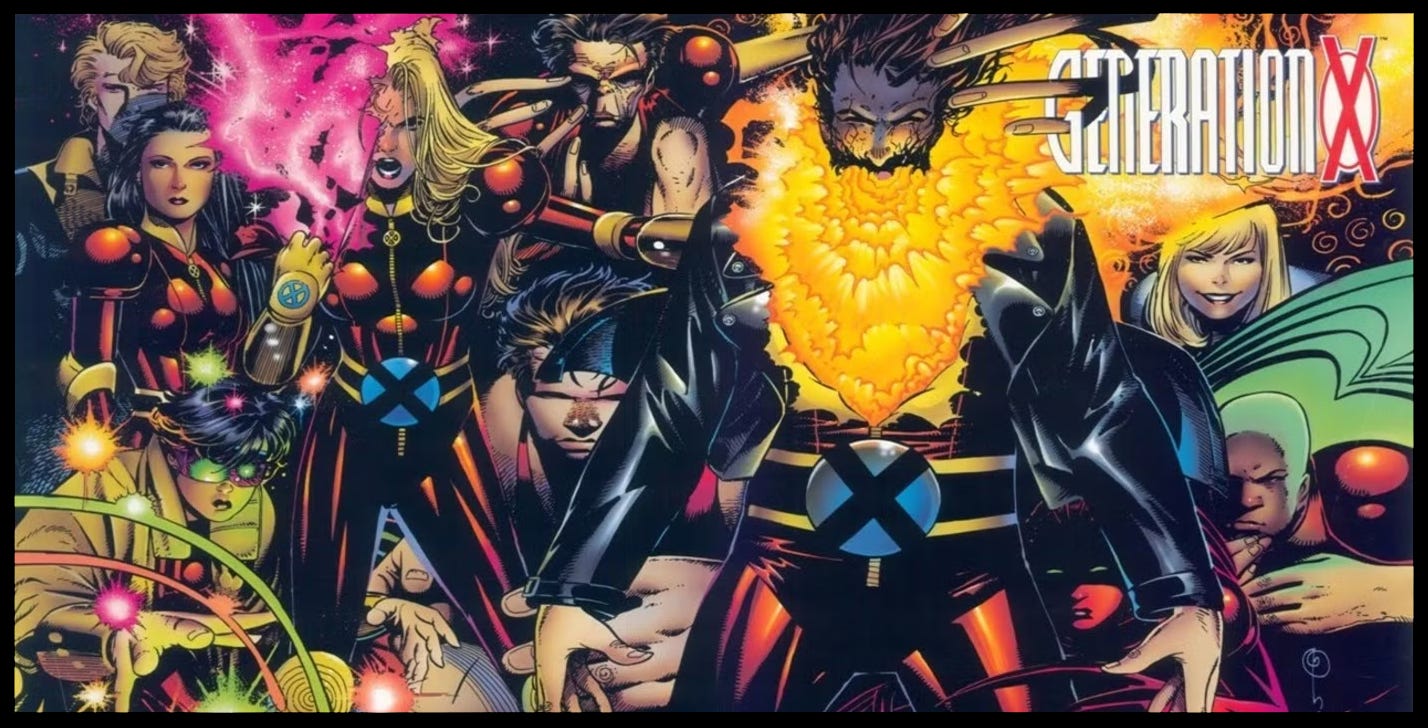
If you’re an old who was reading Marvel comic books in 1994, you definitely remember this promotional image. They hyped the shit out of Generation X.
A month before Generation X #1 was published, one could visit their local comic book shop and pay a couple bucks for the Generation X Collector’s Preview (nota bene: the word “collector” is in the title), a magazine containing interviews with the series’ creators, character profiles, (specious) story teases, and a pile of material pertaining to the X-Books, X-Media, and X-Merchandise in general. To the best of my knowledge, Generation X is the only X-Book that ever got this treatment.
From the preamble:
The X-Men are the originals, and over the years they’ve had to do a lot of adapting. From “The Uncanny X-Men”, to “The All-New, All-Different X-Men”, to “The New Mutants”, and so on, they’ve continued to be the state of the art. And now, in this very tumultuous period in comic book history, they have to continue to adapt. Luckily for them, and for the reader, they thrive on challenge.
Generation X is quite probably the next big evolutionary leap. Lots of folks have been trying to create the new heroes for the coming millennium—or they’ve been trying to convince you they have—but it looks as though Scott Lobdell and Chris Bachalo, both fresh talents on the scene, have really got the ball rolling…
Remember: the comic book market was beginning to fracture. Marvel was desperately hopeful for a Next Big Thing.
On the origin of Generation X:
About a year-and-a-half ago, Bob Harras asked Scott Lobdell to come up with a New Mutants one-shot or mini-series.
According to Scott, the impetus was as simple as Marvel needing to maintain the copyright.8 Lobdell was not especially excited at first, then he went home for the weekend and started thinking about it. By Monday, he had come up with the concept for an entirely new ongoing monthly series starring an all-new team of teenage mutants—with practically nothing in common with their predecessors, except age.
Generation X was Scott Lobdell’s baby. By 1994, he had effectively inherited the mantle of X-Scribe from Chris Claremont. He had been Uncanny X-Men’s regular writer for two years, and had penned at least one issue of nearly every other X-Book. Generation X was his chance to develop a brand-new series from the ground up.
It seems Lobdell’s personal mission for Generation X was to cut against the grain. This was not going to be New Mutants version 2.0, but something completely and totally different. And sure—look! Look at how strange this new bunch is. They’ve got weird mutant powers this time. And now they’re based in a rustic Massachusetts town, not the old mansion in Westchester, so that’s something new, yeah? And check it out: they don’t do their combat training and sparring in any Danger Room. Instead they have the Grotto—an on-campus biodome. That’s kind of cool and different, isn’t it? Isn’t it??
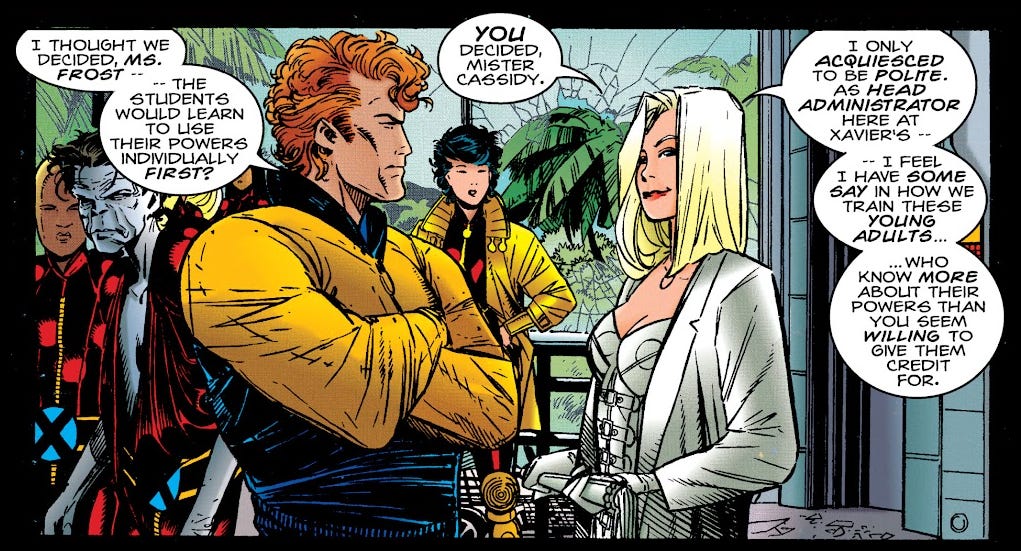
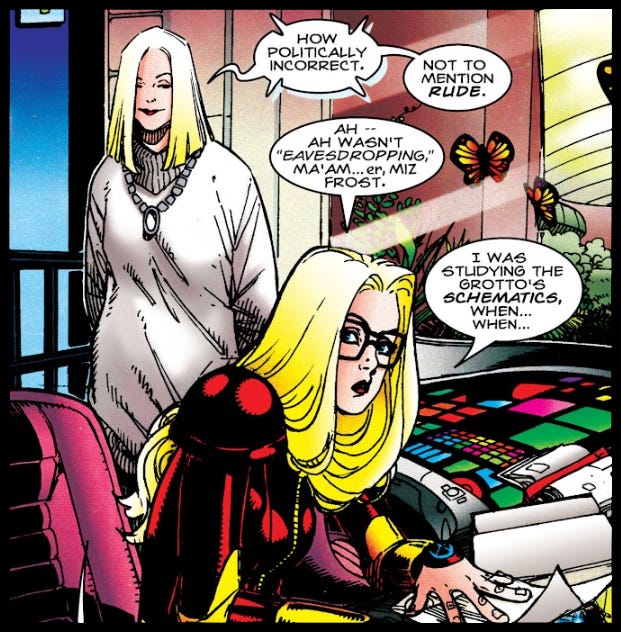
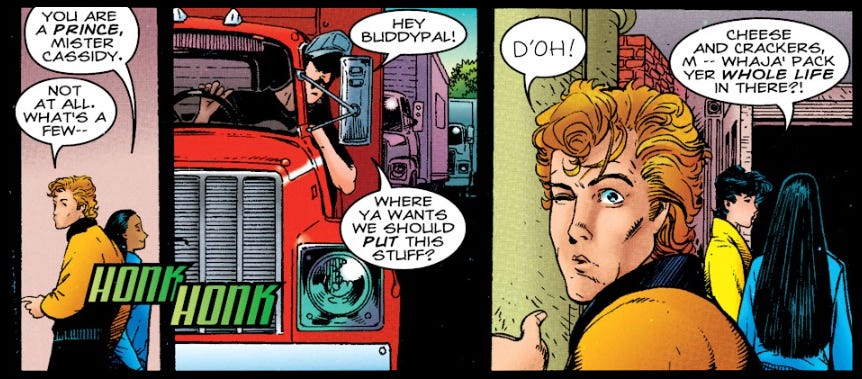
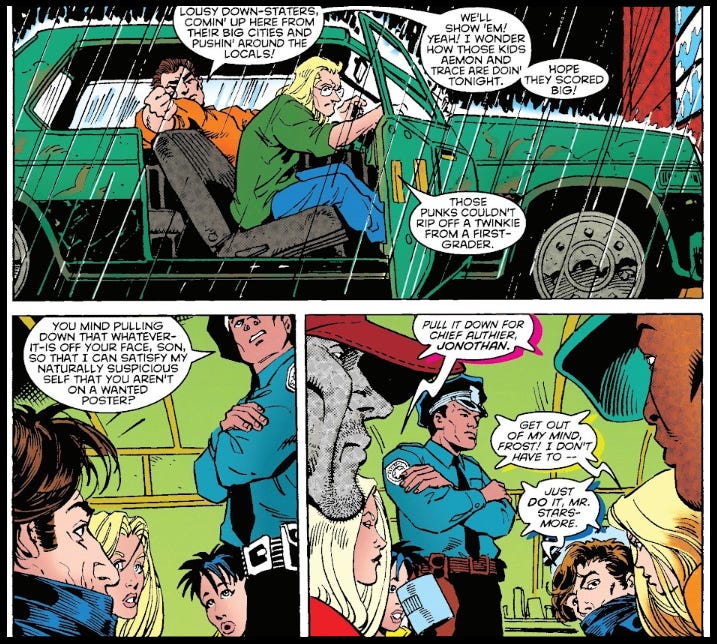
What was perhaps most striking about the Generation X preview material was seeing Lobdell’s choice of teacher/mentor figures. Professor Xavier was out; Sean Cassidy (Banshee) and Emma Frost (the White Queen) were in. The improbable pair comes together in the Phalanx Covenant crossover EVENT to rescue a group of teenaged mutant abductees, after which they spruce up Emma’s defunct Massachusetts Academy, reopen it as the new Charles Xavier School for Gifted Youngsters, matriculate the kids they rescued, and train them to be the next generation of X-Men. Well—why not?
Sean was a smart pick because nobody would have guessed it. He had been an occasional ally of the X-Men during their 1960s run, joined the All-New, All-Different X-Men of 1975, and retired before the decade was over (but continued to make occasional guest appearances). It made no difference that he was never much of a leader, a teacher, or even a father; Lobdell had always liked the character and was good at getting what he wanted from editor Bob Harras. Sean’s return was precisely the kind of thing that turned heads and fueled hype.
Emma, on the other hand, was a truly inspired choice. We know from New Mutants that she was a teacher when she wasn’t up to any nefarious Hellfire Club business, so she’s got the right background for the job. Having recently awakened from a coma to discover that the Hellfire Club is under new management and all of her Hellions were slaughtered by Whilce Portacio some time-traveling asshole named Trevor Fitzroy, Emma figures that a redemption arc might be a wise career move. She wants to atone for her mistakes with the Hellions by doing right by a new group of students.
Let’s take a quick look at those students:
Angelo Esposito (Skin). Los Angeles Chicano. Has a sketchy past involving gang activity. Depending on immediate the needs of the story, he either has like six extra feet of grayish skin just hanging off his bones or possesses Mister Fantastic stretchy powers. His schtick is being cynical, smoking cigarettes, and shouting ¡CARAMBA!
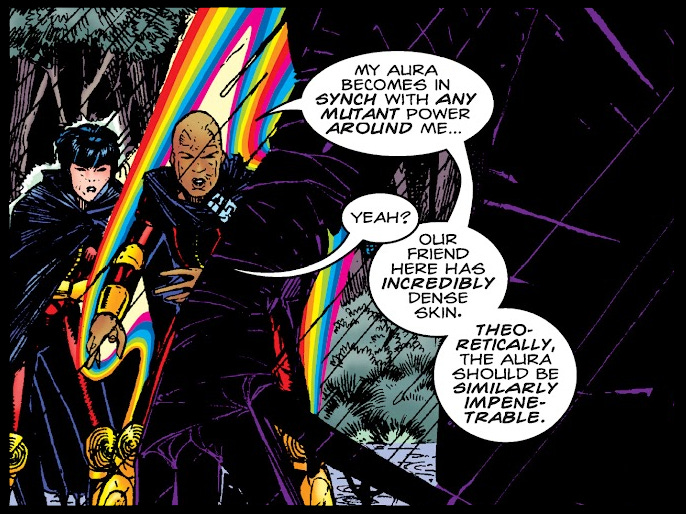
Everett Thomas (Synch). Bright, upstanding young man from St. Louis. Has an amazing technicolor “mutagenic aura” that gives him the powers of any superhuman(s) in the vicinity, and can also be used for pretty much whatever Lobdell thinks might be useful in the moment. It can be a forcefield! A motion sensor! A whatever! Everett’s schtick is being the down-to-earth normal one who gets neglected for character development.
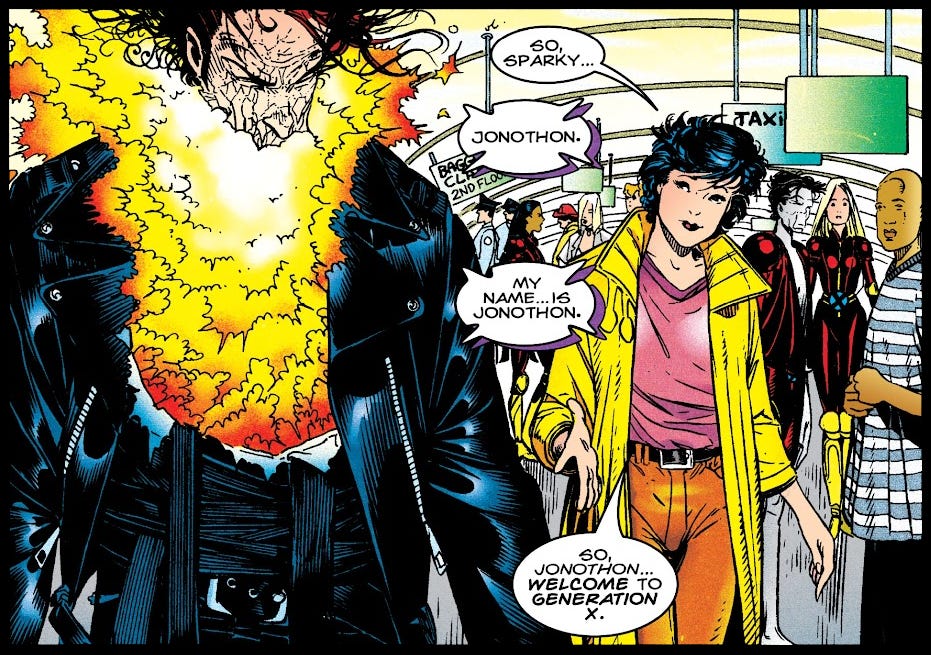
Jonothon Starsmore (Chamber). Post-punkish/goth Cockney dude from across the pond. Has a “bio-nuclear psionic biokinetic field” inside of his body that blew out his chest and the lower half of his face when his powers activated. Doesn’t have a mouth anymore, but conveniently doesn’t need to eat and can telepathically project his speech. He can shoot flames (or something like them) and project shockwaves from the gaping glowing cavity in his face and chest, but is also able to wrap a scarf around himself without it catching fire. Who cares if he doesn’t make sense; he looks cool. His schtick is gloom and self-sabotage.
Jubilation Lee (Jubilee). Chinese-American mallrat from the West Coast. Former X-Man and Wolverine’s ex-sidekick. Tosses out pyrokinetic “fireworks.” Her schtick is being a motormouth and getting no respect for all her reminders that she used to go on adventures with the actual X-Men.
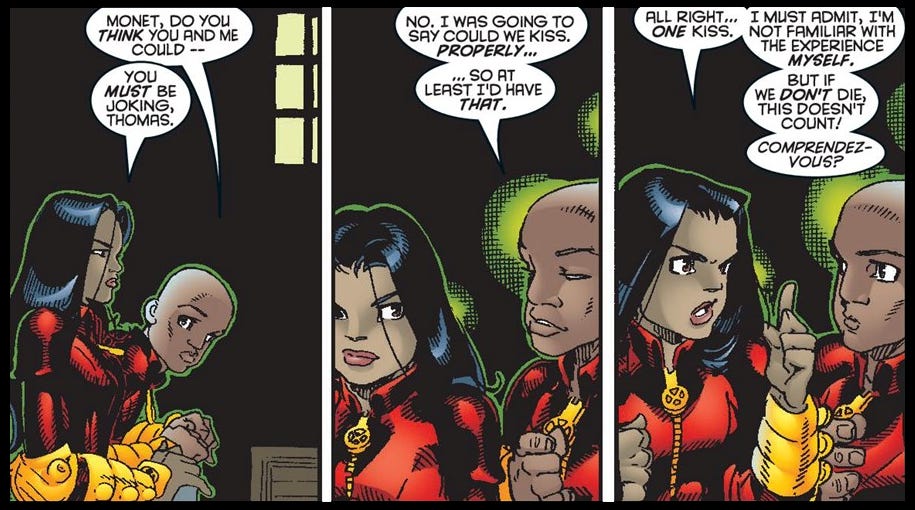
Monet St. Croix (M). Originally from Monaco. Super-strong. Invulnerable. Flies. Psychic. Well-educated. Rich. Conventionally attractive. She’s the whole damn package. Is secretly a pair of eight-year-old twins who merged together to form a sixteen-year-old. One of the twins is comic-book autistic (which is different from being real-life autistic), so sometimes Monet withdraws into herself and becomes totally unreceptive to stimuli. Her schtick is being haughty and perfect and mysterious, and sometimes she speaks French.
Paige Guthrie (Husk). Remember Sam from New Mutants? Paige is his little sister. She rips off her skin to reveal other stuff underneath—stone, metal, lava, more skin, whatever. Her schtick is being a tryhard would-be overachiever who’s sensitive about her rural Kentucky origins. (We’re still in the era of residual Claremont-style eye dialogue, and Paige tries not to lapse into it.)
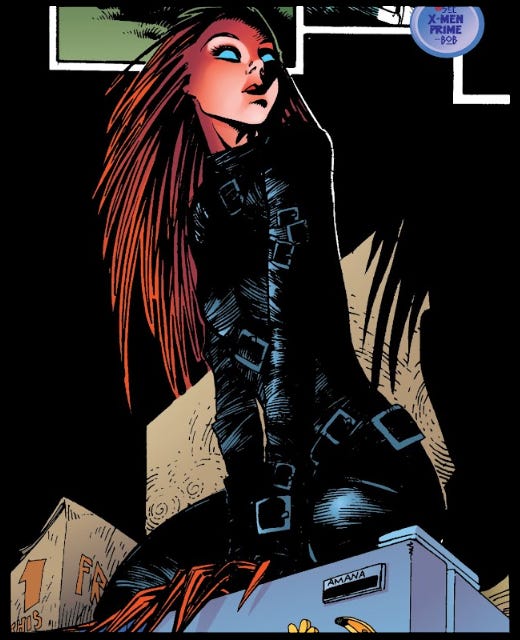
“Yvette” (Penance). Probably from Yugoslavia. Doesn’t speak. Is actually deaf-mute, but Lobdell never bothers saying so. Diamond-hard skin, super-sharp talons for digits, quills for hair. Nonverbal and somewhat feral. Her schtick is lurking, being talked about, and getting written out of the book while remaining in the book.
The corporeal bizarrerie of this group’s mutant powers clearly sets them apart from previous X-cohorts. Angelo, Jono, and Penance can all be considered deformed. (Not long into the series, Bachalo stops drawing Angelo as having the wrinkled face of an old man, but the gray complexion never changes.) Paige’s special ability involves “husking” her epidermis, and Jubilee complains about her leaving strips of skin lying around. Monet is two people fused together. Only Jubilee and Everett’s powers lack any aspect of bodily oddity.
Generation X’s character dynamics are also unusual. Maybe what Lobdell wanted to avoid was distributing stereotyped personalities among his cast (à la Stan Lee) in favor of a more subtle and organic approach. It makes sense—but he accidentally ends up with a group of redundant pairs. Angelo and Jono are both negative nancies. Jubilee and Paige both want more respect. Emma and Monet are both conceited haute monde dames with psychic powers, while Everett and Sean are both down-to-earth dudes doing their best. (Penance is, sad to say, the family pet.)
A couple of these correspondences are interesting. Angelo and Jono are able to bond over having superpowers that ruined their looks. The psychic, intellectually brilliant, and super-strong Monet presents Emma with something she never expected to encounter: a teenaged student by whom she feels threatened. These complementary and opposing similarities lead to some interesting moments—but on the whole, the cast members of Generation X have a hard time individually standing out when there’s someone else in the book performing a variation of their own character-defining bit.
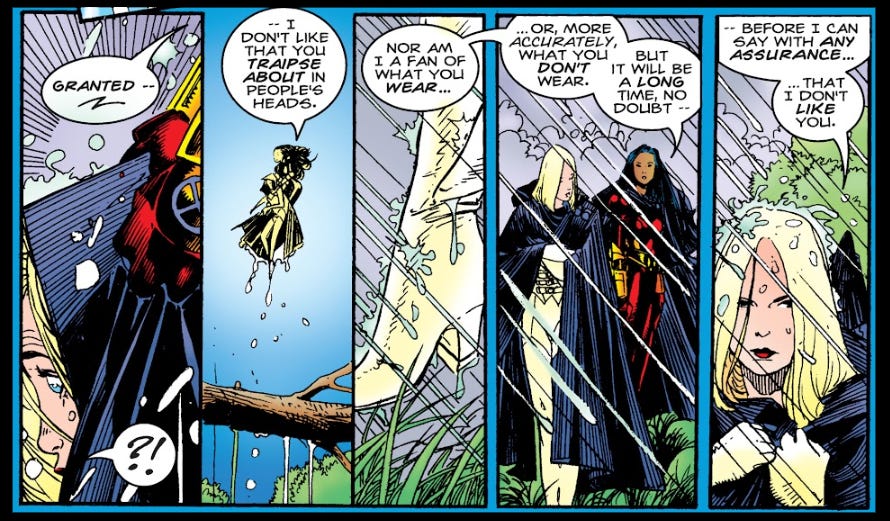
I was tempted to write up little profiles for Emma and Sean because they’re practically members of the team themselves. They don’t stand as loftily above the students as did Xavier, Magneto, or even Cable, and are willing to suffer a lot more back-talk. Whereas Xavier and Magneto typically sat out of their students’ extracurricular adventures, Emma and Sean often join them in (or lead them into) the field. The former X-Man has a kind of Irishy salt-of-the earth quality about him, while the Hellfire Club’s erstwhile White Queen flaunts her sophistication. The pair bickers. Sometimes they flirt. Neither is quite the stalwart, infallible, Lawful Good, Father-Knows-Best figure that Xavier was usually depicted as.
In the original X-Men, the first year’s worth of issues usually begin with Kirby and Lee presenting the X-Men in strenuous Danger Room training sessions. (It got dull, sure, but it did explain how a pack of fifteen-year-olds was capable of holding its own against Magneto.) In New Mutants, Claremont occasionally had Xavier’s latest students (whom the Professor had no intention of molding into mutant superheroes) testing their abilities in the Danger Room, attending dance classes, and doing regular coursework on desktop computers. There’s vanishingly little of this in Generation X. If memory serves, over two years (of publication time) pass before any of the new kids are shown sitting in a classroom. We pretty much never see Emma or Sean overseeing combat training or otherwise giving instruction, and I don’t believe they ever address anyone from behind a headmaster’s desk. Across thirty years, we’ve gone from “please Jack & Stan, we don’t need to see another Danger Room scene” to “shouldn’t they be working out or studying or something?”
We’ve come to a point where flashing X-Men tropes established during the Claremont era can practically pass as storytelling. There’s a Charles Xavier School for Gifted Youngsters. There’s teenagers wearing identical combat uniforms. They fight supervillains whom they randomly bump into off-campus, or who attack them while they’re hanging out at home. Jono shoots flames, Jubilee tosses out fireworks, Monet punches people, and Paige tears off her skin to reveal diamond underneath, and it’s all very exciting and action-packed. So what more do you need? Why should anyone be asking about the curriculum? Why are you acting like there needs to be a point to any of this? Do you hate X-Men comics or something?
There’s something odd going on with Generation X, and founding penciller Chris Bachalo can make it hard to identify. I’m not sure if you noticed, by the way, but the artwork here is phenomenal. Lobdell’s best decision in creating Generation X was poaching Bachalo from Pete Milligan’s Shade, The Changing Man and inviting him on to co-create the series. He’s responsible for the visual designs of all the original cast members, and for making Generation X look like no X-Book anyone had ever seen before.
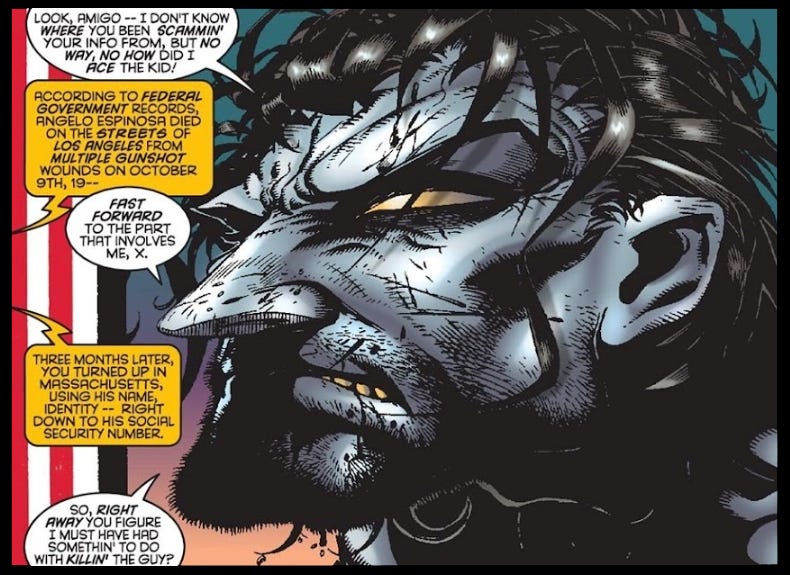
Bachalo’s pencils and inks have always scrambled my interpretation of Generation X. When I was a lad, I felt its first issues (or what I read of them in the comic shop or at a cafeteria table) were intriguingly dark. Something meant for the older kids, maybe, something with a vibe similar to the some of the avant-garde cartoons MTV aired late at night. Many years later, when I glanced again at Generation X again after having discovered the Shade, The Changing Man collected editions, my brain wanted to read it like it was a Vertigo comic—like it was smarter and more interesting than it actually was.
When Bachalo takes a ten-month break between issues #7–16 (was he working on Neil Gaiman’s Death: The Time of Your Life, I wonder?), it becomes clear that he’s the one carrying the book. With middle-of-the-road artists drawing Generation X instead, the illusion evaporates. The series becomes an altogether unremarkable mid-1990s Marvel comic that does nothing to stand out among the other X-Books of 1995–96—the years when the tires were blowing out under Marvel and X-Mania.
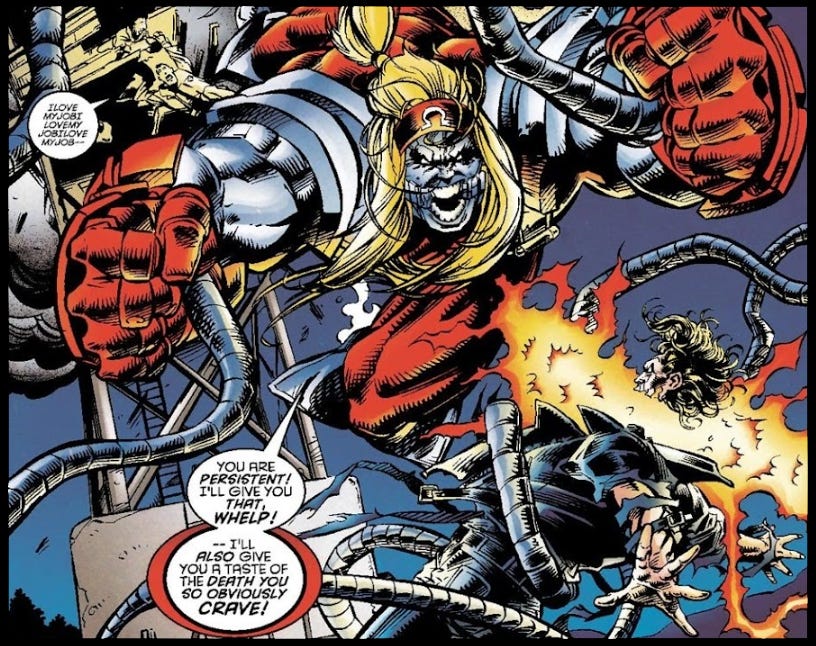
In all fairness, Generation X does get off to a stronger start than New Mutants, tearing out of the gate with vigor and confidence. Lobdell already knows who his characters are and what makes them tick, and that counts for a lot. But here’s the thing about Scott Lobdell—there’s a reason why X-Men connoisseurs usually don’t speak of him with unreserved fondness, and an interview with him the Generation X Collector’s Preview spells out why:
“We will be seeing more of [Blink],” he teased. “Right now, her name is Claire Ferguson and her code name will become Blink, if she joins. We’re pretty sure she’s not going to be joining any time in the immediate future, but I think she’s a really cool character who could fit in.”9
Lobdell’s uncertainty about Blink is characteristic of his general approach to the whole series. On one hand, he has well developed ideas about his characters...but he also divulged that he prefers to plot issue to issue with any series he is working on, conferring closely with his artist, in an organic fashion.
The thing about Lobdell is that he’s totally uninterested in long-term plotting. By this point, superhero comics have long ceased to be the episodic affairs they were during the Golden and Silver Ages, and Lobdell brings a distracted issue-by-issue mindset to de rigueur serial storytelling. After Generation X’s first year or so, his nearsightedness increasingly becomes a problem.
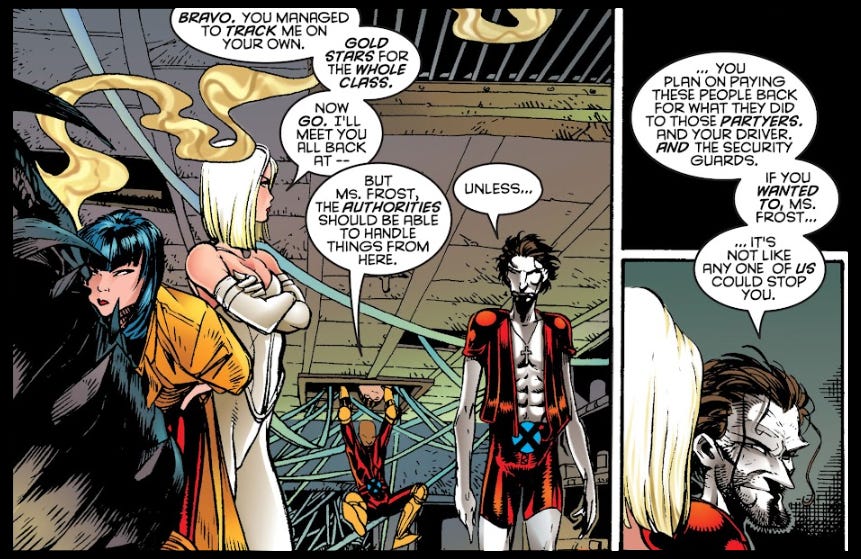
It’s difficult to write an overview of Generation X because on the whole it feels like a collection of anecdotes that don’t scale up into anything meaningful. The gang just kind of does things and stuff just kind of happens for some reason. There’s no plan. No overarching vision or foundational concept. The cast of New Mutants had character arcs; the Generation X kids have schticks. Lobdell teases mystery after mystery (why does Monet blank out sometimes, and what’s her relation to Gateway? what’s the deal with Penance? why is Angelo so touchy about his past?) and draws things out for as long as he possibly can to imbue his haphazard stories with the appearance of narrative momentum.
I find it interesting that Generation X seems to glide so easily in and out of EVENTS like Onslaught and Operation: Tolerance. When X-Factor author Peter David was roped into participating in the 1992 X-Cutioner’s Song crossover EVENT, he got really bent out of shape about it. The way he tells it, it was like being made to throw the characters of a novel-in-progress into a tumultuous side-quest unrelated to anything they were currently up to, and then awkwardly trying to pick things up back up from where they left off. Generation X never has this problem. It’s hard to be interrupted when you’re not in the middle of anything.
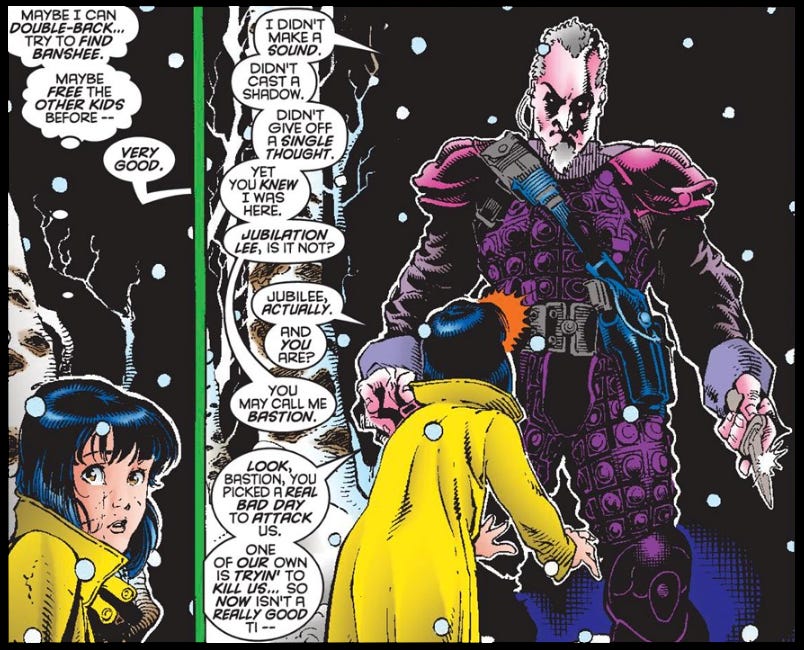
When I learned that Chris Claremont had tried to get into acting before writing comics, it seemed to explain Uncanny X-Men’s mold-breaking character work. Of course: Claremont was thinking like a method actor.
Similarly: when I learned that Lobdell spent some time as standup comedian before becoming a full-time Marvel writer, Generation X suddenly made more sense to me. There’s a rhythm to his dialogue that sometimes suggests little pauses for laugher, even during serious moments, and so much of the book reads like bits.
So an extradimensional mutant vampire pulls up to the airport in a limousine driven by a grinning midget…
So a teenager with fire powers is fighting a cybernetically enhanced super-soldier made by the USSR during the Cold War, and he calls the super-soldier a loser and the super-soldier, like, freaks out…10
So a hayseed girl from Kentucky and a cynical Chicano from LA are playing Scrabble…
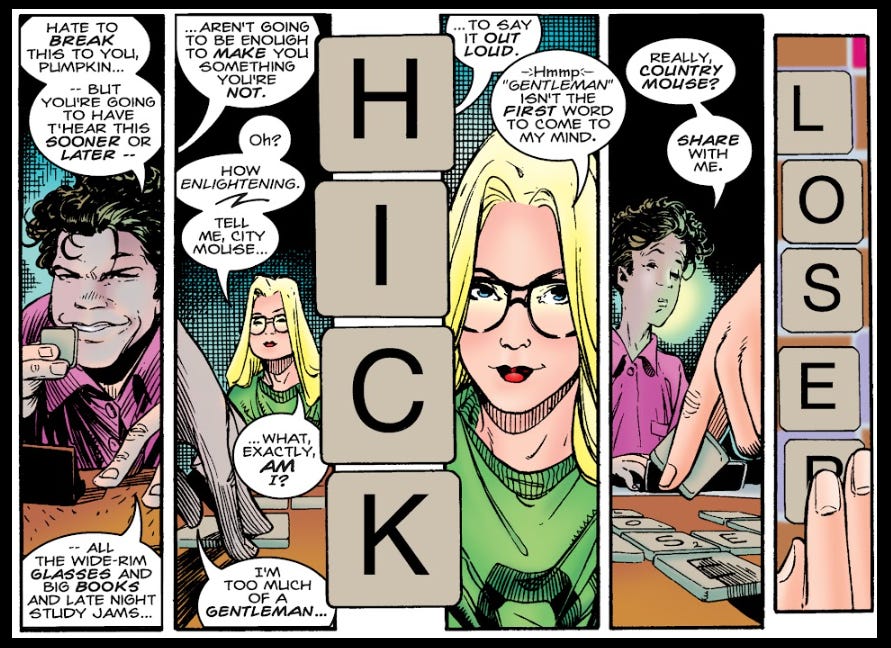
Have you heard the one about the dude from Samoa made out of dirt?
So a hayseed girl from Kentucky gets sad-drunk and wants to make out with a cockney goth boy with no mouth…
So a teenager with super-strength and invulnerability goes into a catatonic stupor on a New York sidewalk, and her friends aren’t strong enough to budge her…
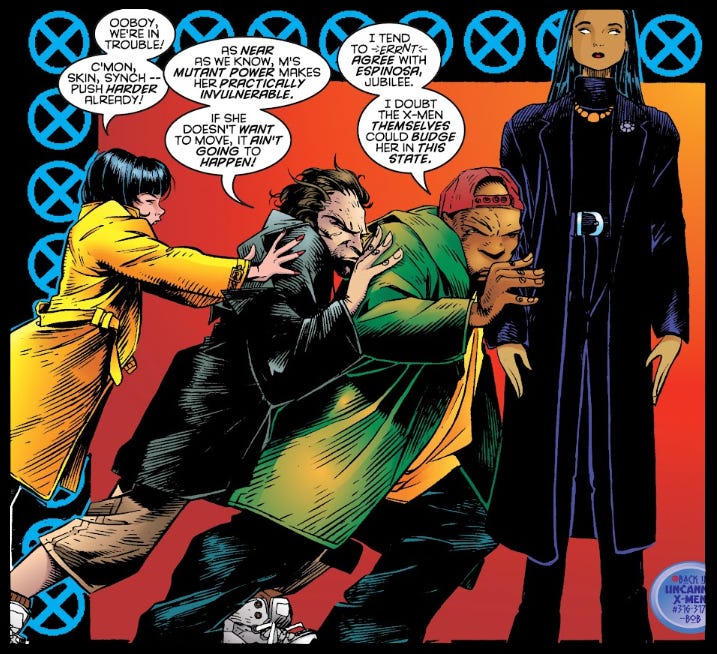
Now here’s Jubilee’s top ten reasons why the supervillain Emplate is a loser…
Hey, have you heard the one about Magneto’s washed-up henchman whose buddy turns people into carnivorous cyber-frogs?
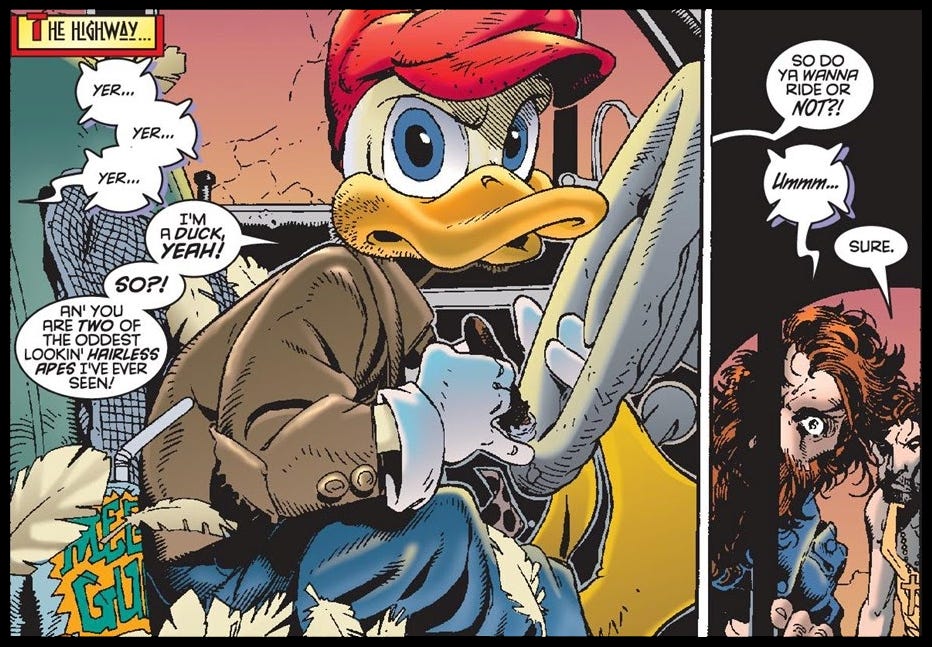
So a cockney goth boy wearing a fake beard and a West Coast Chicano are hitching a ride in the desert, and a talking duck named Howard pulls up…11
So a teacher brings his students to County Mayo, Ireland, and a faerie asks them to fix her glamour machine…
So a guy with super-stretchy skin puts on a bowtie and accidentally knots his fingers together…
So a couple of teenaged girls are trying on sunglasses in front of a street vendor…
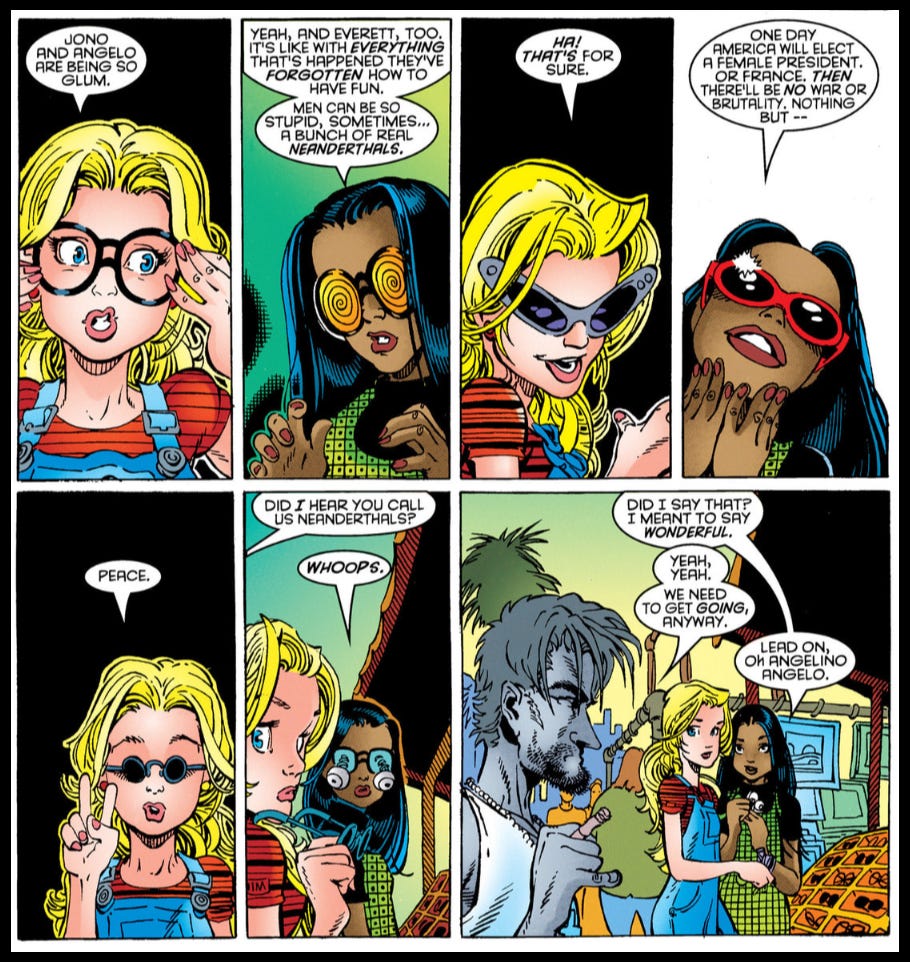
I was cheating with that last one: Lobdell didn’t write it. He left after issue #28, and was replaced by one James Robinson on what was intended to be a temporary basis. (Because Robinson is a fill-in writer, he doesn’t make waves; I read issues #29–31 at least a few times before I noticed Lobdell’s name wasn’t on them, and couldn’t tell the difference.) But this is as good a time as any to mention that towards the end of Generation X’s Lobdell/Bachalo phase, Bachalo begins experimenting with a more neotenic art style. It gets weird.
But think of the Generation X promotional pin-up you saw at the very top. What kind of book did it suggest to you? Something kind of shadowy and mysterious, perhaps? Something a little doleful, something a little dangerous? Something, dare I say it—with an edge?
Well—if you’d read the Generation X Collector’s Preview, you’d have known that Lobdell thought you’d be silly for making such an assumption:
...the last thing [Lobdell] wanted was for the tone of the book to be dark and depressing.
“What’s funny is that people came up to me after seeing some sketches and said, ‘you know, this looks really exciting because it’s going to be a grim and gritty X-Men for the ‘90s,’” Lobdell mused. “Nothing could be further from the truth. As far as I’m concerned, these guys embody the same sense of optimism—defeating all the odds and seeing the light at the end of the tunnel—as the second generation of X-Men in Giant-Size X-Men #1....”
Maybe, towards the end, Bachalo began to realize what kind of comic book he was actually working on, and recalibrated his art style to better suit it.
Generation X’s story exists in stasis. Things happen, but nothing really happens, nothing with any meaningful consequences. Villains attack the school, they’re fended off, and everything goes right back to normal. Jono and Paige have a will they, won’t they thing going on, and then they settle on won’t because Jono is a sadsack and that’s that. Mysteries are teased, but nothing comes of them. There’s no forward thrust—just characters enacting their bits from month to month. Angelo is a cynic. Jono mopes. Paige tires to distinguish herself. Jubilee is bratty and loud. Monet is a diva. Everett is the everyman. Penance skulks in the shadows and doesn’t talk. As for the “mutant school” aspect of the premise, the Generation X kids are students in the sense that the It’s Always Sunny in Philadelphia gang are bartenders.
And meanwhile, Emma’s a priss and Sean’s out there doing his Irish best. They’re not teachers: only rarely do we see them training or disciplining the gang. They’re tough love type-A mommy Emma and buff dadbod aw shucks Sean, looking out for their rambunctious little ducklings.
Emma and Sean are sitcom parents—and that’s the key to understanding Generation X. It’s a bizarre family sitcom dressed up as a 1990s X-Men junior team comic, and isn’t as clever as it thinks it is. What makes the book so strange is that the nearsighted Lobdell doesn’t seem to know he’s actually writing a sitcom.
As I understand it, Lobdell left Generation X because he (understandably) felt he was stretched too thin; he continued on in Uncanny X-Men through most of 1997, and then quit altogether. He had this to say about the circumstances of his departure (excerpted from here, transcribed from a podcast here):
I didn’t ever want to be like Chris [Claremont] or Peter David. A writer who gets wheeled away from the computer with their finger nails drilled into the keyboard. I never felt the X-Men were my book. I don’t feel a proprietary stake in it…I told Bob [Harras] that we get along, I make bold choices, you support them, why don’t you allow me to do Fantastic Four and someone else can write X-Men…
At the time I was making some ridiculous amount of money based on the contract. So when it (a new contract) came back, they said they were going to pay me 10X less than what I was making, which was still more than others.
Marvel filed for Chapter 11 bankruptcy protection on December 27, 1996, so I think we can understand why the company would lowball Lobdell when renegotiating his contract in 1997. I also think we can appreciate why Lobdell would walk away from it. But the thing that should be highlighted is that the guy who became the immediate successor to Chris Claremont—balls-to-the-walls, all-in, these-characters-are-like-my-children Chris Claremont—was a dude who saw the X-Men just as a gig, and one he soon found himself getting bored with.
But Generation X needed a new writer. (Retiring it wasn’t an option; the X-Books still made money, and Marvel needed all the sales it could get.) The editors chose Larry Hama, best known for writing Marvel’s G.I. Joe in the 1980s and penning Wolverine’s solo series when X-Mania was at its peak.12 The thinking probably went that Hama was well-regarded and reliable, had experience writing Jubilee during the years when she was Wolverine’s sidekick, and did a decent job with the Generation X cast when he wrote them into Wolverine #94 for the sake of promoting their book.
Arriving on Generation X with an assignment to “fix” the series (according to his interview with the Epic Marvel Podcast), Hama’s instincts weren’t altogether bad. He makes a point of getting the gang off the Massachusetts Academy grounds and into town more often, and introduces several townie characters with whom they can interact on a regular basis. Something like this was sorely needed: for all our heroes’ wild off-campus adventures, the series’ horizons felt rather narrow during Lobdell’s run. Virtually everyone the characters encountered belonged to either their own weird-ass mutant world or some other sphere of weird-ass activity; it’s refreshing to see the gang navigating situations involving normies for a change.
…And that’s about the best idea Hama brings to Generation X. His run isn’t well-liked by fans, and not entirely on the basis of the thing he does to Penance (which we’ll say more about later). He not only brings a whole lot of the whimsy that characterized his Wolverine run to Generation X, but ramps it way up. In an early story of his, the gang travels to the Citadel of the Universal Amalgamator at the nexus of all realities, accompanied by a martini-drinking pooka and riding a headless snark. (Don’t ask.) Their return trip involves a joke about “water closet” having the came initials as “warp chamber.” This is pretty par for the course.
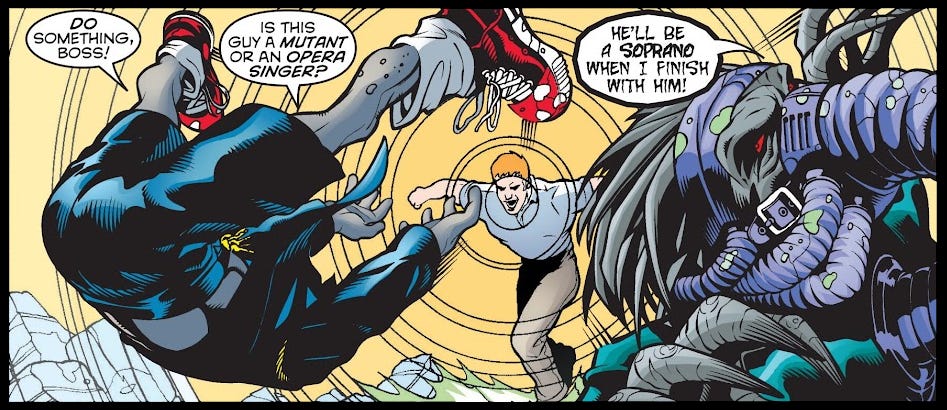
It’s odd: Hama tries to ground Generation X by taking the gang out of their cloister and bringing them into contact with the real world, while simultaneously making the book even wackier on the whole. Moreover, he’s one of those old-school comic book writers who has characters saying much more than they need to (and this is coming from a Claremont fan), and whose dialogic quips skew egregiously corny.
I have a dim (and very probably mistaken) sense that Hama looked at the Lobdell/Bachalo run, twigged the kooky family sitcom dynamic underlying it, and decided “okay, that’s what this book is about, so I’ll just reinforce it and try to make it more exciting.” I don’t think that’s what anyone was really looking for him to do. What Generation X desperately needed was a raison d’etre—to be about something—and Hama’s run just keeps it locked in the holding pattern into which Lobdell had guided it.
Chris Bachalo steps down after issue #31. After a few fill-in artists take their turns, Terry Dodson becomes the series’ new penciller in issue #38. His work is the polar opposite of Bachalo’s: bright, crisp, clean, and cheery. Whatever Generation X was doing before, it’s doing an entirely different thing now. And if I didn’t have some kind of undiagnosed obsessive-compulsive disorder, I could just copy-paste that last sentence a few more times and call this writeup a wrap.
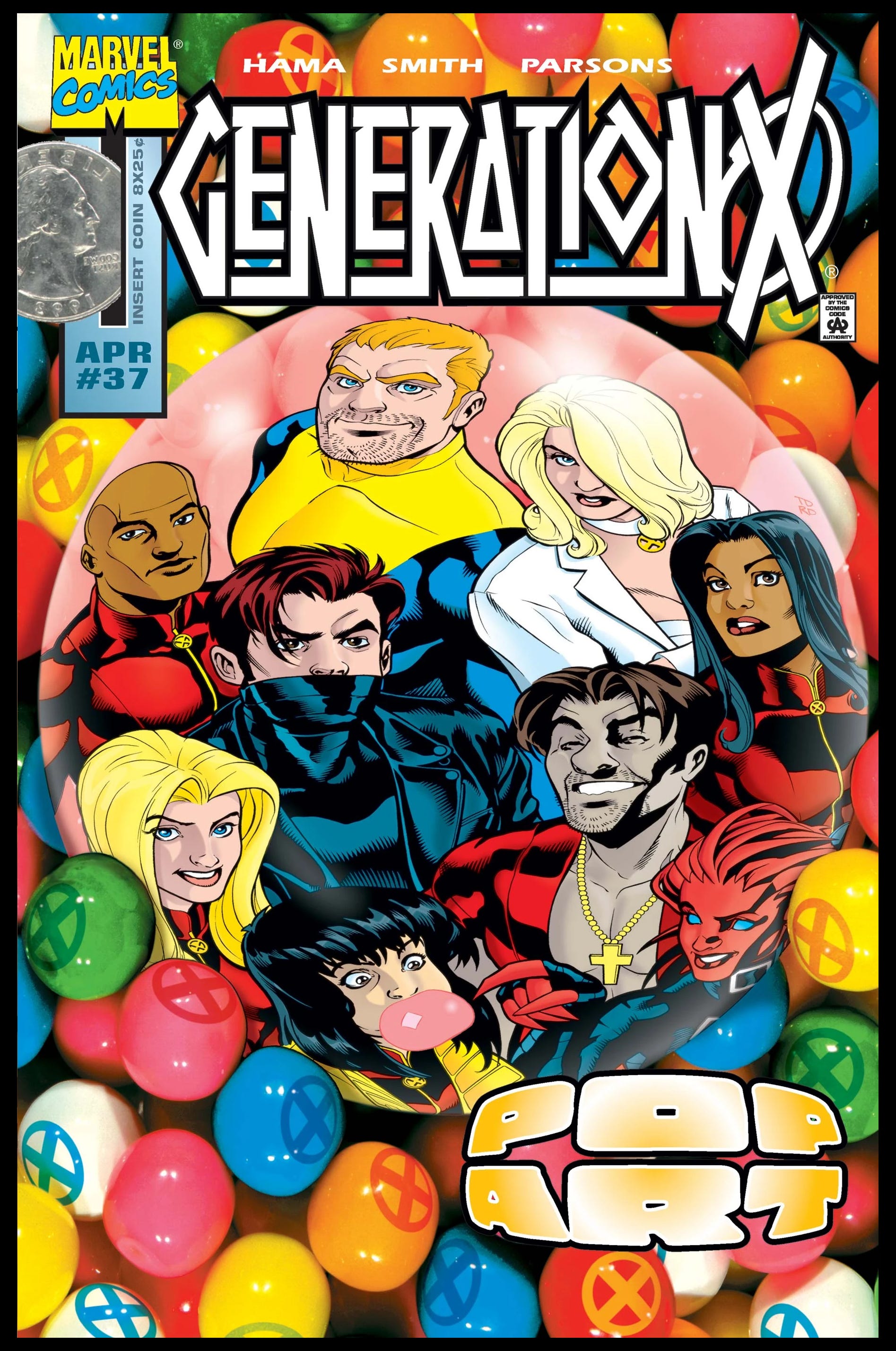
Hama gets ousted from Generation X after issue #47. His successor Jay Faerber drops every single character he introduced and steers the book in a different direction.
In short: Faeber’s fourteen-issue run is an improvement. It’s not brilliant, but it’s better, and Faerber writing Lobdell’s characters more thoughtfully than Lobdell ever did is a pleasant surprise.
Faerber not only gave an interview to the Epic Marvel Podcast about Generation X, but supplied the hosts with his pitch letter. It’s probably not going to be that interesting of a read if you’re not already familiar with the book and its characters, but it offers a few insights into the 1998 X-Office. Three things to take away from it (and the interview): (1) there was an acknowledgement that the early excitement about the series had all but evaporated; (2) Faerber went into this thing with a detailed plan and every appearance of enthusiasm; (3) the editorial department already had a fixed idea about the direction Generation X should go in after it fired Hama, and was apparently just looking for writers whose own takes more or less seemed to vibe with it.
It seems what editorial wanted—and compelled—Faerber to do was reopen the Massachusetts Academy to a (human) student body. This is a fairly huge status quo change, and Faerber’s pitch letter says nothing about it. So now our heroes have to wear two different sets of student uniforms, attend actual high school courses, surround themselves with mostly anonymous classmates, and keep their big mutant-superheroes-in-training secret under wraps. Sure—at this point, why the hell not?
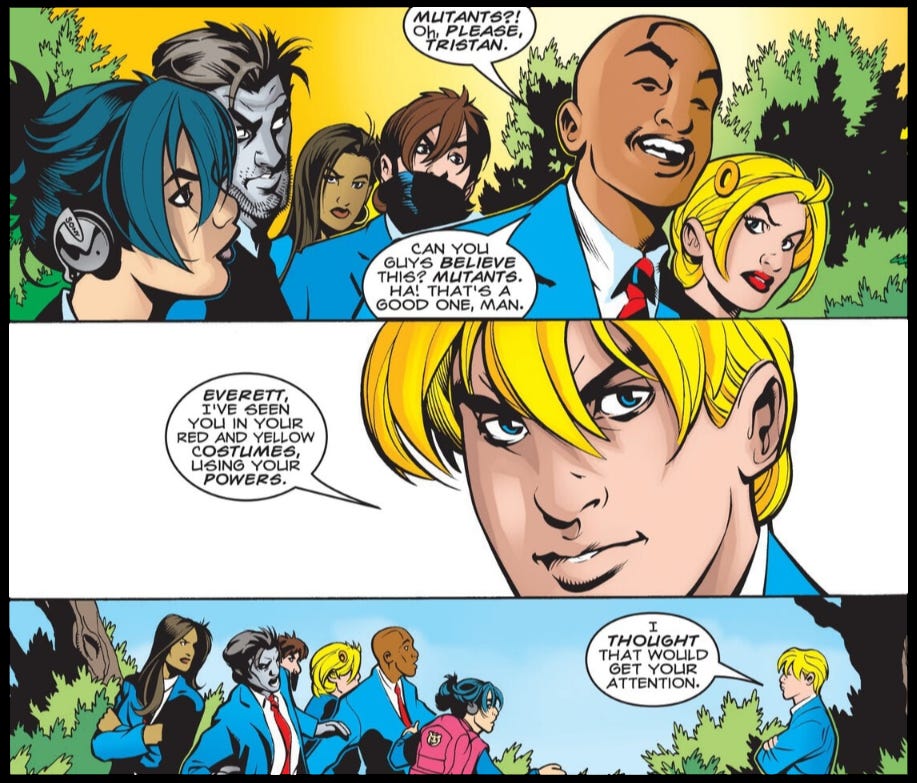
In the story, a cash-strapped Emma appeals to her older sister Adrienne for financial assistance, and Adrienne agrees to help out on the condition that the Academy be reconverted into an ordinary boarding school and she gets to be its headmaster. Although this wasn’t in Faerber’s original idea for the series, Adrienne herself was—and the point of creating her was to introduce a character immune to Emma’s mental voodoo and uniquely capable of getting under her skin. It was a good idea. A lot of Faerber’s ideas were good, if perhaps in need of a little finessing—but most were never realized. In his interview with the Epic Marvel Podcast, he mentions that the editor who brought him on was soon replaced by one with whom he didn’t see eye-to-eye. This probably had at least a little to do with why so much of his plan never came to fruition, and why stories resembling nothing in the pitch (Emplate attacking during a school dance, a totally unnecessary two-issue rematch between the gang and Black Tom Cassidy, Adrienne revealing herself as a murderous lunatic and trying to kill the gang, Monet transferring to a European school where she fights vampires for some reason, etc.) got published instead.13
Several items in Faerber’s pitch letter do appear, but in a curtailed or altered form. There’s an early issue where Monet acts uncharacteristically viciously towards Jubilee when nobody else is looking; it clearly belongs to a plot thread laid out in the pitch, but became a strange isolated incident in what actually got published. Everett was supposed to cause friction by choosing to spend more time with normies (since he can much more easily pass for a baseline human than Angelo and Jono), but this gets reduced to a few moments of quiet resentment from Jono. Faerber meant to introduce a new team member named Reach, described as “handsome, charismatic, self-confident, and a bit shallow;” he very probably became Tristan, a sly normie student with a supervillain grandfather and a crush on Paige.
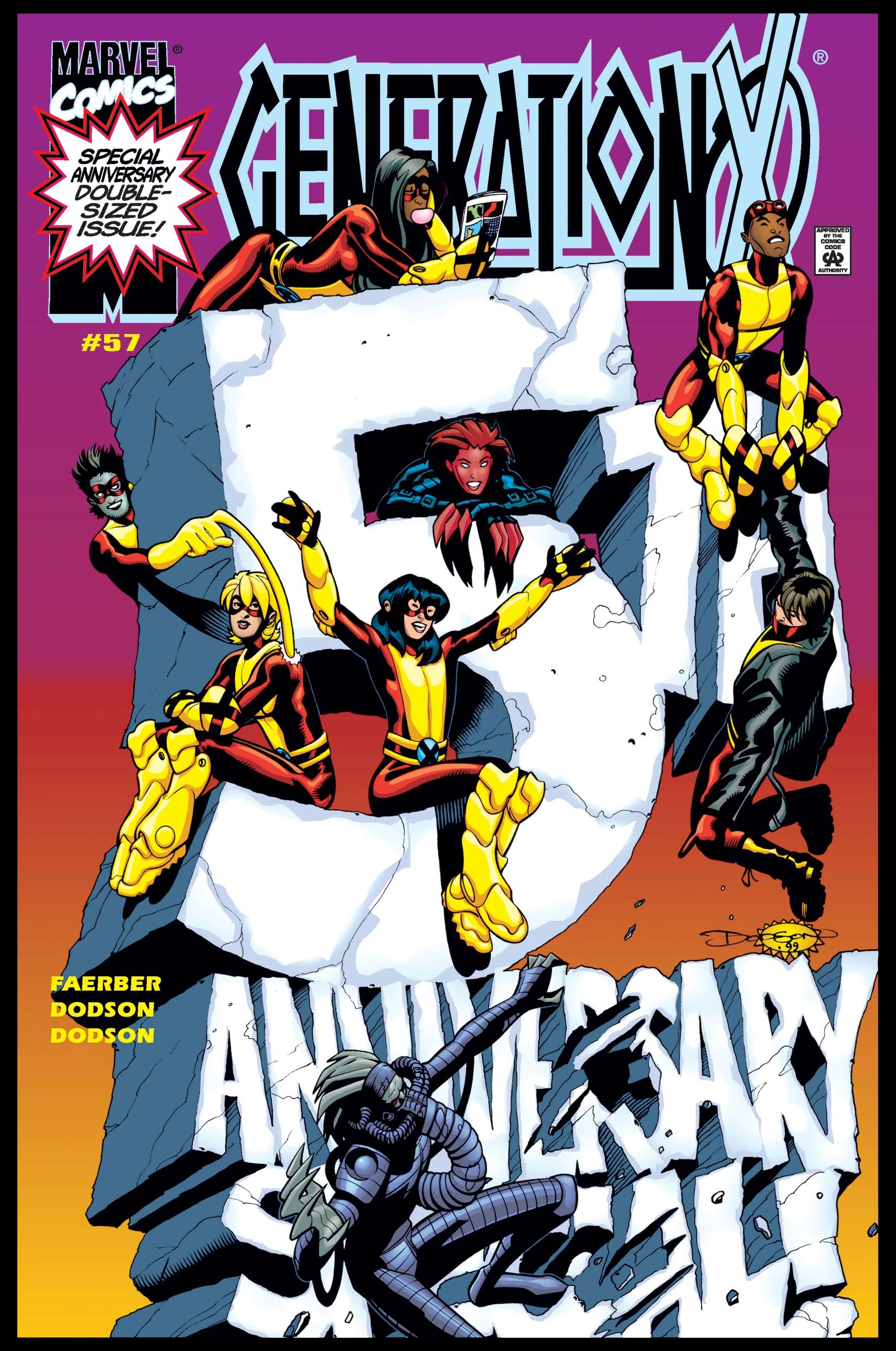
Faerber also wanted to write out Angelo, Penance, and Sean. This too was a good idea: Angelo was never an especially popular character, Penance was deadweight, and the novelty of having Sean back in an X-Book had worn off. If the editor(s) forbade Faerber from dropping them, it probably had to do with Generation X’s foundational concept—or its lack of one. Since it never had a clear mission statement or idea of itself beyond “Scott Lobdell vehemently insists he’s not doing New Mutants: The Next Generation,” it was, like any family sitcom, wholly defined by a specific set of characters, none of whom were ever set up as indispensable leads who could remain in place while old castmates sometimes departed and new ones sometimes arrived.
I’m not sure if Generation X’s sales or reputation improved under Faerber, but it didn’t matter. He and Dodson were getting the axe, regardless. (“I missed the paycheck, but didn’t miss the book,” Faerber tells the Epic Marvel Podcast.)
So I guess now we have to talk about Counter-X, which means we have to talk about Revolution. Should we call Revolution a comic-book EVENT? It’s kind of. Sort of.
In brief: every creative team on every X-Book was dropped and replaced. All at once. That should tell you something about how things were going at Marvel.
The narrative gimmick accompanying the shake-up was a six-month time jump, giving the new writers and artists a free hand to go wild. (Why does everything look so unfamiliar all of a sudden? IT’S SIX MONTHS LATER.) Counter-X was part of Revolution: the idea was to give over the three most underperforming X-Books to a proven big-name talent. He’d select their new writers and artists, plot out the books’ first couple of arcs, and co-author the initial issues.
This all went into effect in the spring of 2000. It went so swimmingly that a year later, the new management made another linewide course correction.
The main problem with Revolution, I think, was that it was backwards-looking. For one thing, its most hyped component was the return of Chris Claremont to write both Uncanny X-Men and Adjectiveless X-Men. I will say more in the footnotes, but it’s like Thomas Wolfe said: you can’t go home again.14 For Counter-X: guess who the editors’ first choice to spearhead it was? Rob Liefeld. Rob freaking Liefeld. Yes, let’s bring the subsidiary X-Books into the 2000s by putting them under the guidance of a meme from 1991.
Liefeld balked because he couldn’t hire the colorists he wanted, so Warren Ellis (probably best known for Transmetropolitan) was put in charge of Counter-X instead. But perhaps this, too, was backwards-looking. Yes—let’s bring the subsidiary X-Books into the 2000s by suddenly making them all feel like edgy mid-1990s Vertigo and Marvel 2099 titles…
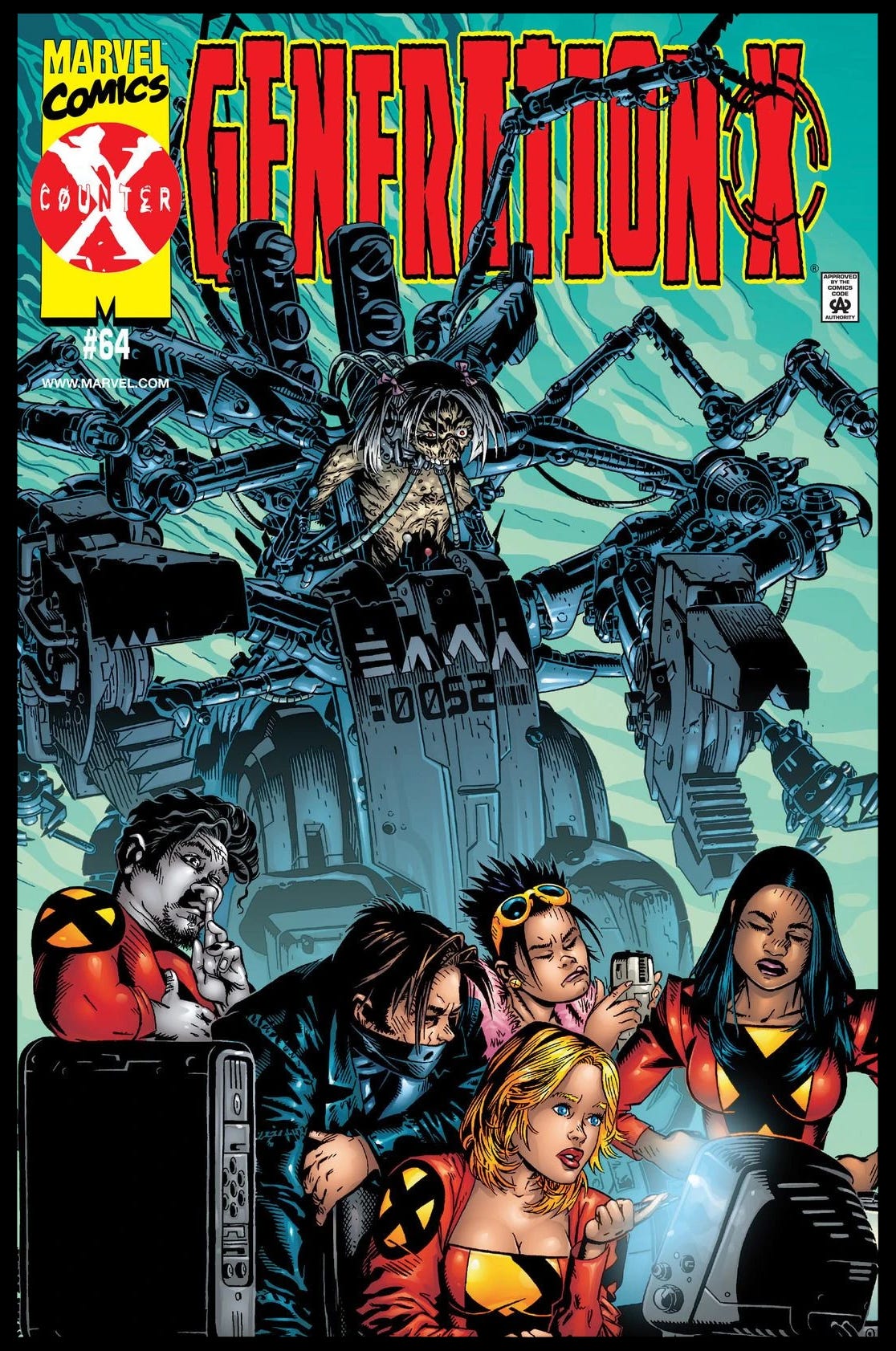
Ellis’ choice for Generation X’s new penciller was the British artist Steve Pugh, who’d worked on several Vertigo titles throughout the 1990s (Animal Man, Hellblazer, Preacher: Saint of Killers, etc.). I know I’m revealing the limits of my aesthetic vocabulary in describing his style as “gritty realism,” but that’s all I’ve got. It’s a different look for the series, I’ll say that much. (Towards the end, the ever-dependable Ron Lim will fill in for a bit, and then take Pugh’s place.)
For the series’ new author, Ellis chose Brian Wood, whose only published work at that point was Channel Zero, a five-issue comic he began writing and drawing as his senior project in college. Wood, too, gave an interview to the Epic Marvel Podcast, and had this to say about Generation X:
I wrote thirteen issues of that crazy book, and I had no idea what I was doing. I really didn’t. I was literally just making it up as I went along. I had to learn how to write a script, like, the format...
These were books that no one cared about much at the time, and the editor was so hands-off because I think he was either afraid of Warren or had decided to put his total trust in Warren, but there was no notes given. I had fun, at the time I had fun, but I cannot look at it now. It’s the most mortifying thing imaginable…
I cranked those things out. I had no sense of craft…I wrote them way too fast…I should have done multiple drafts before an editor even saw it…
This explains a lot, and it’s funny that an authorial run that was hamstrung by its editor should have been followed by one that truly would have benefited from more oversight.
So, six months later: Everett is dead. Adrienne is gone. All the normie kids have left the Academy, and there’s a wrecked building on the grounds. Paige has turned into some kind of computer-whiz hacker activist, and Monet is angry at the world. In the gang’s first big outing after the time jump, they bust into a secret juvenile detention center run by a sadistic superpowered warden and guarded by dead-child cyborgs. (It is very Warren Ellis.) Ellis and Wood’s dialogue radiates all the alienated teenage edge and uncouth humor one might expect to find in a comic book actually titled Generation X—about six years too late.
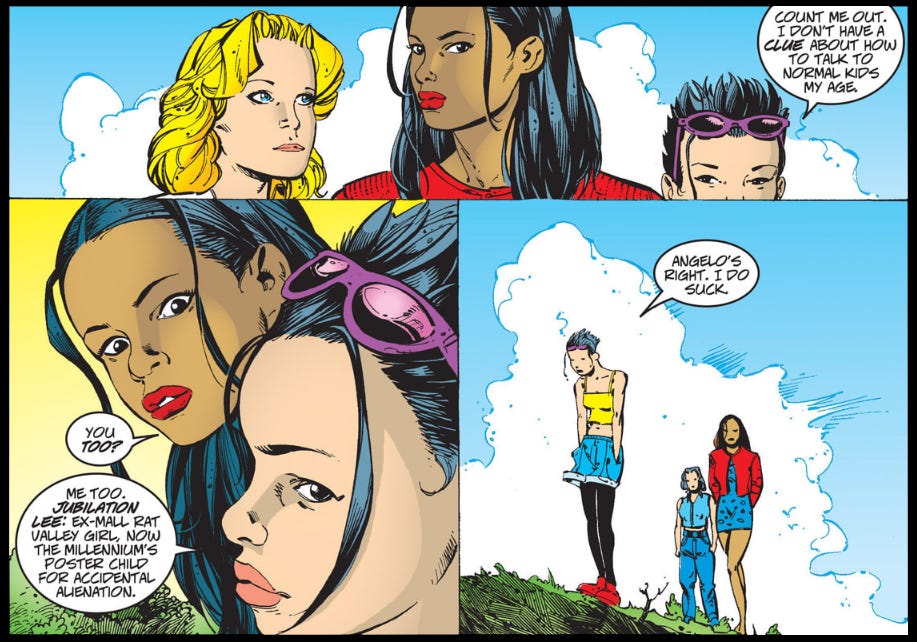
Once the warden and his cyborgs are squared away, we find out what happened to Everett during a four-issue flashback to the last days of the “now the gang’s a group of high school students with a secret” era. During Faerber’s run, the question of how things might play if our heroes got outed as mutants was as much of a non-issue as the likelihood that the Daily Planet staff might one day notice that Clark Kent is Superman. It wasn’t going to happen, but the wink-wink possibility that it could injected secret-identity complications into the new status quo for humor and tension.
Under Ellis and Wood, it’s no longer safe and nothing is funny. Angelo intervenes in a bullying incident, and one of the aggressors grabs a fistful of his super-stretchy skin. The kid tells his parents, and his parents call Emma howling about “freaks and mutants running loose in the school.” An anti-mutant panic seizes the Academy. The situation escalates very quickly.
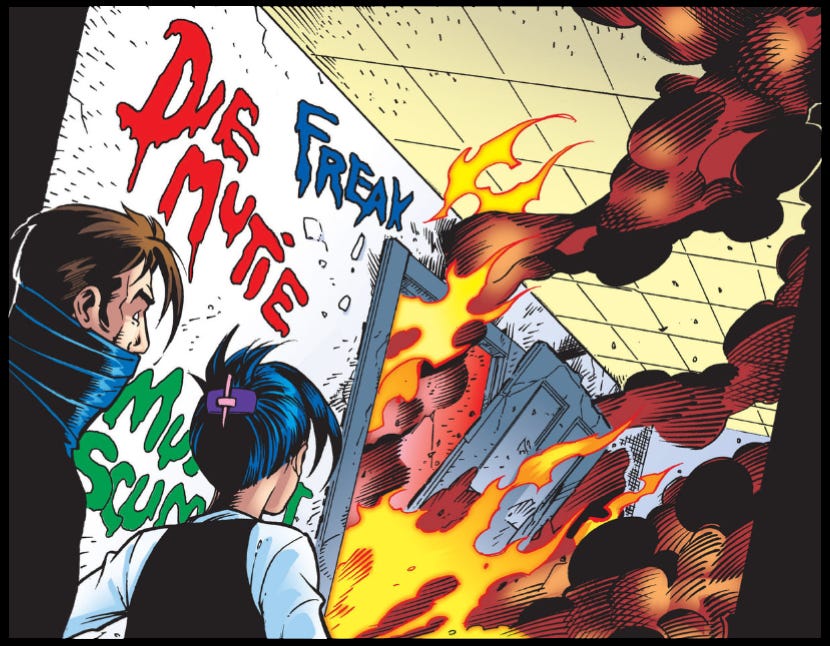
This arc gives us something new: usually our favorite X-characters, whether teenaged or grown-up, live and operate in a safe space, and the World That Hates And Fears Them lurks outside its walls. Here we see the safe space turned into a prison as the gang is locked up in a school full of violent phobes who’ve sniffed them out.
It’s a neat idea, but it’s also the kind of story that only works if we don’t ask why Emma doesn’t just call an assembly and mind-wipe everyone. Her sister Adrienne pours gasoline on the flames by drawing the students’ (equally irredeemably stupid and bigoted) parents to the campus, and rigs a bunch of timed explosives to kill them and their kids because she’s an insane jerk; she gets away with it because we’ve forgotten that even if Emma can’t do a mind-wipe on her sister, Monet should still be able to. Everett gets blown up trying to save everyone.15 Emma pulls a gun and murders Adrienne when nobody’s looking, and then remembers that mind-wiping all the students and their parents is something she can do. And I guess the Academy gets shut down anyway, and now we’re more or less caught up to where we were when Counter-X launched.
Generation X only lasts five more issues. Its cancellation must have come as a surprise: our heroes get snazzy new superhero uniforms, and Wood takes the time to write dialogue explaining that they’re made of a “smart material” that “helps regulate body temperature and offers passive resistance to impacts and the various elements”—but then we never see the gang wearing them on an adventure because they have to split off and do four self-contained (and increasingly off-the-rails) “day in the life” stories before the series abruptly ends.
In the final issue, Emma is feeling pretty great (horny, even) about murdering her sister. Monet catches her in the act of mindwiping and injuring a police detective who shows up asking questions, and it finally dawns on the gang why nobody’s seen Adrienne in six months.16 Sean, meanwhile, has taken to drinking all day and being an asshole to everyone after learning that Moira MacTaggart (longtime X-Men ally, Sean’s ex, still the love of his life) died in the pages of Adjectiveless X-Men. The students reappraise the situation and decide to leave.
As far as endings go, it’s a damned dreary one. With the exception of Jono—who accepts an invitation from Professor Xavier to join the X-Men—none of the kids “graduate.” Instead, they drop out and go their separate ways because their mentors are, in Paige’s words, “a sadistic murdering psychopath and a middle-aged drunk.” Can we think of any family sitcoms where the kids approached Mom & Dad and said both of you are horrible, we’re moving out, goodbye, don’t bother writing during the series finale?
And yet the book still concludes with this:
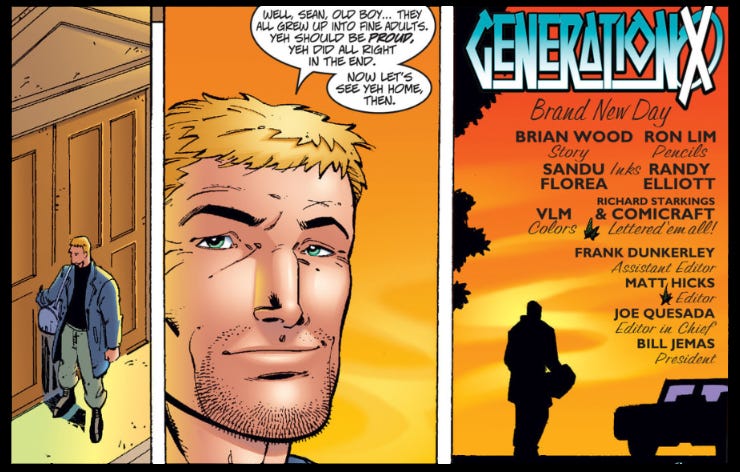
Appropriately enough, the note on which Generation X goes out is “unearned.”
TLDR: This series epitomizes the course of the 1990s X-Books on the whole. It arrived with sound and fury, cruising on the momentum of an epochally popular IP, and boasting once-in-a-generation artistic talent. And then it stalled out, didn’t know what to do with itself, repeatedly tried shaking things up with new creative teams and confused editorially determined pivots, and still just kept on going.
VALEDICTORIAN: Lobdell and Bachalo tried so hard with Chamber. They wanted so badly for Chamber to be their breakout character. Look at him!
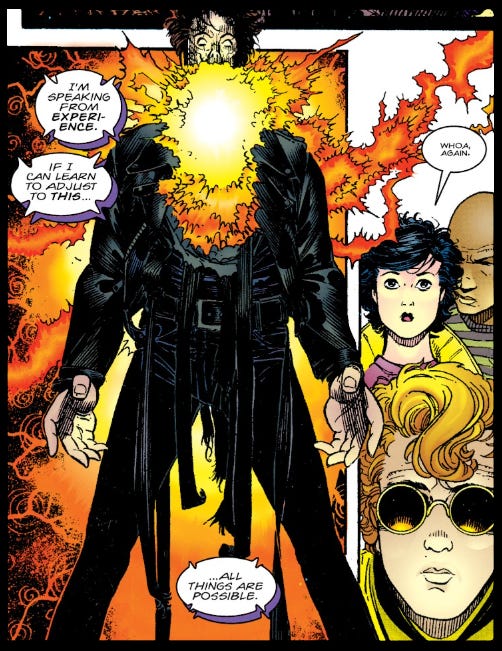
That right there is one hell of a memorable character design. But Lobdell (and subsequent writers) had a hard time making him work. Unless we’re talking about Charlie Brown, a sullen, quiet, self-sabotaging personality is a tough sell in popular fiction. If this were a TV show and a preternaturally charismatic actor with piercing eyes was playing Jono, he might be able to pull off his incessant “I’m a deformed freak and my life sucks and nobody will ever love me and I’ll never make anyone happy” act, but it gets tiresome on the page.17 It doesn’t help that he loses a lot of his appeal when someone other than his creator draws him. Nobody else was ever able make Jono look as striking and impressive as Bachalo did.
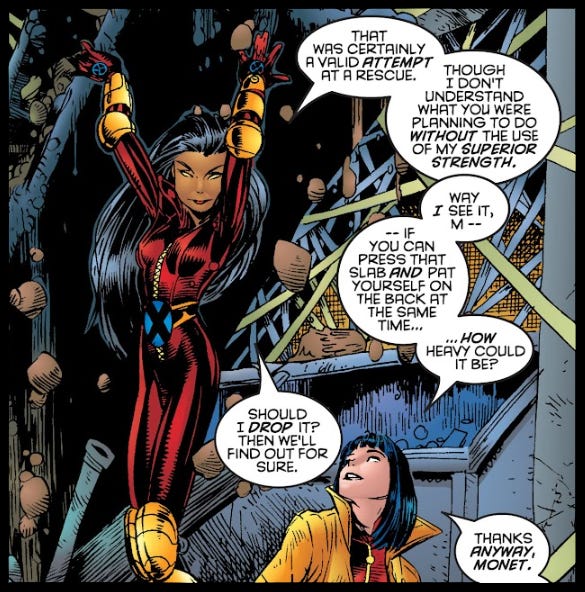
Super-smart, super-strong, mean-girl, “Miss Perfect Priss ‘94” Monet St. Croix, on the other hand, dominates every scene she’s in. What makes her such a great character in an ensemble book like this isn’t the forcefulness of her personality per se, but the fact that everyone around her gets characterized by how they respond to it. Peter David understood this about Monet, and I’d guess that’s why he earmarked her as a central character for his (brilliant) second go at X-Factor in 2005—and why an older, more experienced Brian Wood snatched her back up for his run on the all-female 2010s volume of Adjectiveless X-Men when X-Factor wrapped up.
The real answer, however, is Emma. She joins the X-Men in Grant Morrison’s New X-Men and occupies a central position in the X-Books for many years afterwards—and her time in Generation X made this possible. (Her reverse heel-turn in issue #75 gets swept under the rug, and I’m not sure if the whole “murdered her sister in cold blood” thing ever gets mentioned again.)
DROPOUTS: Mondo and Gaia. Wait, who? Don’t worry about it.
The real answer, though, is everyone but Emma and Monet. Angelo and Sean are both allowed to get killed off a little ways down the road, which means they were seen as characters whom readers wouldn’t really miss. Penance just disappears. Jono and then Paige have turns as regular X-Men, but neither lasts long, and the writers/editors soon lose interest in doing anything with them. Jubilee drifts into irrelevance and then becomes a vampire for some reason. For a team that was more explicitly billed as the next generation of X-Men than the New Mutants, the Generation X gang didn’t have whole lot of staying power. (This will be a theme going forward.)
MALEDICTORIAN: Emplate. No contest. Not because he’s an amazing villain, but because the runners-up are Gene Nation. Nobody remembers Gene Nation.
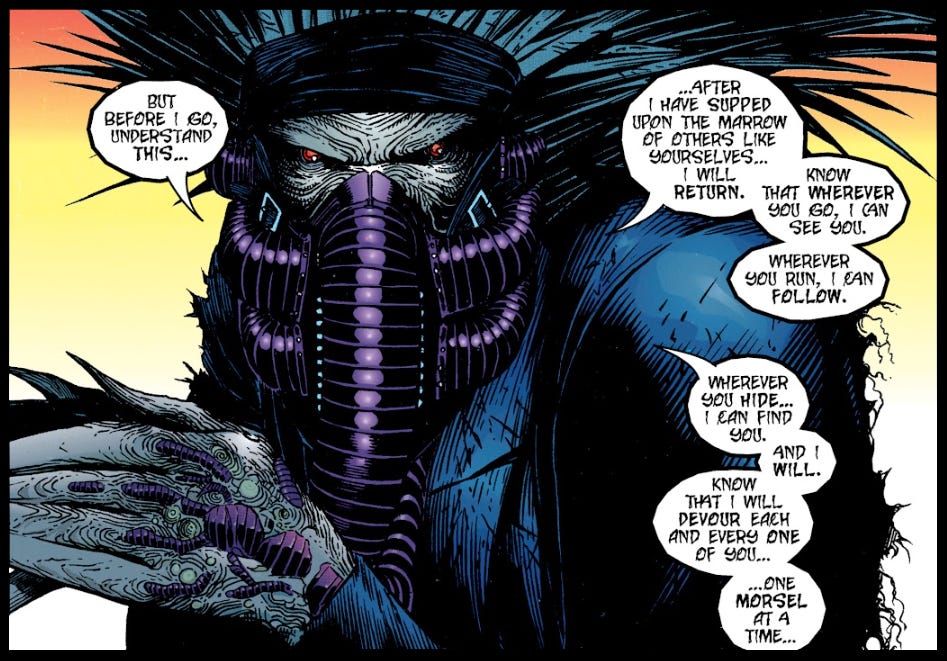
Introduced in Generation X #1 as the series’ Magneto analogue, Emplate is a representatively baroque 1990s supervillain. He lives in an unpleasant dimension adjacent to this one and can move around the material world like a ghost. If he’s strong enough, he can manifest in a visible, solid form. When he’s weakened, he’s pulled back into the otherworld. He strengthens himself by using the creepy mouths on his hands to suck out the bone marrow of other mutants, which grants him temporary access to their powers. Like any vampire, feeding on someone can give him some degree of psychic control over them, and he can also turn them into marrow-sucking monsters like himself. Oh, and it turns out he’s also Monet’s older brother. Emplate makes one a little nostalgic for the days when a “he wears a helmet and has magnetic powers” was a perfectly compelling and sufficient gimmick for a comic book villain.
After Generation X gets cancelled, Emplate pops up in the X-Books every once in a blue moon—but there’s really not much else to say. He’s the most notable original villain of this series, but ultimately ended up on the C-list.
BEST STORYLINE: It probably shouldn’t even count, but it can only be the Generation Next limited series, which replaced Generation X for four months during the Age of Apocalypse EVENT. Prominent among its cast are alternate-timeline versions of Angelo, Jono, and Paige, and in this world they’re on a squad of child soldiers dispatched on a suicide mission. Generation Next is the only time the Lobdell/Bachalo creative engine truly fires on all cylinders (but Bachalo still carries it), and a strong contender for the distinction of being the darkest X-Men story ever published.
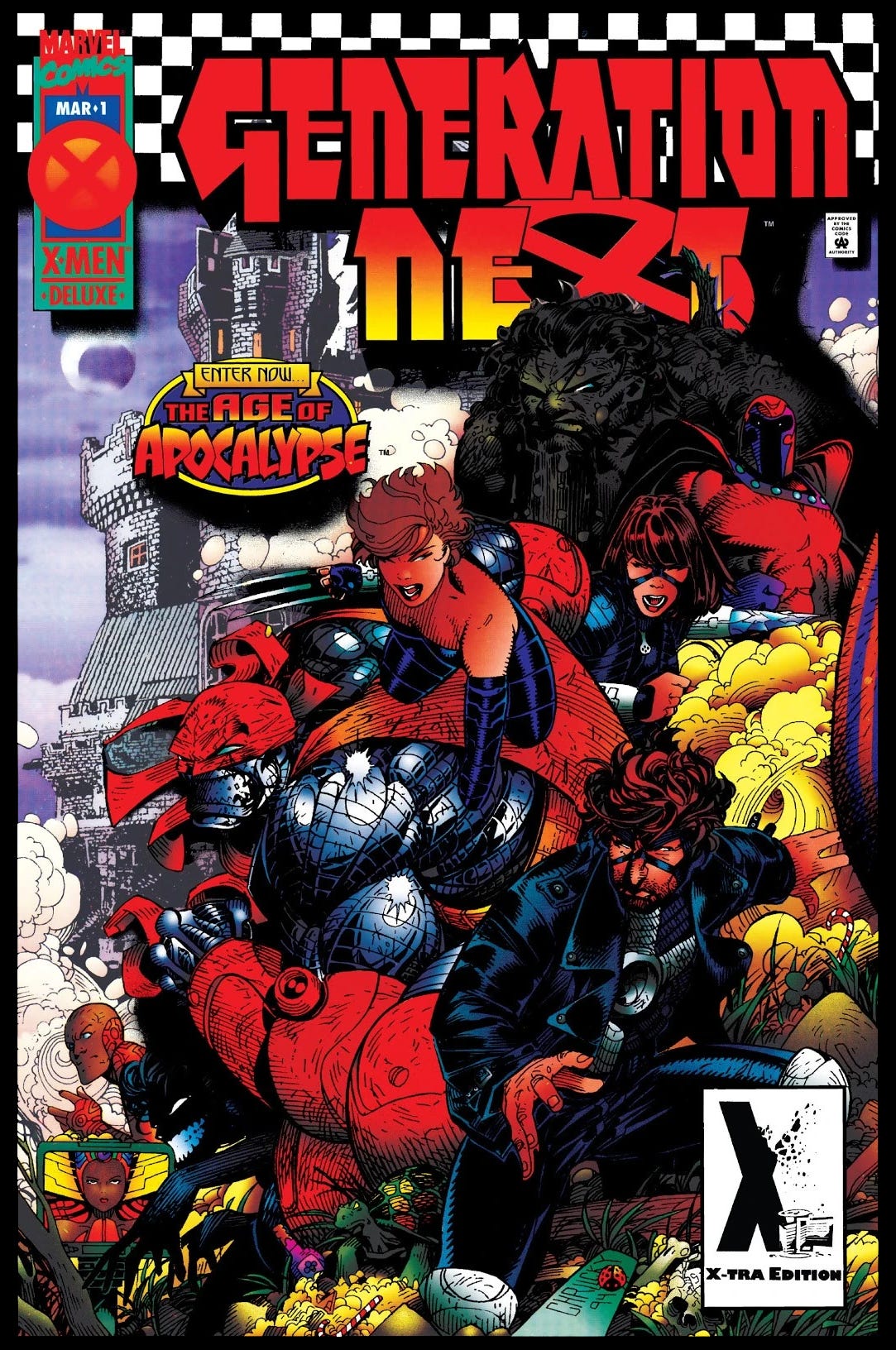
Fun side note: some X-Book writers over the years have held noticeable grudges against certain characters. Scott Lobdell really had it out for Colossus.
WORST STORYLINE: Larry Hama deserves all the shit readers have given him about the Penance “reveal.”
Hama has said that he was put on to Generation X to fix the series. There was a lot that needed fixing at that point, but the character of Penance had become an especially glaring problem. She couldn’t speak or understand verbal communication. She couldn’t touch anybody (because every part of her is razor-sharp). She couldn’t interact with anyone who didn’t belong to the school. All she did was lurk in the shadows and occasionally jump out to surprise whatever villain was attacking the gang at home that month. She was a character who could have been interesting, but Lobdell didn’t want to put in the work. He never even came around to revealing that she was deaf-mute—which might have given her canon armor against what happened next.
Hama’s solution to the Penance problem was to reveal that she and the M-twins (the girls who fused to form Monet) are all sisters, and that Penance is the real Monet, warped and deformed by Emplate—which means that the M-twins have been filling in for their sister and mimicking her personality all of this time. So then they all switch places: Penance becomes Monet again, and the twins become Penance. Somehow.
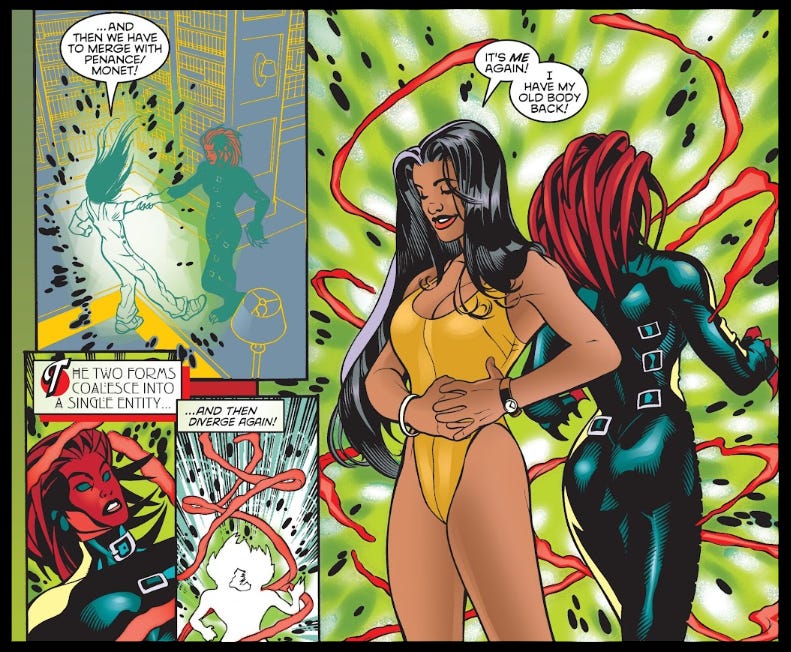
Yvette, the traumatized deaf-mute girl from Yugoslavia, gets overwritten. Now she never existed because she’s Monet—the old Monet. And the new Monet is also Monet. This kind of writing is the reason why I will never argue with anyone who says superhero comics are stupid.
X-MAN
(1995–2001)
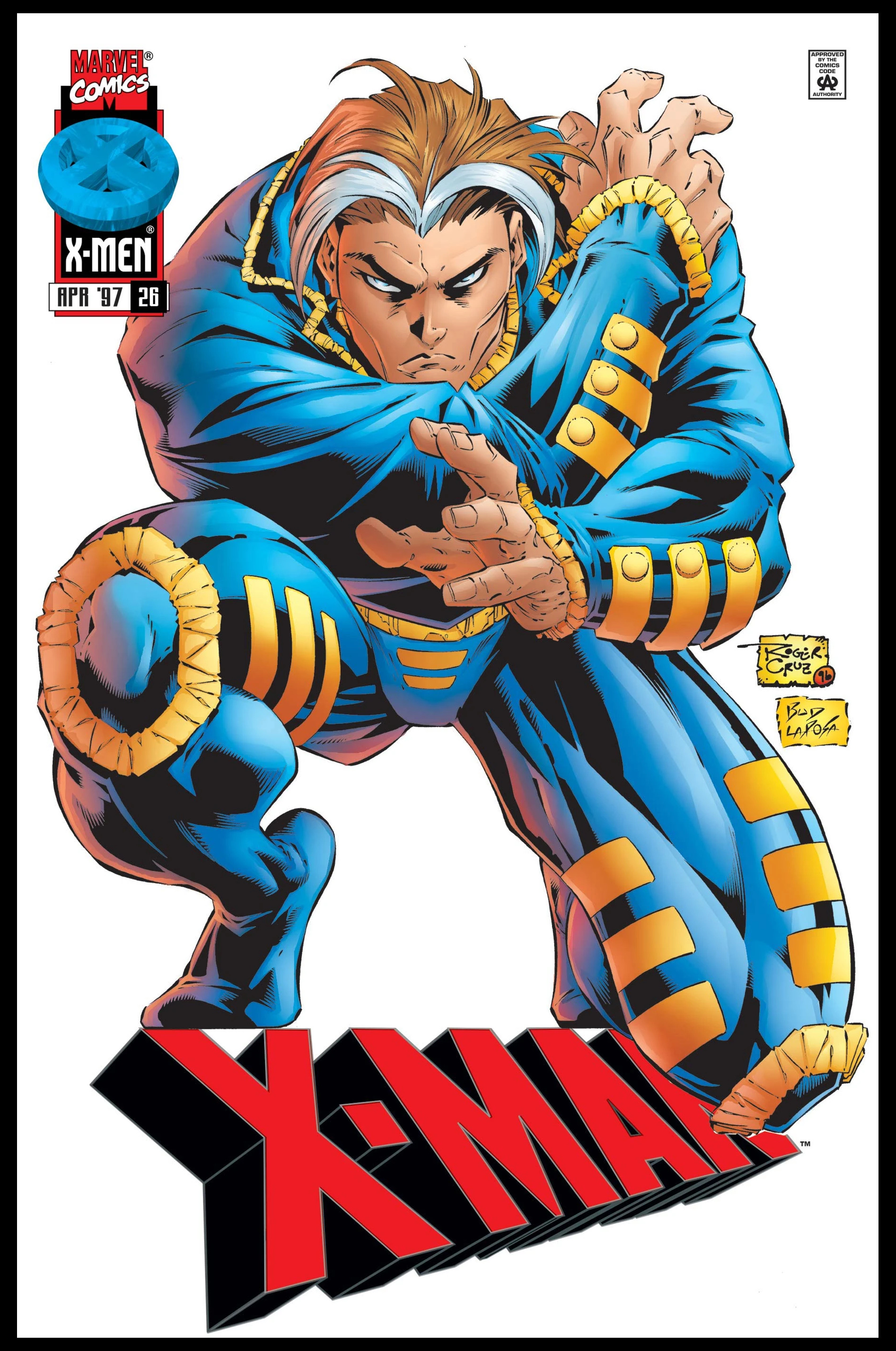
Huh boy. I read (okay, skimmed) most of (or a lot of) X-Man basically just to torture myself for embarking on this silly project to begin with.
I wobbled on doing a writeup on X-Man. Does it qualify as a “teen team” X-Book if it’s just about a single teenager? Not really—but the character and the book warrant a very, very quick examination on the basis of how perfectly they encapsulate the mediocrity and mismanagement of the mid-to-late 1990s X-Books and Marvel Comics in general.
If you’re unfamiliar with these comics, you might be asking: X-Man? I thought it was “X-Men.” Who’s the X-Man, then?
There is no simple answer to that question. Even if you’re aware of American comic books’ reputation for involute lore, you really have no idea how wacky it gets until you’ve studied the Summers (Cyclops) family tree. It’s the superhero version of the Julio-Claudian line.
Let’s try to summarize Nate Grey’s origin story:
During Chris Claremont’s Uncanny X-Men run, Jean Grey dies at the end of the Dark Phoenix Saga. Cyclops leaves the X-Men and meets a woman named Madelyne Pryor—who looks exactly like Jean. OMG, everyone says—she must be an amnesiac Jean! She brought herself back to life once before; maybe she did it again! What’s going to happen when she remembers who she is and her powers reactivate?! But no! The big twist is that Madelyne really is just a normal woman with an unbelievable resemblance to Jean. By and by, Scott falls in love with Madelyne for who she is, and not because she reminds him of his dead ex. He retires from being a superhero adventurer and marries her. They move to Alaska, have a son named Nathan Christopher Summers, and should have lived happily ever. But . . . .
X-Factor happens. Bob Layton writes Cyclops abandoning Madelyne and Nathan to get reacquainted with the actually-not-dead Jean and hang out with his high school pals. Seeking to repair the damage to Cyclops’ character, Claremont and Louise Simonson do some more retconning. So actually—get this—Madelyne is a clone of Jean! Having deduced that the combination of Scott Summers and Jean Grey’s genes would produce some kind of super-mutant, the nefarious geneticist villain Mr. Sinister cloned Jean, gave her false memories of having lived her own life, and contrived to introduce her to Scott, all for the purpose of acquiring the baby they’d make together. Also, Madelyne was kind of evil, and also Scott was acting under some sort of post-hypnotic suggestion inscribed by Mr. Sinister, or something, which made him run out and leave her and Nathan vulnerable to abduction. Why not?
In the “Endgame” storyline that capped off pre-changeover X-Factor (drawn by Whilce Portacio, plotted by Portacio and Jim Lee, and scripted by Claremont), the immortal tyrant Apocalypse infects baby Nathan with a deadly technovirus. (Just roll with it.) A woman named Askani comes back from the future, Kyle Reese style, and tells Cyclops that his son is destined to save the world—but can’t be cured in the present day. Scott agrees to let Askani take Nathan into the future for treatment, even though he’s told it’ll be a one-way trip and he’ll never see his boy again. (Conveniently, this means Scott can soon become a lead character in Adjectiveless X-Men without a baby distracting him or taking up any valuable real estate on the page.)
Still with me? I promise this is all relevant.
So Fabian Nicieza is scripting X-Force for Rob Liefeld, and has some ideas. Cable, he understands, is going to need an actual origin story at some point. With “Endgame” and Nathan Summers’ supposedly one-way trip into the future fresh in everyone’s minds, Nicieza has certain enemies and confidants of Cable start addressing him as “Nathan.” Aha! Cable is Cyclops’ son, raised in the 31st century, and returned to the past!
More retconning, more revelations: the reason Mr. Sinister wanted the offspring of Scott Summers and Jean Grey to begin with is because he’s under Apocalypse’s thumb and wants out. He hasn’t the means to confront that monster and win on his own, so he schemes to breed a mutant that does have the inborn firepower to kill Apocalypse. But the technovirus screwed everything up. Cable’s mutant power consists of telepathy and telekinesis on a ridiculous scale, but he can’t do much with it because it’s constantly being taxed to keep the technovirus (which—aha!—is why half his body is made of metal) in check. Ironically, Cable spends most of his adult life fighting a war against Apocalypse in the distant future, and has returned to the past to prevent the tyrant’s ascension.
We’re almost there:
So when Legion goes back in time and accidentally kills Professor Xavier, he creates the Age of Apocalypse timeline. Sensing Legion’s power, Apocalypse wakes up way ahead of schedule and kickstarts World War III, taking over the United States and preventing the emergence of our beloved Marvel heroes. Since things play out differently in this new history, Mr. Sinister is able to collect Scott Summers and Jean Grey’s genetic material without any cloning or subterfuge and grow their offspring in a test tube as his anti-Apocalypse trump card.
So this is Nate Grey: an eighteen-year-old who’s more or less genetically identical to Cable (don’t overthink it) and doesn’t have any gnarly techno-plagues inhibiting his psi powers. And after some comic book shennanigans at the end of the Age of Apocalypse EVENT, he gets dropped into the repaired timeline of the more familiar Marvel Universe as an interdimensional exile.
There you have it.
Around the time Age of Apocalypse kicked off, Jeph Loeb was writing Cable’s solo series. Cable was “cancelled” and replaced by X-Man, still written by Loeb. The whole idea of it was that X-Man (Nate Grey) was the alternate-timeline version of Cable (Nathan Summers).
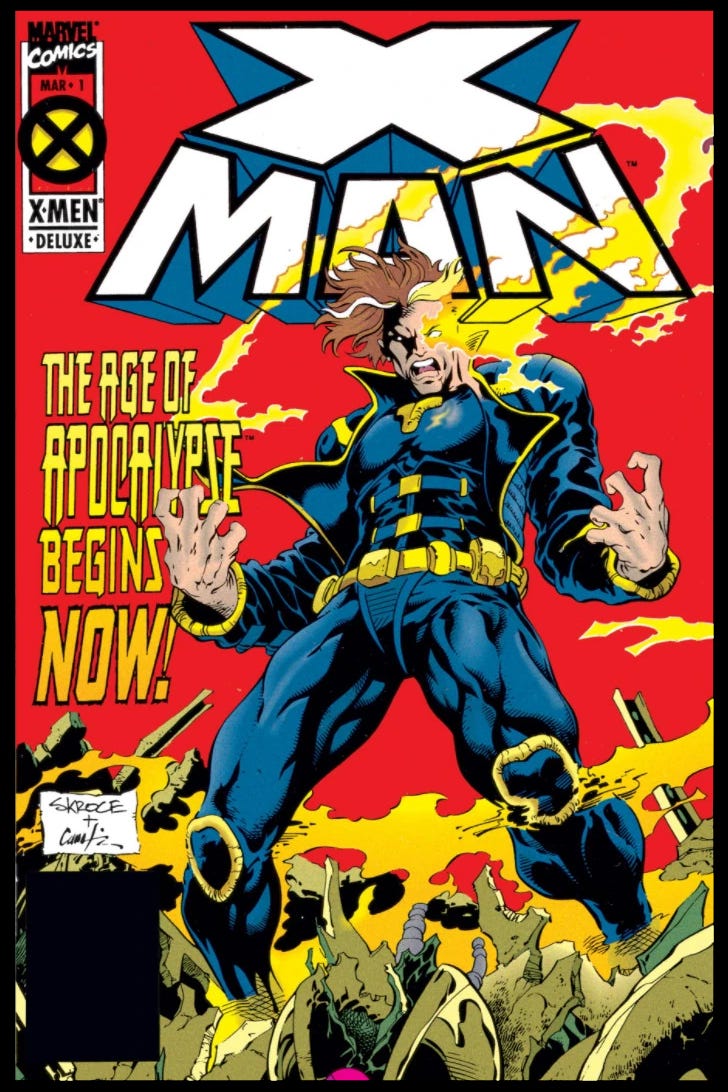
At some point, Loeb approached X-Books editor Bob Harras with a bone to pick. Age of Apocalypse, as planned, was shaping up to be something like a big dramatic television three-parter that turns out to have been a dream, a training simulation, or some other scenario with no consequences for the ongoing story. Loeb didn’t want the universe to be restored to exactly what it had been before; he wanted ramifications. He wanted characters from the nightmare Armageddon timeline—maybe, say, Wolverine—to get shuffled into the normal timeline and displace their counterparts.
After some back and forth, Harras came back to Loeb and said something to the effect of “okay, X-Man won’t end after four issues; we’ll make it an ongoing monthly, and you’ll be writing it. We can’t very well get rid of Cable, though, so now he and X-Man will each have their own solo series.”
The Power of X-Men podcast has an interesting interview with Loeb where he recounts all of this. I won’t transcribe any of it here (it’s a bit rambly), but go to the six-minute mark to hear about what Loeb wanted to do with X-Man, and what Harras told him he’d be doing with it. It’s . . . something, that’s for sure. At any rate, Loeb lasted until issue #9, and was replaced by Suicide Squad creator John Ostrander.
“I literally had no idea where I was going, what I was doing, what Nate was doing,” Loeb says of X-Man. “And then poor John Ostrander got handed this pile of crap…”
Ostrander lasted just half a year. The hackish but consistent Marvel company man Terry Kavanaugh took over and wrote the book for the next four years (up to issue #62 of 75).
Note: with the addition of X-Man as an ongoing series, there were now nine monthly X-Books. “Oversaturation” and “diluting the brand” were not terms in Marvel’s vocabulary. Have we mentioned, by the way, that Bob Harras was promoted to Marvel’s editor-in-chief in late 1995 and held the post until 2000?
Anyway, yes, let’s talk about X-Man.
While it’s safe to say that most superhero comics are adolescent male power fantasies, X-Man is . . . . a bit much.
What can we say about Nate Grey? Well—he’s powerful. Like, really powerful. Like, “is he the messiah or the harbinger of doomsday?” powerful. “Can hit the Hulk and Thanos so hard it actually hurts them” powerful.
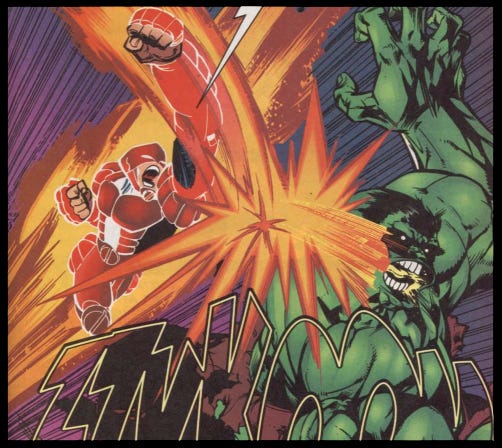
Telepathy? Yep. Telekinesis? Yep. Energy blasts? Yuh-huh. Mind control? Yessir. Protective forcefields? Out the wazoo. He’s like Silver Age-Superman in this regard: whatever the writer needs Nate’s mind-over-matter powers to do in a given situation, they can do exactly that.
In issue #13, Nate fights the Marauders, Mr. Sinister’s hit squad. The Marauders are classic Claremont villains, totally capable of going toe-to-toe with the X-Men. They’re really bad news.
Nate wipes them out. Barely breaks a sweat.
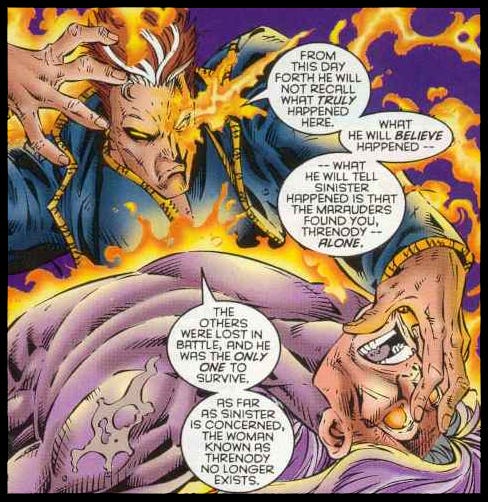
In issue #14, Nate fights Exodus, the scary-dangerous Magneto scion everyone’s terrified of.
Nate wipes him out. Barely breaks a sweat.
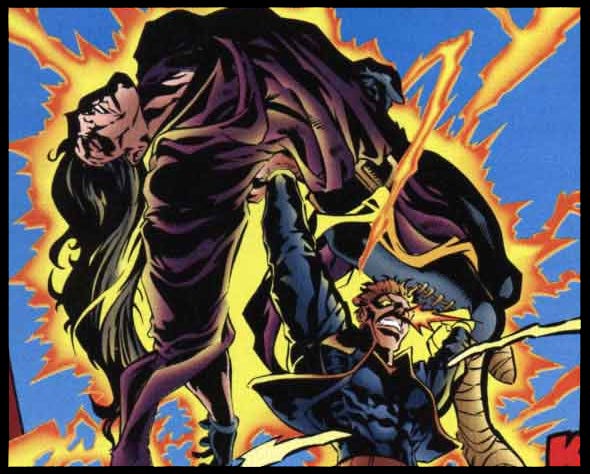
If Nate Grey ever struggles in a confrontation, all he needs to do is HRRRRGHH GOTTA PUSH MY POWERS TO THE MAXIMUM and then he wins because his brain makes shit blow up.
Nate Grey beats all the villains and he gets all the bitches.
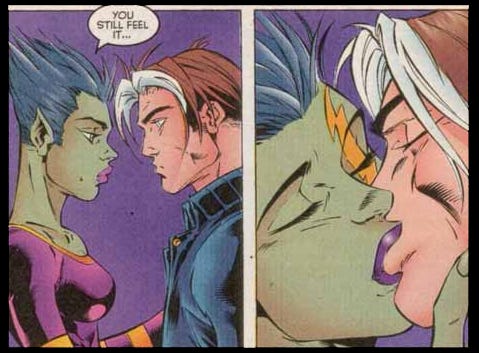
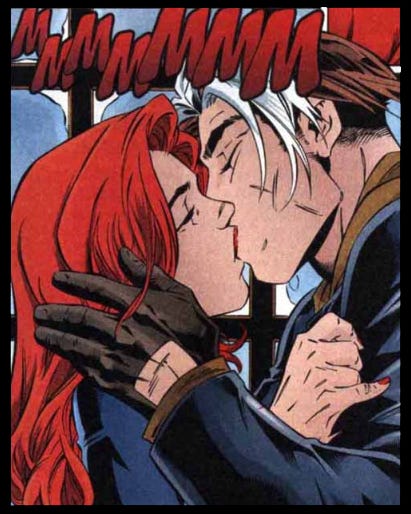
The girls love Nate Grey. They all want to make out with Nate Grey. His mutant brain is so sexy and powerful that it brings Madelyne Pryor back from the dead and even Madelyne Pryor wants to make out with him. Madelyne Pryor is genetically his mother. Nate Grey doesn’t give a shit. He doesn’t care about anyone’s rules because he grew up in the Age of Apocalypse and is a bad ass. He makes out with Madelyne Pryor.
Nate Grey is so cool. He lives in New York in the 1990s and hangs out at the Limelight. All the girls at the Limelight want to make out with Nate Grey. He fights a supervillain at the Limelight and blows up the Limelight after becoming the coolest person at the Limelight.
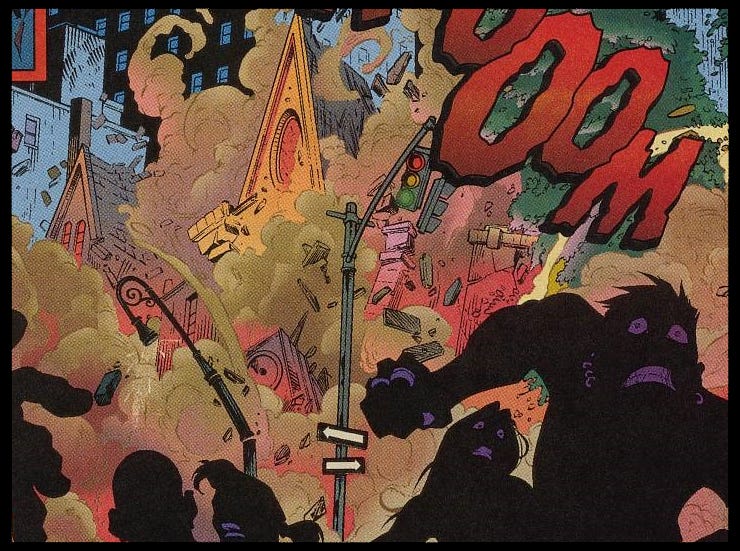
Nate Grey’s dialogue is written in colloquial English ‘cause his book’s authors were thinkin’ that’d get readers relatin’ to his sexy rough edges n’ all. And he’s so tortured and stormy and passionate. When he’s told that his powerful sexy brain is so sexy and powerful that it will burn out and kill him before he turns twenty-one, Nate Grey says “WHO WANTS TO GET OLD ANYWAY?” and uses his awesome gorgeous bad-ass brain to make something explode.
When Nate Grey arrives in the restored timeline, he draws the attention of concerned, well-meaning people like Professor Xavier and his associates. Like a dozen early issues of X-Man involve Nate Grey meeting various X-people. “Hey, Nate,” they say. “You’re kind of out of control and a danger to yourself and everyone around you. Why don’t we talk about—”
“STOP TRYING TO CONTROL ME!!” Nate Grey says. “I CAN’T TRUST YOU!! I CAN’T TRUST ANYONE!! I WILL NOT BE TAMED!!”
Then Nate Grey blows up a city block with his incredible brain and flies away.
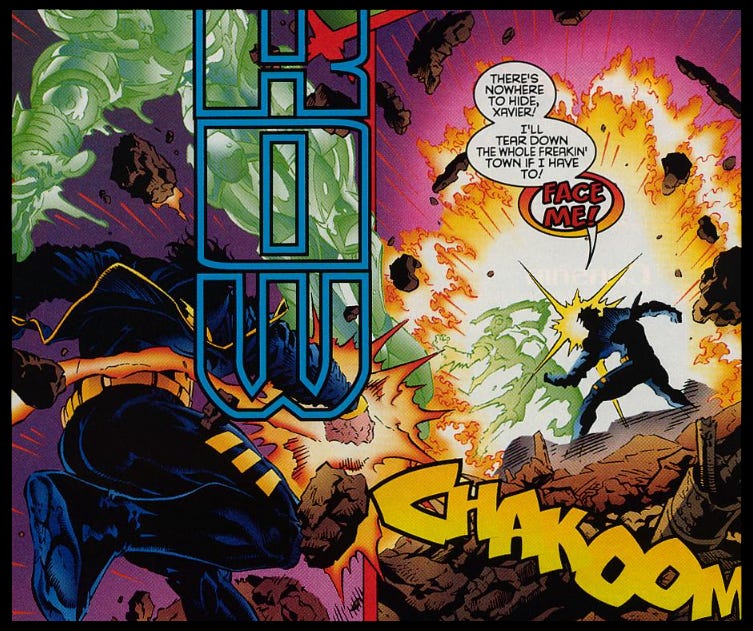
Nate Grey is a bad ass. Nate Grey goes places and does things and fights people and blows shit up. Nate Grey and his book have no direction whatsoever but that’s your problem, dude. Nate Grey is the coolest and the most powerful and he gets to decide what he wants to do, which is whatever he wants.
This book ran for as many issues as Sandman. Jesus Christ.
VALEDICTORIAN: feh
DROPOUT: Nate Grey. After his book is (finally) cancelled, he reappears ten years later to join the New Mutants in one of their revival series, severely de-powered. He canoodles for a bit with Dani Moonstar, and it’s all very sweet and amorous and whatever, but then that book gets cancelled and their pairing is never mentioned again (as far as I know). And then he gets re-powered and features in the late-2010s Age of X-Man EVENT, where he creates his own alternate timeline à la Age of Apocalypse—but the whole thing existed only to stall for time before Jonathan Hickman hard-soft-rebooted the X-Books in 2019. It’s not even a decade later, and nobody remembers it.
MALEDICTORIAN: who cares
BEST STORYLINE: X-Man is the only book that the Counter-X initiative inarguably improved. Writers Warren Ellis and Steven Grant ask: hey, what if we took this protagonist with godlike powers and did something with him that’s kind of, like, interesting? It only took five years for the stars to align—for someone to think of trying it, and for editorial to allow it.
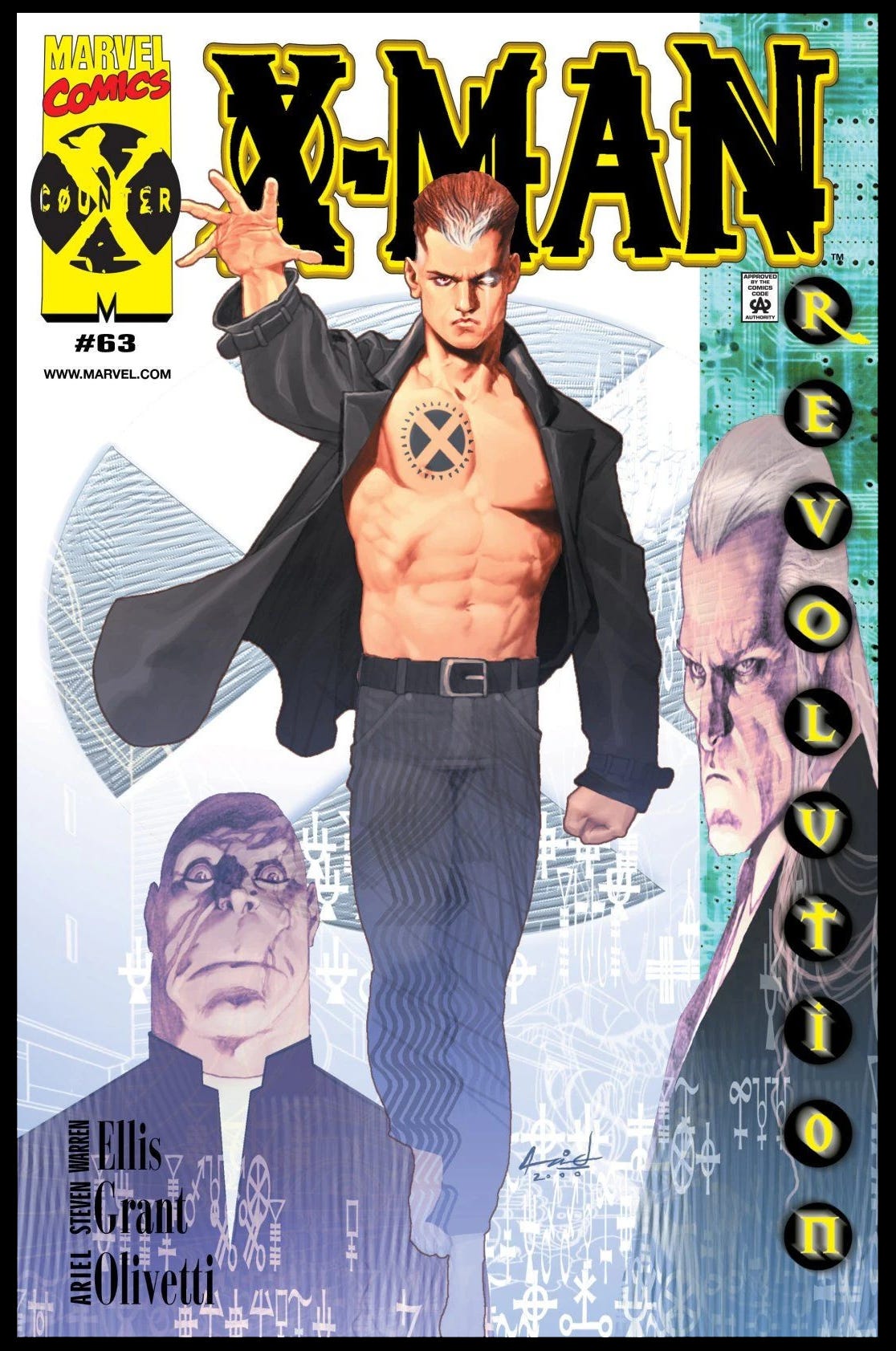
WORST STORYLINE: Choosing one would mean thinking about X-Man even longer, and I don’t want to. Does Nate repeatedly sucking on the mouth of an alternate-timeline version of his mother count as a story?
X-FORCE
(1996–2000)
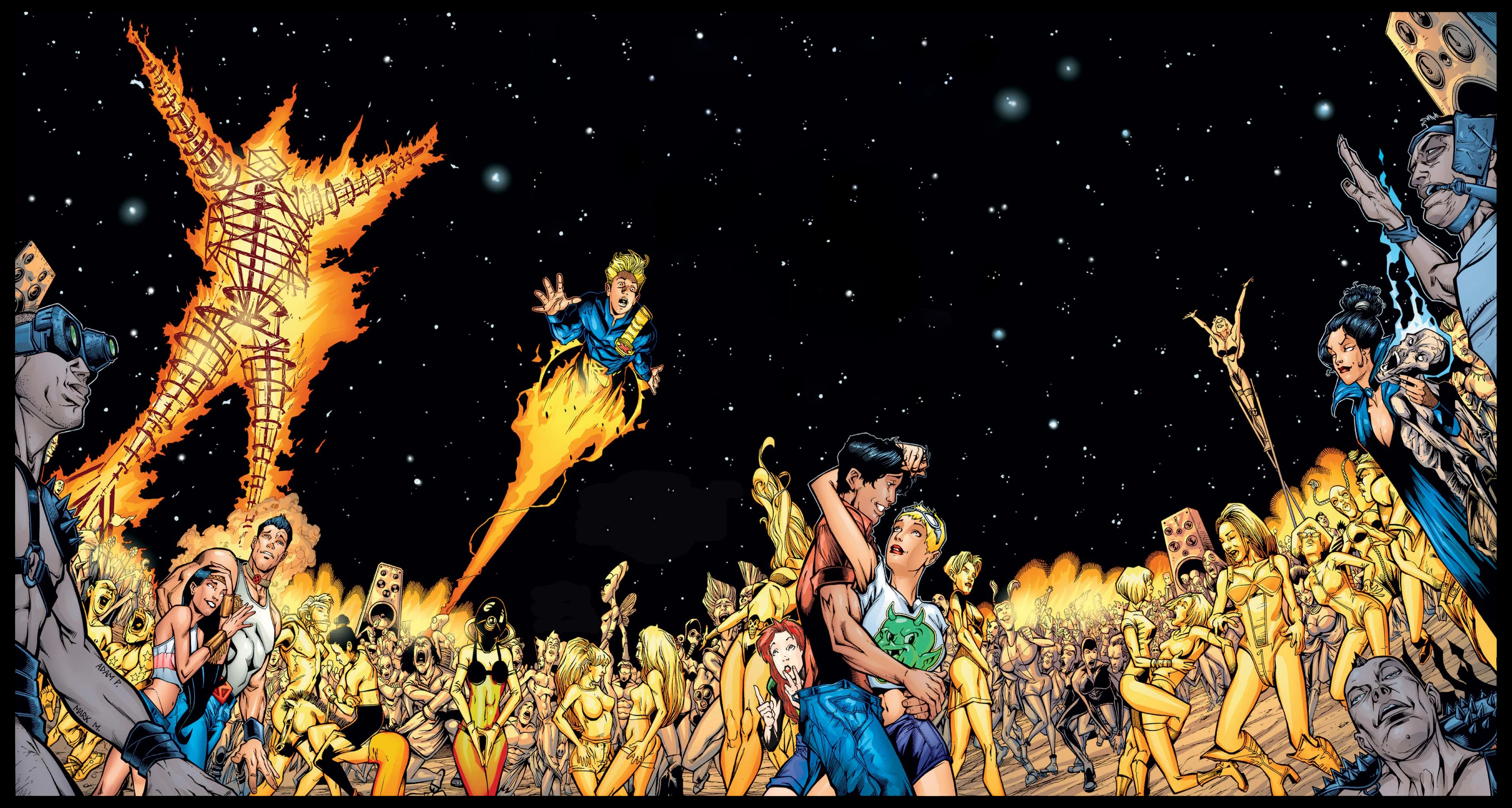
Once again, I’m going to cheat. We’re just glancing at X-Force issues #63–100: the run of author John Francis Moore.
I wish I knew what the hell happened to John Francis Moore. He wrote the first twenty-five issues of the wonderfully fun Doom 2099, and all thirty-six issues of the flawed but endearing X-Men 2099. His Factor-X (alternate-timeline X-Factor) has got to be at least in the top three on any ranked list of the Age of Apocalypse books. Moore is a solid, reliable B-tier hero comic writer. He was never on the level of Grant Morrison (S tier) or Peter David (A tier), but there hasn’t been a single comic book with his name on it that I haven’t enjoyed reading.
From the look of it, he disappeared from the comic book scene during the early 2000s, and hasn’t published anything or worked in media since. This feels somehow appropriate. If I had to describe Moore’s creative orientation in one word, that word would be “nineties.” He seems like the kind of guy who would have had a lot to talk about with someone like X-Files creator Chris Carter. His comics bespeak a fascination with postwar Americana, conspiracy theories and buried secrets, New Age woo, counterculture, and Hunter S. Thompson.
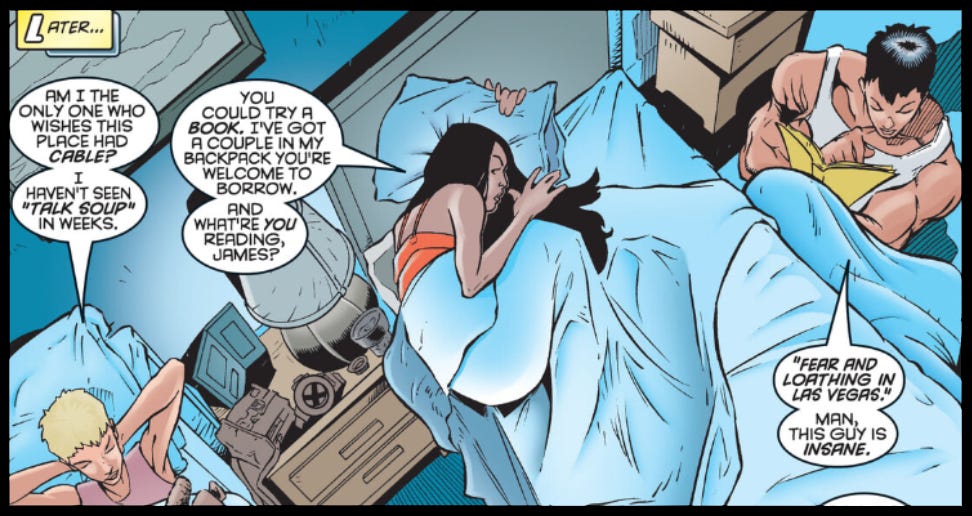
As we saw last time, X-Force began as a direct continuation of New Mutants, over which penciller Rob Liefeld assumed complete creative control in late 1990. X-Force was hot garbage, and Liefeld leaving Marvel during the Image Exodus was the best thing that could have happened to it.
The cost of repairing it under subsequent writers (Nicieza and then Jeph Loeb), however, was to deprive it of its identity. Even if “violent outlaw strike force X-Team” had been an unnecessary and stupid identity, at the very least the series had a thing it was doing. (Nowadays we might call it a “brand.”) With Cable and the gang moving back into the X-Mansion and working with Professor Xavier under Loeb’s authorial tenure, X-Force might as well have changed its title to X-Men: But with Different and Obscure X-Men in Stupid Purple Uniforms, and Cable Is Here Too.
Moore took over writing and plotting in X-Force #63, and started rearranging the furniture. (Penciller Adam Pollina sticks around from Loeb’s run; his art takes a little getting used to.) Over the next several issues, team members Caliban, Domino, Rictor, and Shatterstar either get written out or separated from the main cast. Dani Moonstar gets rotated back in after more than half a decade, and a convenient retcon about her being an undercover SHIELD agent infiltrating the terroristic Mutant Liberation Front reverses her heel-turn under Nicieza.
In issue #70, Cable freaks out about Operation: Zero Tolerance. We’ve gotta go underground, he tells the crew. There’s a war a’ comin’, and…
The gang has heard this one before. We’re not doing that again, they say, and walk out.
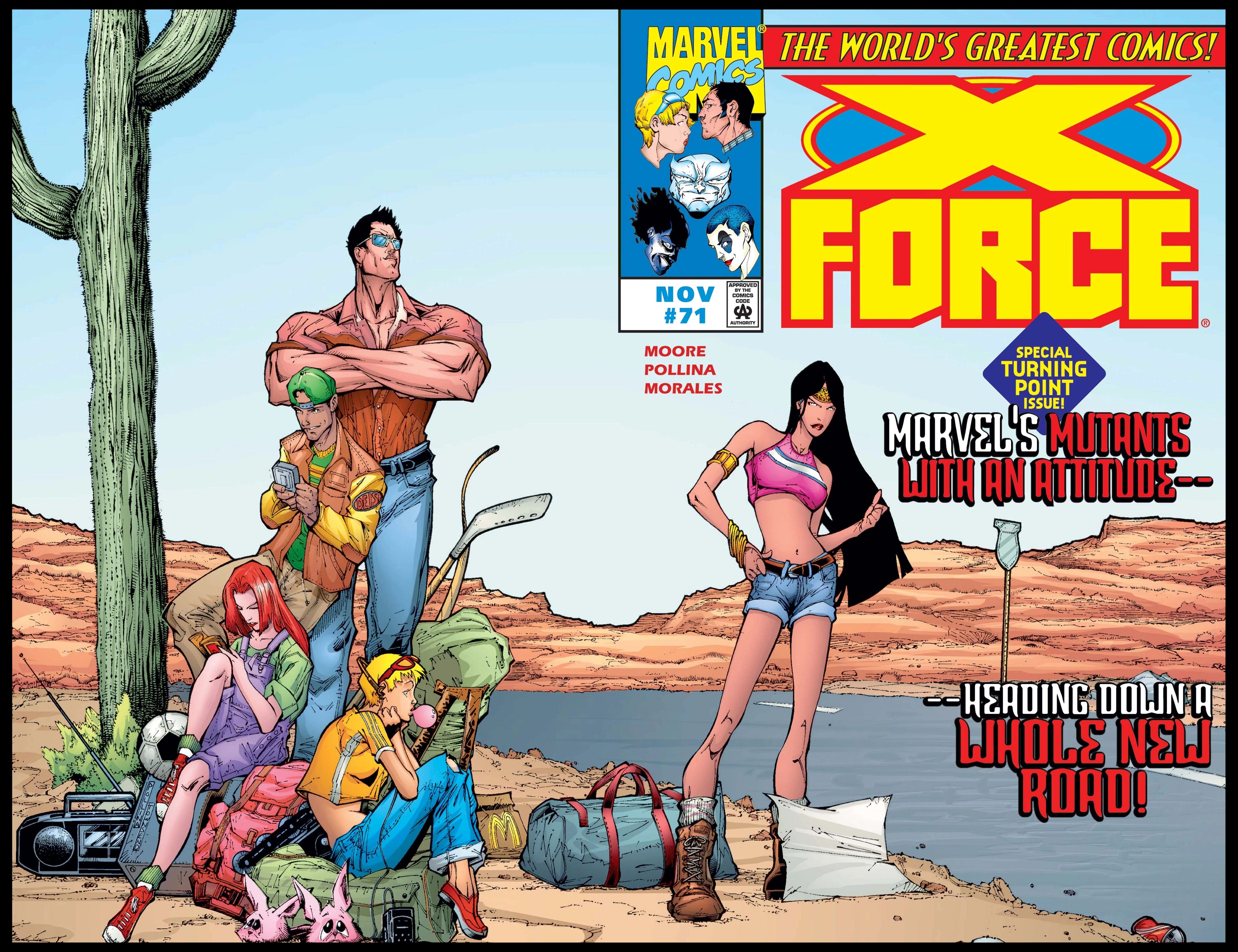
The John Francis Moore era of X-Force really begins in issue #71.
At this point, the team has been winnowed down to original New Mutants Dani and Roberto, later addition Tabitha, former Hellion James, and former Fallen Angel (and Banshee’s daughter) Theresa. All of them predate Liefelds’s takeover of New Mutants. I don’t believe anyone’s mentioned their ages for a while, but they’re old enough to be in college. And now they’re taking a road trip to clear their heads and figure out what they want to do with their lives. X-Force began as an edgy & gritty New Mutants sequel/spin-off; at this stage of its life-cycle, it turns into a New Mutants revival.
The Road Trip era of X-Force runs from issues #71–81, and is really quite charming. We hardly ever see the gang in their superhero garb. Roberto gets cut off from his trust fund, so the gang has money problems. They sleep in cheap motels. They go bowling and eat at midwestern diners. When their car breaks down, they hitch a ride with a hippie couple that’s clearly Shaggy and Thelma from Scooby-Doo. In issue #75, the crew goes to Burning Man (in the book it’s called “Colossal Man,” but it is Burning Man), where they briefly reunite with their old pal Shan and fight the giant Burning Man Colossal Man sculpture when the mutant sorceress Selene brings it to life. It’s delightful stuff.
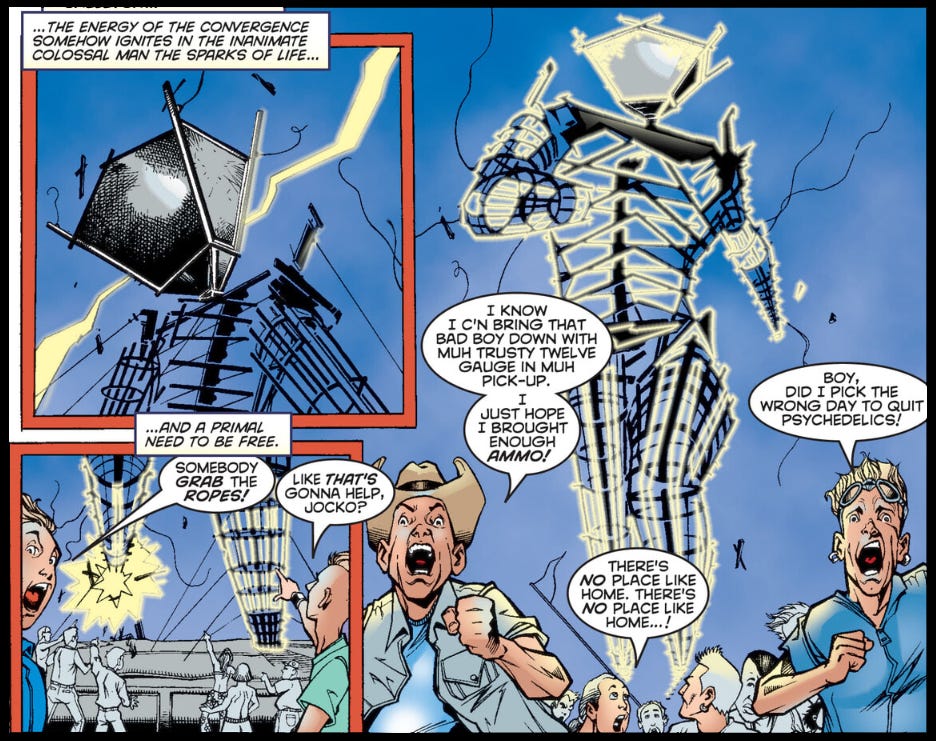
On the Karma reunion: I’m pretty sure Shan “came out” during Moore’s run—i.e., it was his call to make her gay, or to strongly insinuate she is when the team meets her at Burning Man Colossal Man. This sort of thing has become a gigantic point of controversy among comic book nerds in recent years: authors taking long-established characters and suddenly writing them as queer.
My two cents: there are instances where it works (Rictor and Shatterstar), and there are instances where it doesn’t (Tim Drake).18
Shan is an example where it does work. She gets more character development in just a few pages of X-Force #75 than during most of her time in New Mutants. And since she was always so underutilized as to never participate in any romantic comic book melodrama, it’s not like her being a lesbian negates or interferes with any previous characterization. It opens new possibilities for the character in a way that feels natural.
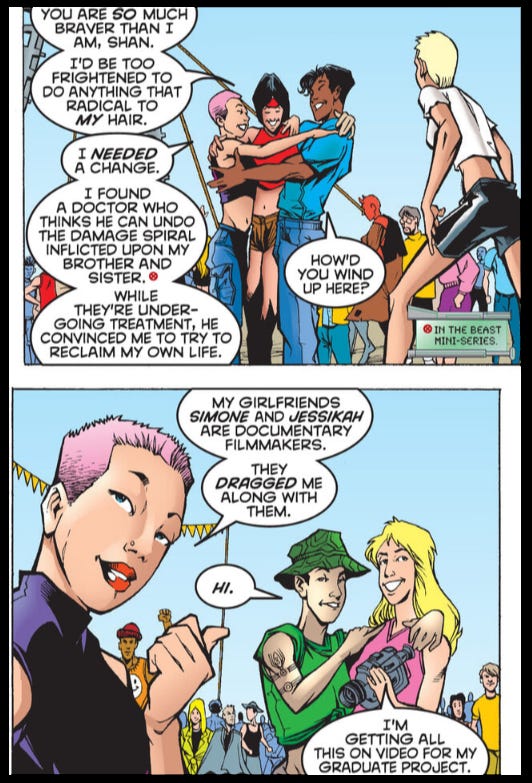
The Road Trip era is something of a journey down memory lane: at every turn, the gang comes up against an old friend, a familiar enemy, or a long-dangling plot thread in need of tying up. With New Mutants coming up on its fifteenth anniversary, it was a fine time for X-Force (both the team and the book) to reconnect with its past and figure out what to do next.
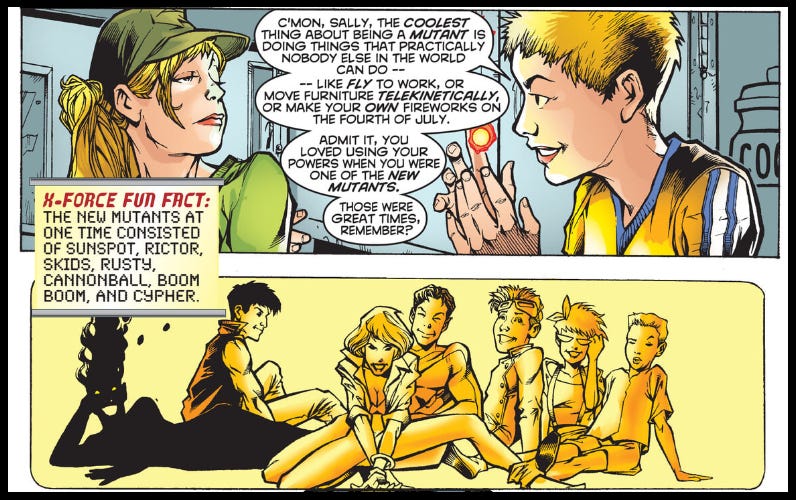
Hmm. This New Mutants lineup never existed. Cypher and Skids didn’t overlap. In the next panel, the disillusioned Skids recalls throwing herself into danger every day “because Xavier or Magneto or Cable to told us that’s what we’re supposed to do”—but she never met Xavier, barely knew Magneto, and was gone before Cable showed up. Whoopsie.
This is a question that will come up later: how reasonable is it to expect these books’ writers to have a comprehensive knowledge of decades’ worth of fictional comic narratives?
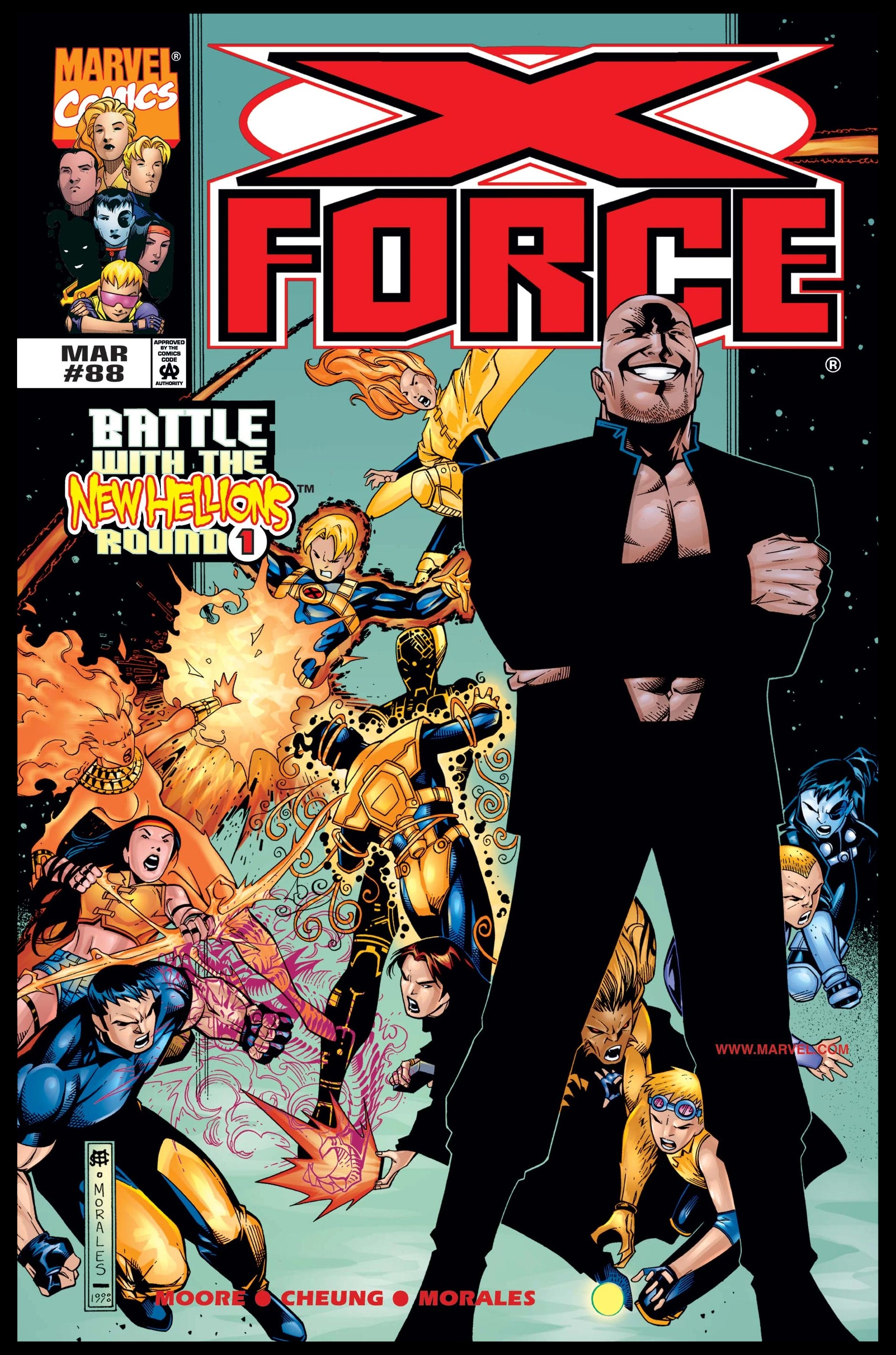
Adam Pollina departs in issue #81, the last issue of the Road Trip era.19 For the rest of his run, Moore is paired with young British illustrator Jim Cheung, whose style takes a lot less getting used to than Pollina’s. At this point, X-Force stops meandering. Roberto gets his trust fund back. The gang sets up shop in San Francisco and gets back to doing in-uniform superhero stuff. Sam and Domino rejoin the group. There are ongoing story arcs about Dani’s evolving mutant powers and a mysterious organization called the Damocles Foundation—but we’ll limit ourselves to a look at the episode involving King Bedlam and the New Hellions.
In the pages of Factor-X (Age of Apocalypse X-Factor), Moore introduced a pair of minor characters called the Bedlam Brothers. Jesse had the power to make machines go haywire; Terrence made people’s synapses fire all out of order. Moore brings the mainline-continuity versions of the characters into X-Force, first giving Jesse a slot on the team. He does an excellent job writing him as an honest and true “cool nerd” type—the kind of guy who’s bright, tech-savvy, and affable, but also somewhat timid and good at pushing people’s buttons without meaning to.
I’ve known people like Jesse. I’ve also known people like the girl he’s talking to in the panels below. When Moore writes about people from 1990s subcultural scenes, he gives one the impression, truthful or not, of having had some personal experience in those domains. (I never really believed Lobdell’s Jono as either a Brit or a goth/punker dude.)
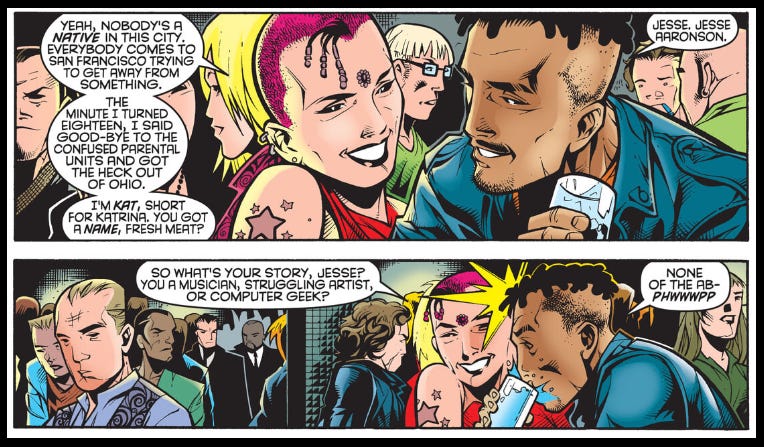
Jesse signs on with X-Force because he wants their help finding his long-lost brother Christopher (not named Terrence in this timeline). As it happens, Christopher has taken the sobriquet King Bedlam, formed a consortium of ambitious and ruthless mutants called the New Hellions, and prepares to make his power play by releasing the Armageddon Man—a walking metaphor for the buried secrets and moral compromises of World War II and the Manhattan Project. (Chris Carter preferred to use downed UFOs.)
Moore packs the New Hellions with familiar faces: original Hellion and James’ former teammate Tarot (mysteriously not dead), founding X-Force member Feral (chased off because everyone hated her, teammates and readers alike), and most notably, former New Mutant Amara—who always had a chilly aristocratic hardness about her, and has grown spiteful and cynical ever since Fabian Nicieza rewrote her history. Readers know Amara has gone seriously astray because she went and had her nose and tongue pierced. (How outré!)
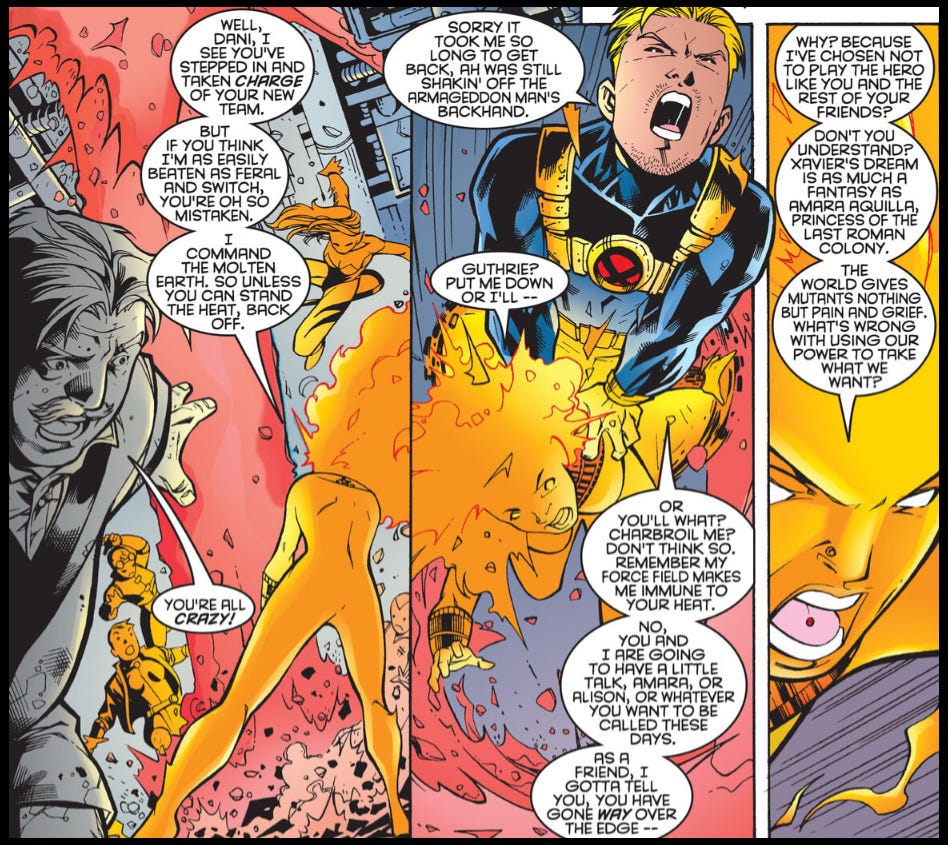
As one-shot malefactors, the New Hellions do their job well enough, and their complicated past with the X-Force gang spices the drama—but we can read in this story, and in X-Force’s mining of its own history, an upcoming problem for the X-Books.
After the 1990s, we don’t see a lot of de novo villain teams like the Marauders, the Reavers, the Mutant Liberation Front, the Dark Riders, or, well, the original Hellions—or at least none that last very long. The fans respond better when an X-Team rumbles with a group of antagonists composed of established characters.
Jesse Bedlam joined the cast of one of eight X-Books being published in 1998, and his creator stopped working on the series less than two years later. The book went on for a little while longer after Moore left, and then got cancelled.20 With nobody interested in championing the character, Jesse was allowed to get killed off for shock value (along with Angelo from Generation X) in Chuck Austen’s Uncanny X-Men. But why not? Even if Austen hadn’t had him crucified, it wasn’t like Jesse would be putting in any appearances for the foreseeable future.
The New Mutants never had the same star power as the X-Men, but belonging to the cast of what was once the sole Uncanny X-Men spin-off granted them a lasting prestige. Someone like Shan, who was never an especially exciting or beloved character, has been able to pop up again and again in the X-Books because she’s recognized and remembered. She has a deep-lore anchor that prevents her from getting swept off into oblivion. (Even a relatively minor regular character from Star Trek: The Next Generation has more cultural cache than the captain of Star Trek: Enterprise.) Jesse Bedlam, arriving when the X-Books were oversaturated and underperforming, was doomed to get lost in the crowd.
After three decades of publication, the X-Books had the depth and sweep of something like Romance of the Three Kingdoms, but were incapable of clearing Liu Bei, Cao Cao, and Sun Quan from the stage and ushering in their successors. We’re past the days when Chris Claremont could write longstanding characters out of Uncanny X-Men and replace them with new blood when the moment seemed to call for it. The pre-1991 characters are locked in; most of the ones introduced afterwards come into a franchise past its prime where the legacy figures will always overshadow them. When their books are cancelled, or when the writer with a soft spot for them finishes their one-to-three-year turn on a given title, they disappear indefinitely.
What we have to look forward to in our survey are next-gen teams that get forgotten as soon as their books are cancelled, endless New Mutants revivals, and ill-fated attempts to get the attention of grown-up Nineties Kids who remember Generation X. We’ve got another decade to go before things get really bleak, but senescence is already catching up with the franchise.21
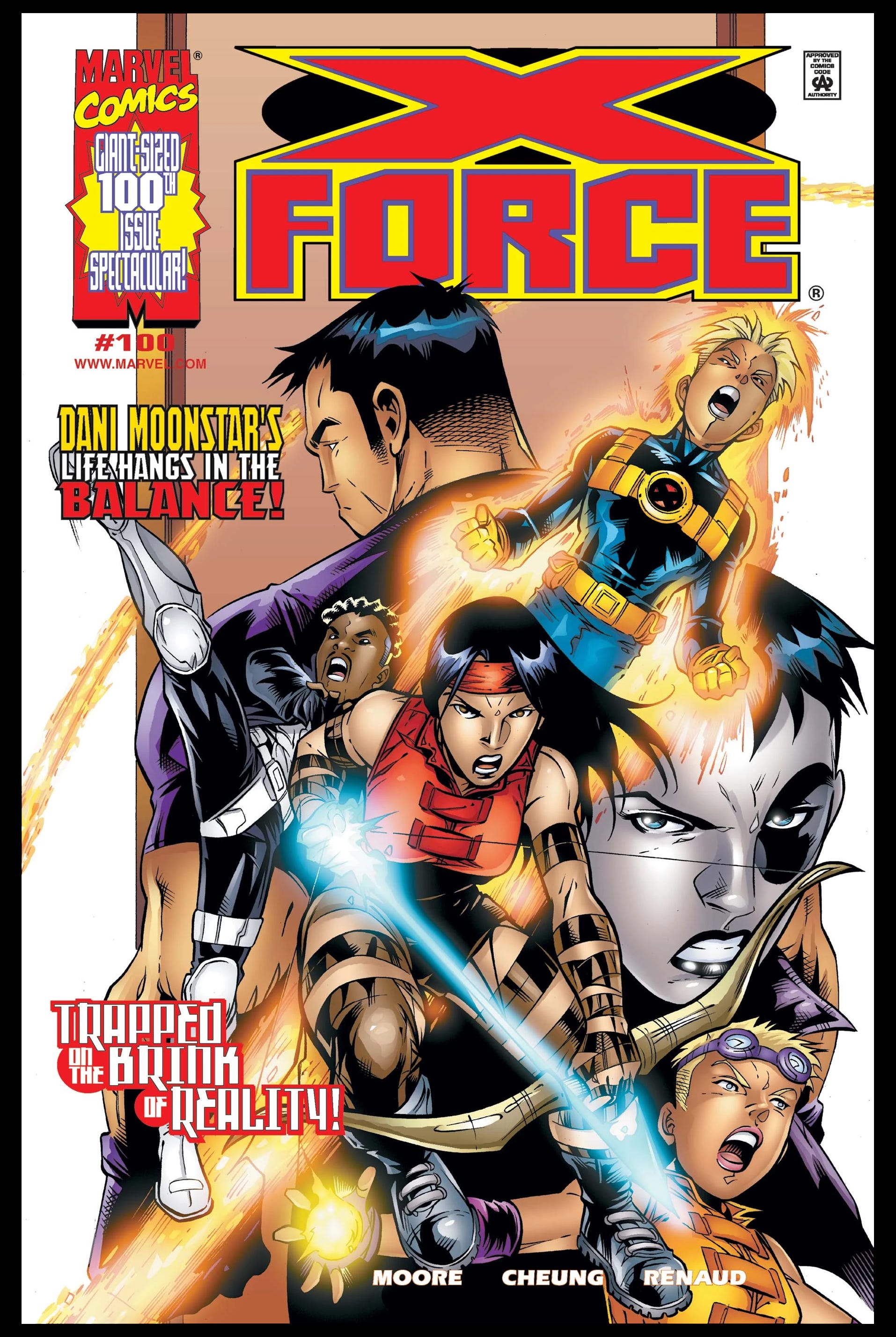
At any rate: Moore’s X-Force is very probably the best X-Book of the late 1990s—although that’s on par with the honor of being nominated as the best sludgy alt-rock band of the same era. There’s a low bar. But his X-Force has good character work. There’s something in the way of an overarching direction and a distinct flavor. It looks great, it’s competently written, and it’s fun.
And then Moore and Cheung go away so Warren Ellis, Ian Eddington, and Whilce Portacio can turn X-Force into the gross apotheosis of what Rob Liefeld tried to do with it from the very beginning.
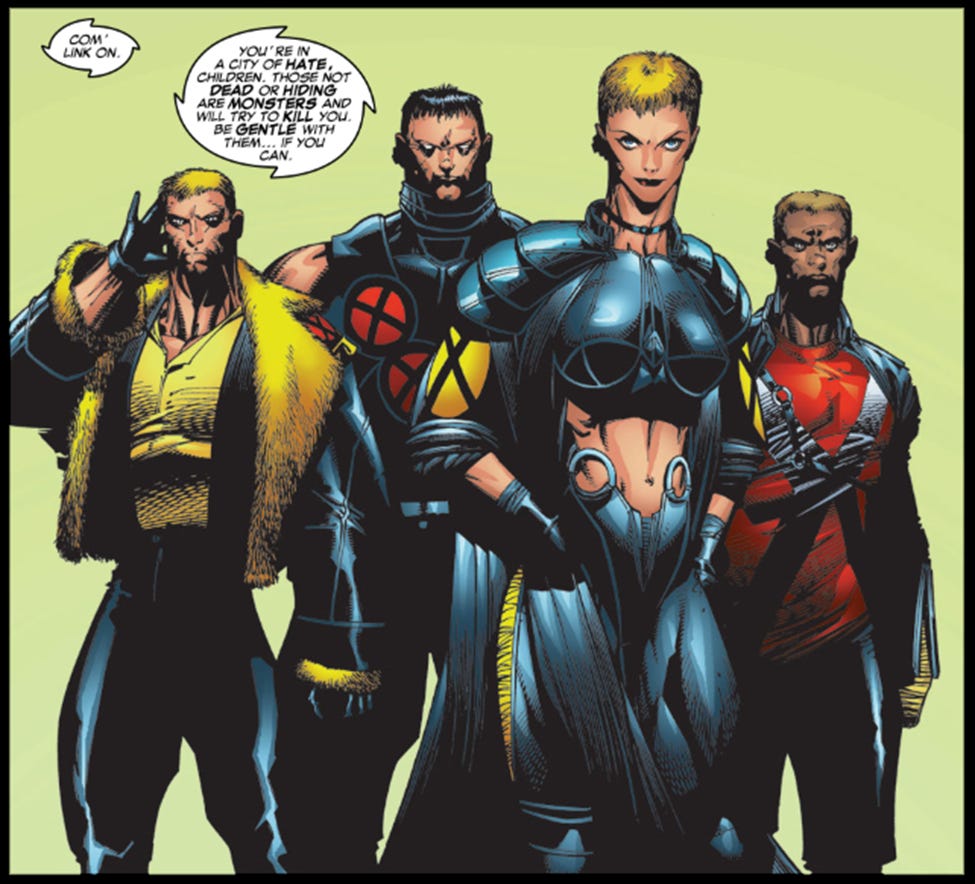
Scroll back up to the cover of X-Force #100 and try to match the characters in the above image with their six-months-earlier counterparts. They’re all there. Counter-X X-Force was embarrassingly bad.
NEXT: The Second Wind
Self-indulgent aside: if you clicked the Ishkur link, you might have skimmed this:
Like all UK Garage genres (with the exception of Speed Garage) Dubstep was beloved by the Drum n Bass scene where it was first used as an enjoyable second room/chill area at their jungle parties until it eventually took over the main room. That's like inviting a homeless person to crash at your place out of charity but they decide to stay, sleeping in your bed and eating all your food.
I fucking remember this happening during the late aughts and am still sore about it.
I notice, however, that “mullet Superman” isn’t included on this particular list.
I corrected the text: I somehow got it into my head the death/resurrection thing was 1994–95, when it was really 1992–93. Whoops.
(1) Well, most of them looked great.
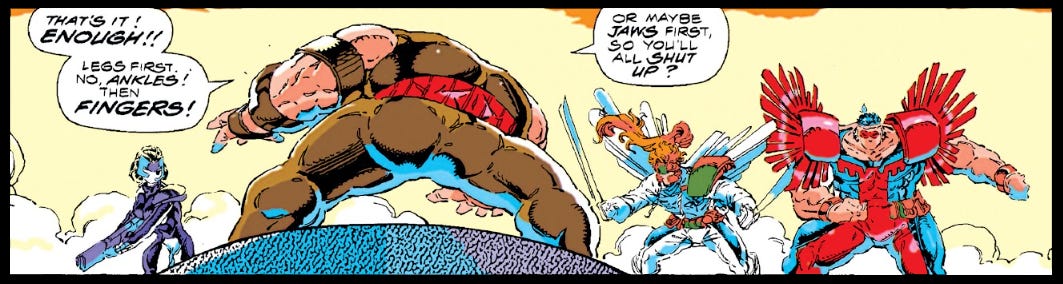
. . . . . . . . .
(2) Jim Lee’s redesigns of Cyclops, Psylocke, Jean Grey, Storm, etc. are stylish and striking, but what made them truly iconic was their inclusion in the early-nineties animated series and the mid-nineties video game adaptations. These are the versions of the characters recognized by people who never read an X-Men comic once in their lives, but watched the cartoon every Saturday morning and dropped quarters into X-Men Vs. Street Fighter at the arcade.
John Byrne, you might remember, illustrated Uncanny X-Men during the late 1970s and early 1980s, and was practically the book’s co-author during that time. Here he explains why he lasted only a few issues in his new role:
“The problem was the books were terminally late when I was asked to script them. Jim [Lee] and Whilce Portacio would both send me the plot and then they’d send me three pages of pencils. I’d script those because they had to be scripted right away and fax the scripts directly to Tom Orzechowski, who was lettering the book. I bought my first fax machine working with those guys. Then I’d get one more and the one page didn’t match the first three pages because they’d taken off on a tangent, and they were both doing this. So I was constantly re-writing, and re-writing and writing. It was just a nightmare. I was working weekends, which I never used to do in those days. I finally called Bob Harras and said, ‘Something’s gotta be done about this. This is insane.’ And Bob said, ‘We’ll take care of it.’ Years later I was told, you should always be careful when Bob says, ‘We’ll take care of it.’ What ultimately happened was about two weeks later, Terry Austin called me and said, ‘’Hey, I hear Scott Lobdell is writing X-Men,’ and I said, ‘Huh?’ And he said, ‘Yeah, at a barbecue at Berni Wrightson’s place, some friend of Scott’s was there and said he’s just picked up the X-Men assignment.’ That’s how I found out I wasn’t writing X-Men, that’s how they’d taken care of it.”
DeFalco, Tom. Comic Creators on X-Men. London: Titan Books, 2006. p116,119
I know that there are two sides to every story like this one (and Byrne himself has a reputation for being difficult to get along with), but it’s hard not to see Bob Harras as an incompetent at best and a corporate supervillain at worst.
Wolverine (and former Uncanny X-Men) artist Marc Silvestri left too, but I don’t believe Harras had given him the same dispensations as Lee, Liefeld, and Portacio.
Remember that distinction between the X-Men’s Blue and Gold teams? Well, neither did the writers or editors.
Maybe this explains why the otherwise pointless New Mutants: Truth or Death limited series happened.
By the time the interview was published, Blink was already dead. She was the could-have-been Generation X character who sacrificed herself to save the rest of the group during the Phalanx Covenant EVENT. An alternate-timeline version of the character became a beloved fan-favorite during the Age of Apocalypse EVENT, and during the 2000s she was a central character in Judd Winick’s cult-hit Exiles series (think X-Men meets Suicide Squad meets Sliders). It will later turn out that the version of Blink who died wasn’t so dead after all, and we’ll be looking at the book she appears in.
“Loser” is the supreme insult in Scott Lobdell’s vocabulary.
(1) Ever hear of the cinematic bomb Howard the Duck? He was a Marvel Comics character.
(2) Howard features in a four-issue Generation X spin-off book called Daydreamers with Artie, Leech, and Franklin Richards, who live in a treehouse Angelo and Everett built for them in the Grotto. I have not mentioned them because they don’t matter, and I have no intention of reading Daydreamers.
(3) Speaking of Generation X spin-offs—yes, plural—there was a 1998 one-shot called Generation X Underground Special written and drawn by one Jim Mahfood. See, back in the 1990s, people said “underground comics” instead of “indie comics,” so…
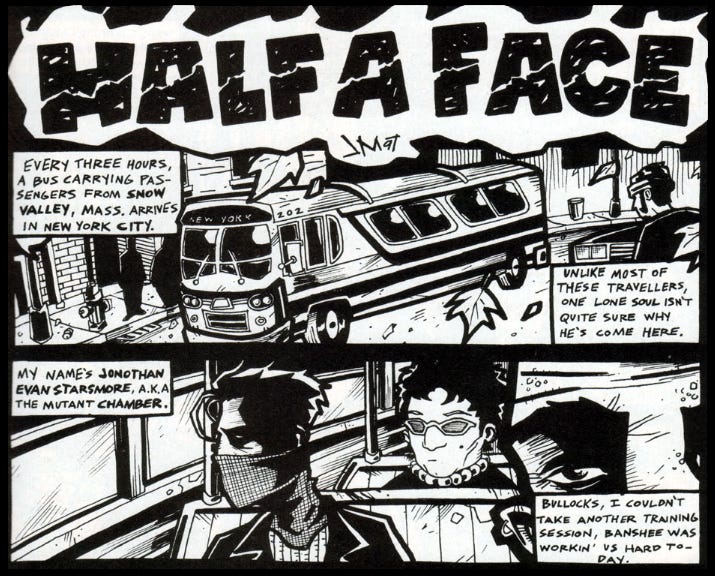
I have no idea how or why this comic happened.
Hama’s Wolverine is actually pretty good. His being a Vietnam vet probably gave him some insight as to how a grizzled old warrior type should be written, and the strange wackiness he brings to the series actually works for it—and gives the character’s solo book something that can define it other than his being at liberty to violate the X-Men’s “no kill” rule when Cyclops, Storm, and/or Xavier aren’t looking.
They had a big showdown with Black Tom in issue #25. No, wait—Emma, Sean, and Penance fought Black Tom. The rest of the team was elsewhere, but Tom used his creepy plant powers to make like living marionettes resembling them so Sean (and the reader) would believe Tom was torturing his kids. Jubilee was there, though. For a second. But she got kidnapped by Bastion, who killed Mondo in the process, but now it turns out not to have really been Mondo but one of Black Tom’s plant constructs—although Mondo, however, was apparently still secretly working for Black Tom and was still actually evil, and since someone felt that this nonsense needed to be clarified almost three years later (and after everyone had already forgotten about it), Black Tom has to show up and the gang has to fight him and his pal Juggernaut and Mondo. There’s a lot of stupid shit in Generation X, even for a superhero comic.
If there are any X-Men fans who argue that Chris Claremont’s work in the aughts exceeds The Claremont Run (generally understood to mean his 1975–1991 tenure on the X-Books), they are so scarce as to be invisible. What’s controversial is how good or bad his later work on the X-Books actually was, and the possible reason as to why it never came close to matching the quality of his original run. Is the later stuff terrible? Underrated? Merely passable? Better than the average comic book, but saddled with impossibly high expectations? Had comics changed too much, and were Claremont’s sensibilities too dated, after his nine-year absence from the franchise? Was he unable to perform as well under heavier editorial oversight and plotting? Was he just not as invested as he was before, given that none of the characters or stories belonged to him like they did during his halcyon years?
For the record, I don’t think nu-Claremont was all that bad—I rather like his collaboration with Chris Bachalo on Uncanny X-Men—but it’s just not the same.
In the Epic Marvel Podcast interview, Brian Wood mentions receiving death threats from fan who were absolutely livid about him killing off Everett (even though at this point he was still just following Warren Ellis’ plot outline). Generation X may not have been moving product like it did in 1994–95, but the fans-for-life it made during that time were (and in some cases still are) pretty damned invested in the characters. I’d say they have questionable taste, but who am I to talk?
There’s a scene at the very end where she gets off the phone with Professor Xavier(?) and boards a helicopter manned by people with prominent X’s on their uniforms, and I have no idea what it has to do with anything. I suppose maybe Wood and/or the editors had been told she’d been slated for a spot in Grant Morrison’s New X-Men, but could only guess at what was actually planned for her.
Holy crap I just remembered there was a made-for-television Generation X movie. I have not seen it. I don’t want to see it. I know that it’s on YouTube, though.
It doesn’t matter what anyone think about it, of course, because it’s a fait accompli. A comic book death can be reversed; a coming-out can’t.
Incidentally, the book gets a new editor in issue #77. Given what we saw during Jay Faerber’s Generation X run, I wonder if the new guy came in and told Moore to hurry up and get the team to wherever they’re going and put them back in their X-uniforms.
That’s the simple version. The more complicated version is that after Counter-X X-Force flopped, the title was given over to Pete Milligan and Mike Allred, who turned it into a completely different book, which then spun off into X-Statix. I will have to write about that one someday. I am not in the habit of calling something like a superhero comic “prescient,” but X-Statix is really an exceptional piece of work.
If perhaps you’re more familiar with old anime than old comic books, the evolution of Akira Toriyama’s Dragon Ball provides a useful analogy. When the series begins, protagonist Son Goku is a child. Over the years, he grows up. He gets married and has a son, Son Gohan. And then we see Gohan growing up. Goku dies during the Cell Saga, but by then a teenaged Gohan has surpassed him. The narrative arrow points consistently forward.
And then the Buu saga happens. Goku comes back to life, and before the thing is over, Gohan gets permanently sidelined. It was probably a smart decision from a commercial perspective, but the transformative progress that made Dragon Ball’s narrative such a thrill to follow for so many years became mostly illusory from there on out.
I might ask if it wouldn’t have been an overall better creative choice for all these franchises to quit while they were ahead—but I’m aware that after crossing a certain threshold in their development, artistic value ceases to be the real point of the endeavor.
Wow took me 2 months to catch up with this. 21 footnotes you are like Douglas Adams over here. I remember some of these characters.
Age of Apocalypse: I got a big old cardboard box of the entire event in a cardboard box from an unkle. It was it's own self contained story, sort of, so he didn't need to keep it. It was its own self contained story, sort of, so I loved it. Nate Grey wasn't a bad character in the context of that story. I will never forget him as the first amnesiac protagonist I read whose story was like: "they don't remember because they weren't." Then, like, he blows up a factory full of vats of human bone marrow. Being angry and blowing shit up is a perfectly well adjusted reaction to the world he was born to, lol.
Also, that storyline about rescuing Illyana left a mark.
Ugg collector's stuff. At least my unkle didn't keep them in those celophane bags. I mean the cardboard boxes are good for moving the things but those bags oh god and the cardboard backing jeeze. A lot has been written on bubbles. But the accoutrement stuff of the collecting is gross.
I remember reading on a Web Site, possibly a Web Shrine, about Monet, I thought she was Morrigan in the arcade game because of her opening animation. What a deep cut I imagined. Thanks for letting me know which were memories, which were confusion.
Chamber and Husk are cool character designs. I like the gross heroes who aren't gorey I guess. I definitely prefer a backstory of "she's so and so's sister" more than "she's so and so's lover" for my random womenfolk characters.
The Generation X movie has Angelo as the new character things are explained to, Caucasian Jubilee, and a plot involving arcades with games with subliminal ads that mutants are immune to for candy flavored cigarettes.
I love how your Nate Grey description is basically a copy paste of your FF7 Cloud description. The 90s hero was very clearly defined