
X-Men Generations (Part 1)
The Stumbling Sixties
Preamble & introduction here. This is definitely getting cut off if you’re reading it in your inbox.
THE 1960s
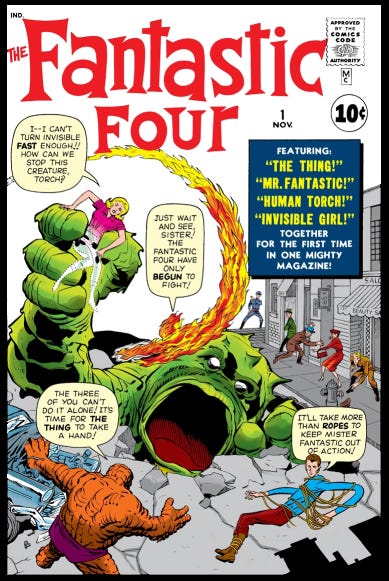
Ah, the Silver Age of [American] Comic Books—when Superman was a dick, the Joker was a larcenous goofball, anticommunism was integral to the Fantastic Four’s origin story, every neologism ended in “o,” and superhero monthlies were perfectly content to be cheap, clean, lowbrow entertainment for boys and young men.1
Calling the years between the mid-1950s and the early 1970s the Silver Age implies there had been a prior Golden Age of Comic Books and that it had already ended. In terms of long-term trends, this was true: television had recently stormed the cultural landscape with all the dominating swiftness of a seventh-century caliphal army, threatening print-based entertainments with an even more formidable competitor than either film or radio. But there had been an especially marked decline where superhero comics were concerned—so let’s back up a couple of decades.
Following the premieres of Superman, Captain Marvel (lately renamed Shazam), Batman, et al. at the tail-end of the 1930s, the World War II years saw a bonanza of comic books featuring “mystery man” vigilantes and/or do-gooders with fantastic abilities. Like the pulp magazines they emulated and competed with on the racks of Depression-era newsstands, comic books came in a variety of flavors: horror, crime, romance, comedy, cowboy western, science-fiction, and so on—but the mask & cape rags were kings of the hill.
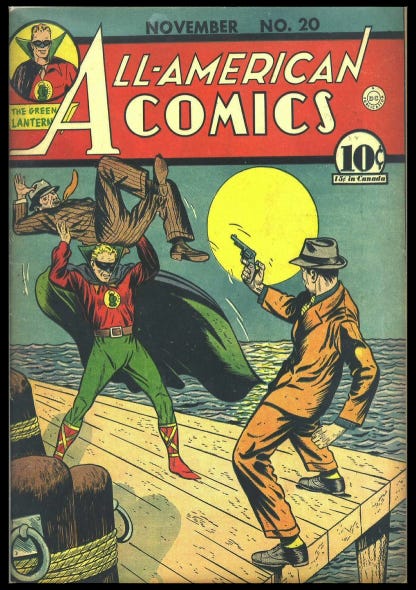
Drew Bradley of Multiverse University’s examination of the state of comic books in 1943 gives some indication of why the period is remembered as the medium’s golden age:
[T]he comic book industry had its most profitable year yet in 1943. Newsstands were selling 25 to 50 million comics per week nationally for an annual gross of $30 million ($500M in 2023 dollars). The demand for comics was so high, sell-through often exceeded 100% because readers desperate for the escapism were willing to buy damaged copies. Superheroes were still the most popular genre with multiple characters able to move a million copies per issue.2
Success was not evenly distributed. Between the start of the comic industry [in the early 1930s] and 1943, at least 45 different publishers had tried their hand at comic books. Half of them either gave up or went of of business within 10 years, only be replaced by 20 other starry-eyed entrepreneurs. The survivors felt established, however, and in 1943 they had the confidence to schedule issues themed around holidays for the first time. Before, they had relied on general inventory that would appeal to readers year round with a seasonal cover thrown in occasionally.
Who was buying all those comics? A better question might be “who wasn’t?” The Market Research Company of America found that 35% of Americans ages 18-30 regularly read six or more comics per month. A smaller segment (15%) of older demographics reported reading comics “regularly.” Elementary-aged kids were reading them “often” at a rate of 95%. They stretched their dime investment as far as they could by sharing and trading their purchases with one another until the average copy of any given issue was read by 6-10 people.
Superhero titles waned in popularity after 1945, and some pop-culture historians ascribe the vibe shift to war fatigue. Many flamboyantly dressed champions of justice had, after all, spent the previous five years foiling Japanese and German spy plots on American soil and/or actually fighting on the European and Pacific fronts—but fad fatigue was undoubtedly a factor as well. Established crowd-pleasers like Batman, Captain Marvel, Superman, and Wonder Woman held on tight, but dozens of masked champions of justice you’ve never heard of—appearing in monthlies published by “[Buzzword] Comics” companies you’ve also never heard of—dropped off between the end of the war and the mid-1950s.3 Crime and horror comics replaced them as the new big thing among male audiences.
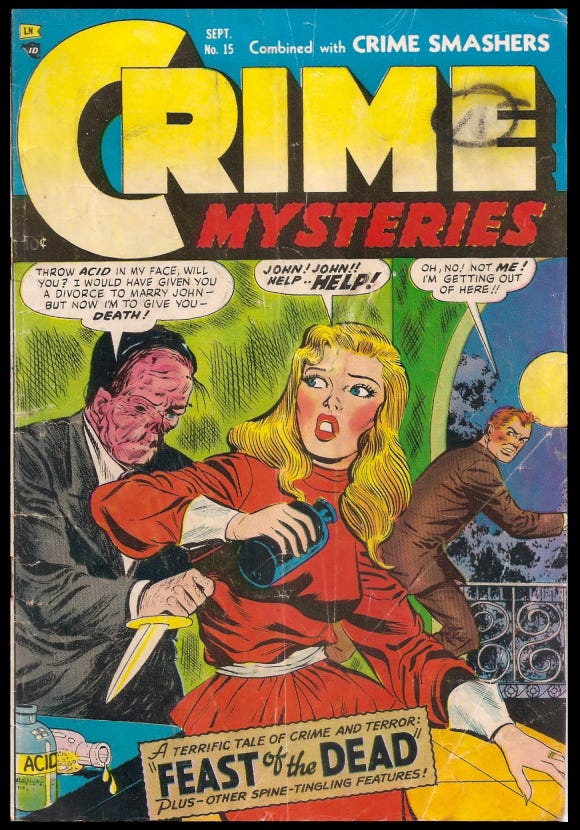
In April of 1954, a psychiatrist by the name of Frederic Wertham published a book called Seduction of the Innocent and fomented a moral panic. Comic books, Wertham argued, were a vector for juvenile delinquency and deviance. Look, he said, at how crime and horror books glorify violence and antisocial behavior. Look at Batman and Robin living together in Wayne Manor, promoting the homosexual lifestyle. Look at Wonder Woman and her lasso—she’s obviously a lesbian with a bondage fetish. Superman? The name says it all: he’s the fascist ideal of the Übermensch.
The sorts of persons you might expect to freak out started freaking out. Lawmakers took notice. Now that the TV revolution was underway, congressional grillings of comic book publishers could be and were televised. The industry was so spooked that it created its own moral watchdog, the Comics Code Authority, to audit its output.4 For the next several decades, the covers of mainstream comic books had an “Approved by the Comics Code Authority” seal printed on the upper-right corner. Publishers were under no legal obligation to submit their products for CCA review—but in the face of such hostile scrutiny, neither they nor retailers were keen on taking their chances and provoking the custodians of American moral hygiene.
Horror comics had their legs cut out from under them. Crime comics were dealt a blow from which they never recovered. Graeme McMillan of PopMatters explains the dilemma facing publishers:
With this new code of conduct in place, and the industry under pressure to prove that it can entertain its readers without doing anything that would upset those who had just months earlier been burning its product or working to shut everything down entirely, comic book publishers were faced with an existential question: what could they publish?
Some pre-existing material had escaped public censure already: so-called Funny Animal books continued to sell because, well, how could you go wrong with anthropomorphized animals doing comedy? Romance comics, too, might have been mildly censored – the Comics Code required that "passion or romantic interest shall never be treated in such a way as to stimulate the lower and baser emotions," after all – but there were ways around that; stories started to center on younger characters, less prone to more base instincts, in order to maintain at least an illusion of propriety. But what about readers looking for adventure and thrills who could no longer find such things in the new, sanitized generation of horror or crime stories? What would they want to read?
The answer, in brief, lay in reviving superhero comics, and injecting them full of popular concepts and gimmicks from midcentury science-fiction pulp to hold readers’ interest. Thus dawned the Silver Age of Comic Books.
Aside from its reimagined versions of 1940s characters, gratuitous speculative fiction elements, often (but not always) lighthearted tone, and simple moral clarity, the Silver Age is commonly associated with the arrival of an upstart on the comics scene—although, really, this “new” publisher had been around since the start of the Golden Age.
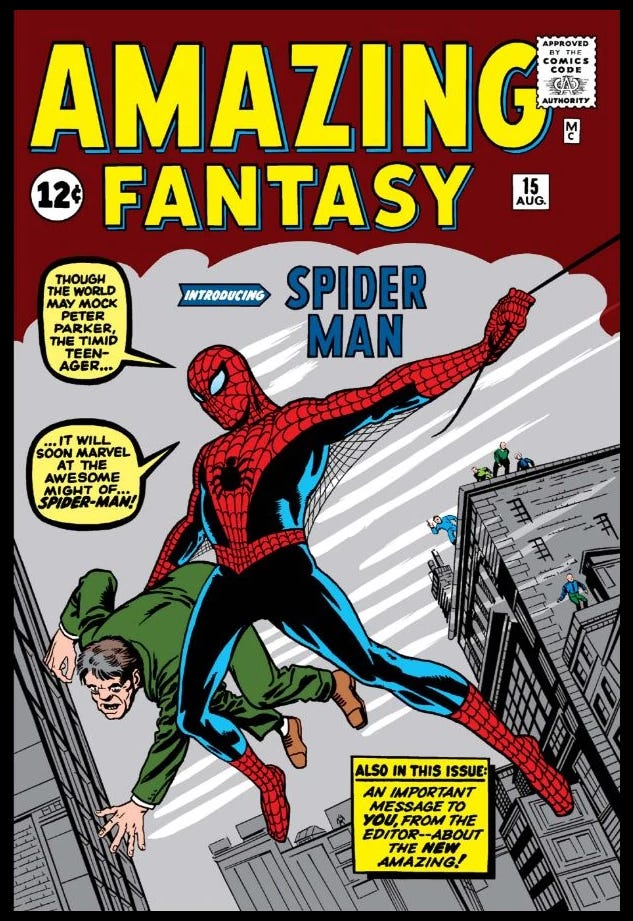
In 1939, a purveyor of pulp magazines called Timely Publications, founded by one Martin Goodman, attempted to cash in on the comic book craze with the release of an anthology called Marvel Comics. (By issue #2, it would be retitled Marvel Mystery Comics.) Encouraged by the results, Goodman went all in and rechristened his company as Timely Comics in 1941.
The company rebranded itself again in 1954: after jettisoning all of its superhero titles (one of which was Captain America), Timely Comics became Atlas Comics. Seven years later, seeing how well DC Comics’ resurrected hero monthlies (most notably The Flash and Green Lantern) were performing, Goodman re-re-re-renamed his company after his first comic book—Marvel Comics—and tapped a cousin-by-marriage in his employ to get it back on the superhero bandwagon.
How about we let Seth Stevenson introduce Stan Lee:
Lee…had been around Marvel as a sort of gopher since 1939, cleaning out ashtrays and getting the artists fresh ink. In the 1960s, he began to become more involved in the creative process. He also seized the spotlight. “Stan Lee was a really good salesperson,” says [Sean] Howe. “He was a good showman. He was sort of an ambassador of the art form, and he was very happy to be invited on talk shows or to be interviewed for magazines and talk about how comic books have this endless potential, and if Shakespeare and Michelangelo had been around today, this is how they would have collaborated.”
Under Stan Lee and his less heralded collaborators, Marvel clawed its way back by drawing on two principles that would become the foundations of its long-term success. The first was that superheroes could have flaws. Howe explains: “The Marvel characters had feet of clay, you could say. They were really insecure and neurotic. Spider-Man famously would catch cold and worry about not having any girls interested in him, and so there was a certain relatability to adolescents in seeing that superheroes are just like us. They have to worry about being picked on or where to sit in the cafeteria. I think that made everything feel fresh.” […]
The second cornerstone of Marvel’s 1960s comeback was the way it wove its many characters together into one storyline. Heroes would cross over into one another’s comic books. You’d have to read an Iron Man comic to feel like you fully understood what was going on in a Captain America comic. Howe says, “That was the beginning of the Marvel Universe, and this was pretty much the beginning of comic books having these shared universes that have now become bigger than comics, really. It’s something in all kinds of world-building in different media.”
‘Nuff said! as Lee would write. (Under his tenure, Marvel developed an exuberant editorial lingo that defined the brand almost as much as its intellectual properties.)
Marvel heroes’ celebrated tendency to cross paths was likely the result of a business restriction. In the late 1950s, Atlas Comics lost its distributor—the middle-man company responsible for getting comic books to newsstands. It cut a deal with Independent News, which was then the owner and distributor of DC Comics, to move its books. But since Atlas/Marvel was competing for DC’s market share, Independent News was only willing to circulate eight of their titles per month. By the mid-1960s, Marvel books were selling well enough that Independent News evidently saw more good than harm in incrementally allowing the company to put out more content (for which it would receive its cut). But in the meantime, a character like Iron Man—who, like Spider-Man, was introduced in an anthology series—had to get in line and settle for making appearances in other heroes’ books.
Since Marvel could only put out a paltry number of titles per month, every release had to count. Every book had to pull its own weight. And this was an intractable problem for the runt of the Marvel litter, a comic about teenaged mutant costumed heroes called…
THE X-MEN
(1963–1970)
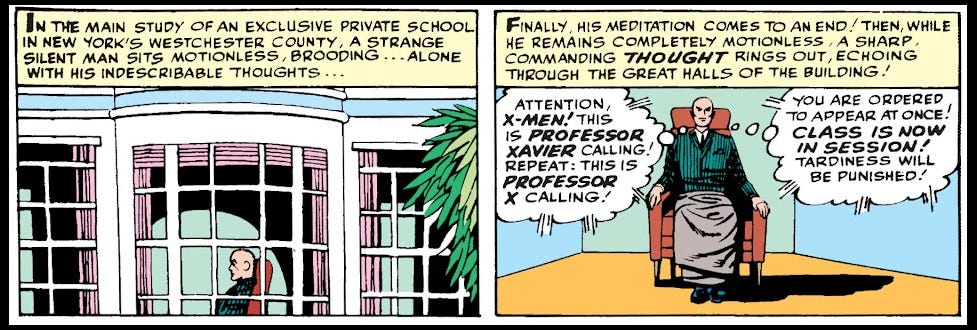
Yes: the original X-Men started out as a teen team. Or did you forget that was our theme here?
(Note: For the most part I’m going to give more attention to the writers than to the artists, and to balance the scales I’m naming the pencillers in the image captions. Something else to bear in mind: most of these images will be coming from the digitized versions of the comics, available on Amazon and through the Marvel app. They’re much brighter and cleaner than they looked when they were first published on newsprint stock.)
Like Fantastic Four and The Incredible Hulk, X-Men was a production of artist Jack Kirby and writer Stan Lee—and here I am required to mention Kirby’s odious treatment by Marvel and Lee’s tendency to give himself credit for work he didn’t actually do and ideas he didn’t actually have. Where comic books credited to Kirby and Lee are concerned, we can be reasonably certain that Kirby drew them and Lee wrote the words, but Lee’s role in thinking up new characters and devising stories was probably more limited than he would have had the public believe. (He was sort of like the Steve Jobs of comic books.)
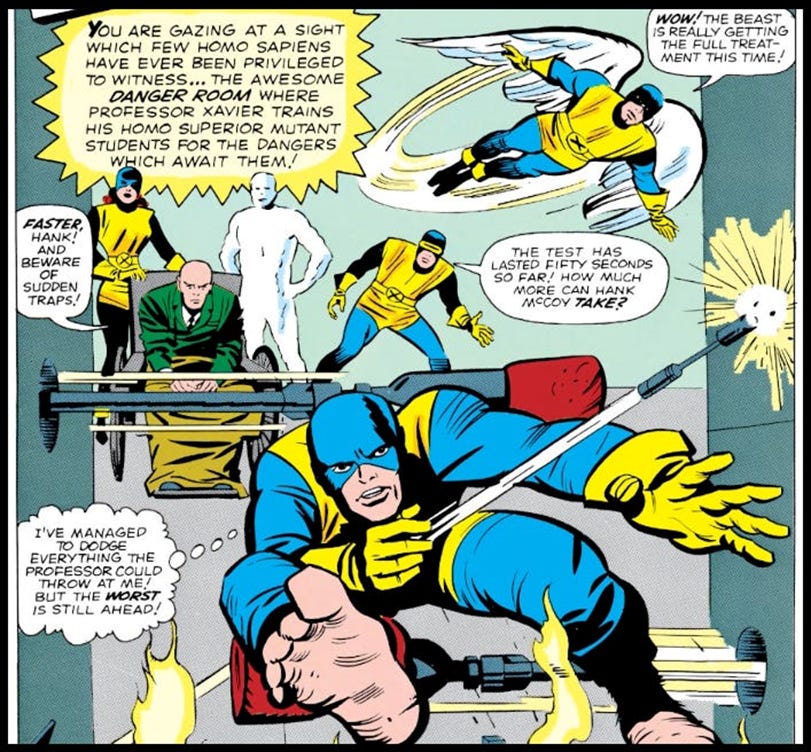
The premise: one Professor Charles Xavier has converted his mansion in upstate New York into the “Charles Xavier School for Gifted Youngsters,” a progressive prep school so selective that it makes Exeter look inviting. But the campus hides a shocking secret: Professor Xavier is a “mutant” (Homo superior), a human being born with an “X-Factor” gene that grants him the ability to read minds and communicate through telepathy.5 His five teenaged students are mutants as well, each possessing a unique “gift” of their own. In addition to giving them a primary school education, Xavier trains his “X-Men” to use their powers for the benefit of mankind—namely by dressing up as an incognito “fighting team” and embarking on dangerous missions against criminals, evil mutants, incorrigible mad scientists, and the like.
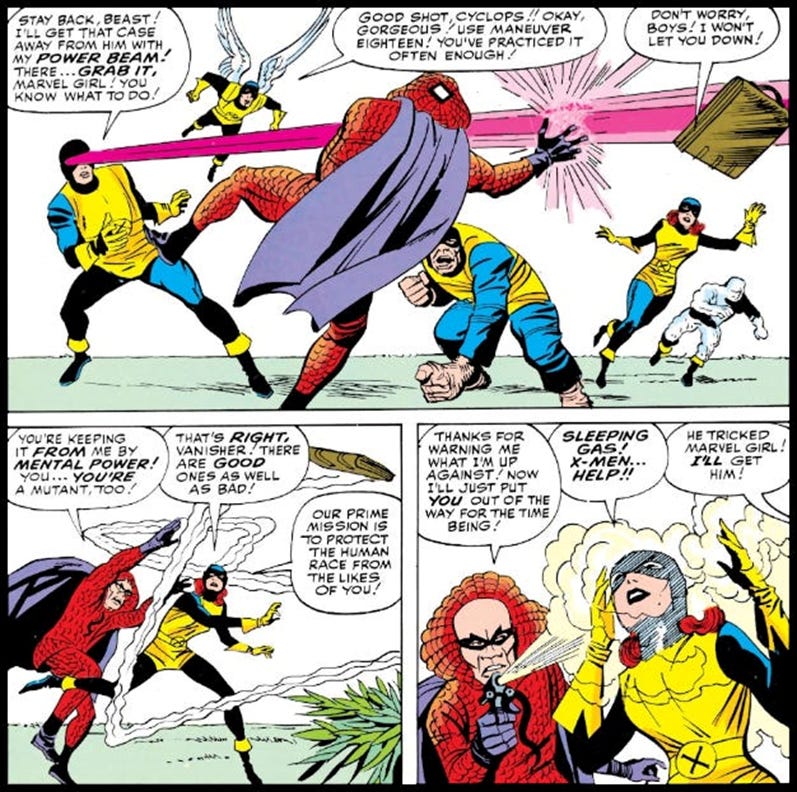
Yeah, yeah. You probably already know the basics of the story. Let’s do a pro forma review of the roster anyway.
Scott Summers (Cyclops). Emits an uncontrollable “power beam” from his eyes. Has to wear a special pair of glasses or a visor so he doesn’t flatten everything he looks at.
Bobby Drake (Iceman). Freezes things and makes ice. Goes into fights frosted up, taking on a snow and then an ice form. For a while it’s a little ambiguous whether he’s covered in ice, or turns into ice.
Hank McCoy (Beast). Agile as a monkey, strong as a gorilla. Big hands and feet. No blue fur just yet.
Jean Grey (Marvel Girl). Telekinesis. No telepathy just yet.6
Warren (Angel). Flies on the feathered wings growing out of his back.
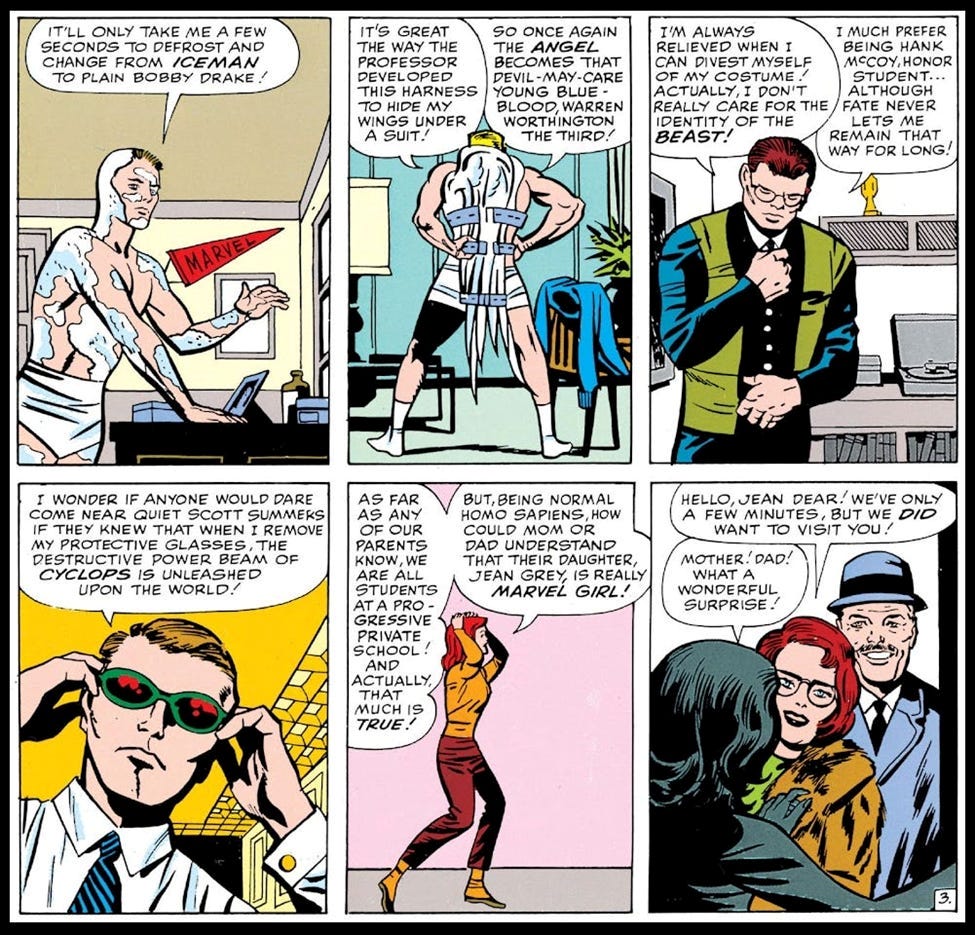
My pet theory regarding the clunky dialogue of early comic books is that writers (and readers) during the 1930s and 1940s were keyed to radio dramas—where characters could do nothing but talk, and where any event that couldn’t be conveyed by a simple sound effect needed somebody describing it out loud. If the first Batman and Superman comics often read like material transcribed from radio shows and set to illustrations, institutional inertia accounts for why this dialogical style persisted into the television age: by that point, it was just how comic books had always been written.
But in the case of the expository monologuing up above: Stan Lee probably figured that new readers would appreciate being brought up to speed about who they were reading about. (I don’t believe there was any market for back-issues at this point.) Later on, Chris Claremont preferred to use epithets and stock phrases for this purpose. The thinking ran: any given issue might be somebody’s first.
At any rate: this is a pretty decent setup for an action-adventure team book, a genre where characters’ superhuman attributes are as dramatically important as their personalities. Scott’s the ranged attacker. Hank is the muscle. Bobby and Jean act as support units. Warren covers their airspace. When necessary, the Professor mops up with his “and now I’ll use my mind-powers to make everyone but us forget what happened!” whammy. Simple. Synergistic. Kirby and Lee already intuited that building an entertaining superhero Fighting Team was like putting together a baseball team, in that its members should each excel at some specialized role.
This principle also extends to the characters’ personalities, where we find a menagerie of stereotyped profiles. Scott is the quiet and serious one, the team leader. Warren plays the arrogant silver-spoon pretty boy. The loquacious Hank is the brains of the outfit. Bobby fills the role of playful, mischievous kid brother. Jean is the girl.7 All of them enact dependable, individualized schticks: Hank bounces around and spouts five-dollar words, Bobby plays pranks, Warren acts hoity-toity and flirts with Jean, Scott is tense and quiet (and in love with Jean), Jean performs femininity (and secretly pines for Scott), and Xavier scolds and bosses everybody around. For a long while, there’s not much more to this bunch than that.
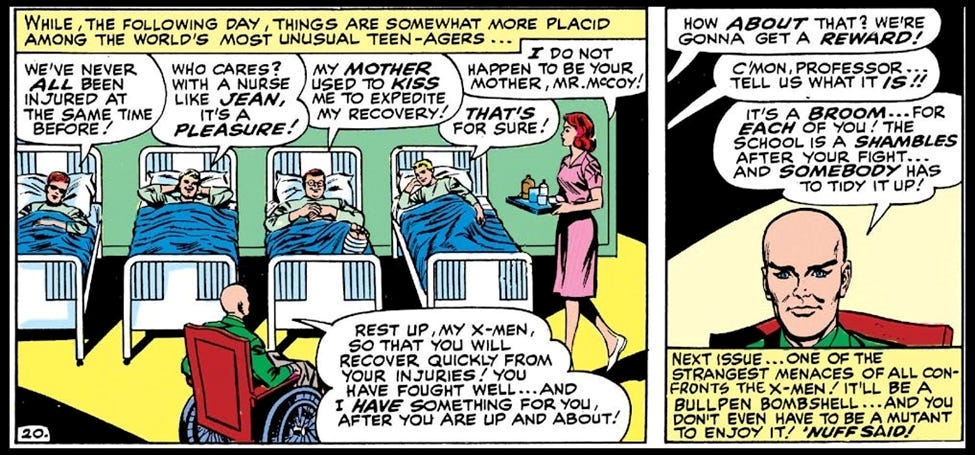
From issue one, the dynamic between Professor Xavier and the X-Men is obvious. He’s their stern but goodhearted headmaster, and despite being in a wheelchair, is way more powerful than any of them. (A clever twist, don’t you think?) The kids are his diligent, obedient students, learning to master their powers and work as The Strangest Fighting Team of All Time.8 While the early issues place a somewhat odd emphasis on showing readers the strenuousness of the X-Men’s training regimen, that was the book’s gimmick: the X-Men are teenagers and students, so it seems to have been important to Lee and/or Kirby that they be seen assiduously participating in superhero school. Usually the Danger Room sequences provide a pretense to have the group showboating, bickering, and performing their character beats, but this stuff is usually less riveting and indispensable than Lee and/or Kirby seemed to believe.
The X-Men “graduate” in issue #7, but it changes nothing about the narrative machinery. The kids stick around, and the Professor still runs them through grueling training sessions, criticizes them, and sends them off on missions.
Out of uniform, the “most unusual teen-agers of all time” aren’t very unusual at all—not on the face of it, anyway. Given their cover story of being prep school students, it makes sense that the X-Men dress the part when they’re out and about, but it seems to come rather naturally to them. Should we be surprised that a comic book promising strange teens during the rise of adolescent subcultures features a cast that wears respectable-looking suits and ties (dresses in Jean’s case) when they’re not in their X-Garb?
Alienated social outcasts, these X-Men definitely ain’t. We learn early on that Jean and Warren’s parents are totally unaware that their kids have extranormal capacities, so there’s that—and we know that Hank ruffled some feathers in his hometown before being brought to Westchester—but there’s no palpable angst about any of this. Befitting the vibe of the Silver Age, this is a rather jolly and well-adjusted bunch.
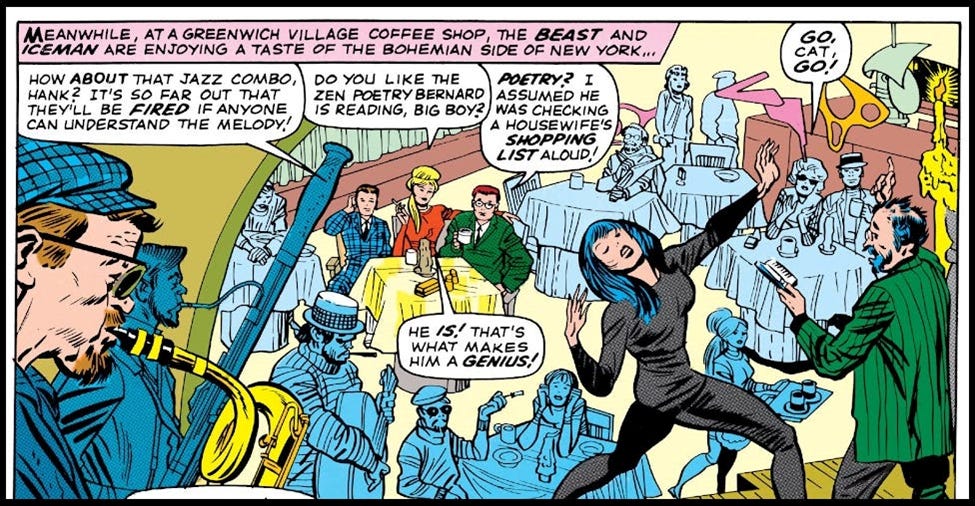
During Lee’s run as X-Men’s credited writer, Hank and Bobby pay a couple of visits to Manhattan’s Coffee A Go-Go and take in the vibes. Neither of them is particularly impressed, and the comic cracks a few jokes at the freaky beatniks’ expense.9 For all their supposed strangeness, the X-Men are written as middle-of-the-road American normies who so happen to have superpowers (which they’re obliged to conceal when they’re not wearing their uniforms and masks). It’s probably too early in the game to talk about the Mutant Metaphor, but the earliest iteration of the X-Men are thoroughgoing assimilationists. We might even say they’re closeted, whereas Magneto and his Brotherhood of Evil Mutants are more like out-and-proud queer nationalists.
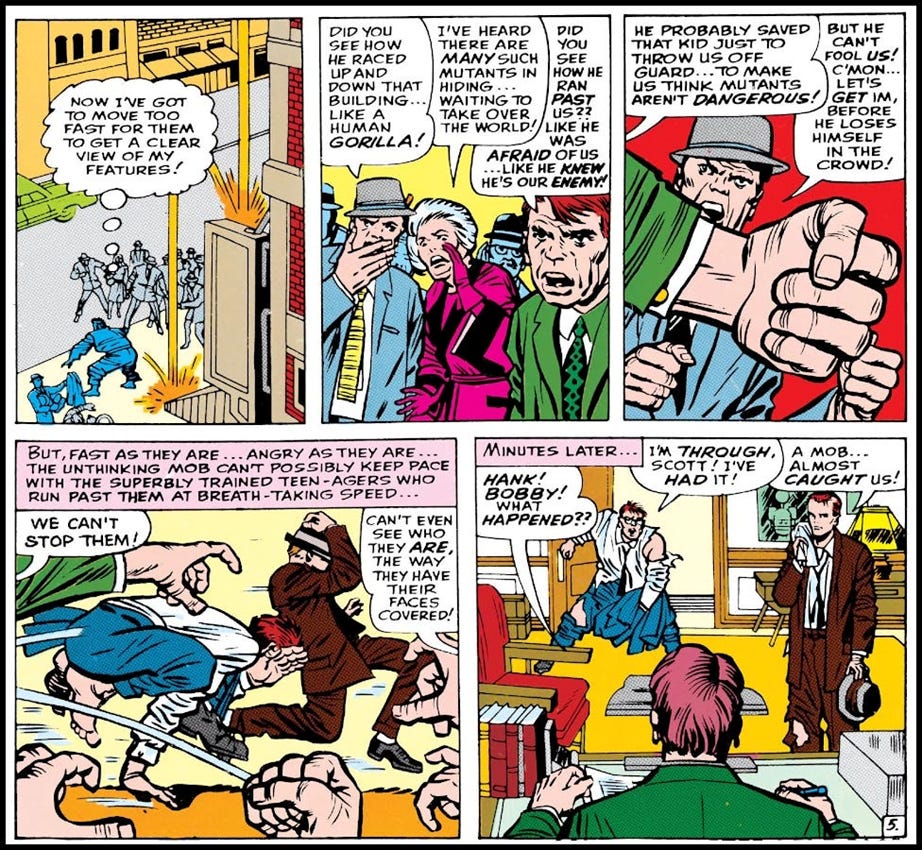
In the early 1960s, the Mutant Metaphor—writing the X-Men (and other mutant characters) as symbolizing marginalized members of American society—was vague and half-baked. I’m tempted to say the Metaphor wasn’t just undeveloped, but not even there yet. The way angry mobs behave towards mutants in the book’s first couple of years is more analogous to scenes of fearful but frenzied villagers going after Frankenstein’s monster or a “known” witch than to hate crimes motivated by racism, homophobia, antisemitism, etc.10 This stands in contrast to what comes later on, where phobic Homo sapiens are seen to abhor mutants not only for the potential threat they pose to public safety, but for being someways unclean.
Over the course of the original sixties run, we do see things beginning to inch in this direction. By 1968, Iceman’s origin tale in the B-stories of issues #44–46 (written by Gary Friedrich) has a crazed Nassau County mob trying to lynch him after he encases a belligerent meathead in a block of ice out of self-defense. When the sheriff attempts to intervene on behalf of due process, a member of the mob calls him a “mutant-lover.” If you’ve read To Kill a Mockingbird, you know what this is supposed to sound like.
But as far as Kirby and Lee are concerned, I’m not sure how hard they were thinking about the Metaphor. No Civil Rights rhetoric steals onto the pages of their X-Men, and it’s not unlikely that Lee preferred to avoid courting controversy while Marvel was still taking off. I’d like to think the political parallels were on Kirby’s mind, given his liberal sensibilities, but aspiring to success in the field of pre-internet mass entertainment required playing things safe. Chris Claremont’s Uncanny X-Men didn’t allegorically inveigh against South African apartheid until mainstream opinion had already condemned it. By the time Joss Whedon’s “mutant cure” storyline parabolized gay conversion therapy in the pages of Astonishing X-Men, the Gay Rights movement had already gained formidable traction. Typically, superhero books take stances only when it’s safe for them to do so. Revisiting the mainline superhero rags of a given half-decade is to glance into that period’s Overton window.
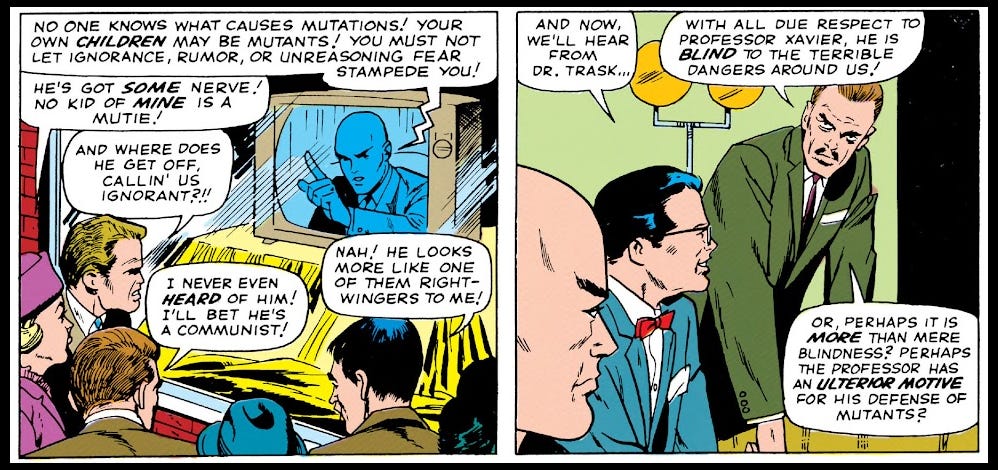
Here is how early X-Men views mutants: there’s a vanishingly tiny population of people born with superpowers, probably because their parents were exposed to atomic radiation. Some of these people are good, some of them bad. The public pays more attention to the ones who rob banks, attempt to steal nuclear weapons and state secrets, overthrow the governments of small Latin American nations, and/or declare their intention to enslave humanity—all to the detriment and frustration of the good ones. At first, it wasn’t much more complicated than that.
And the bad mutants are just bad. This clip from an episode of the late 1970s Fantastic Four cartoon (written by Stan Lee) featuring Magneto as the villain of the week epitomizes what the character was about in the 1960s. Initially, Magneto was nothing more than a mean, ridiculous asshole with magnetic powers and a colossally high opinion of himself. His rhetoric about persecution (Homo sapiens will never accept us, they will always hate and seek to destroy us, you’re only safe with me!) is meant to be read as from the cult leader playbook for ensuring the loyalty of subordinates who might otherwise head for the exit. Early X-Men comics have no moral gray areas, and little sympathy for their villains.
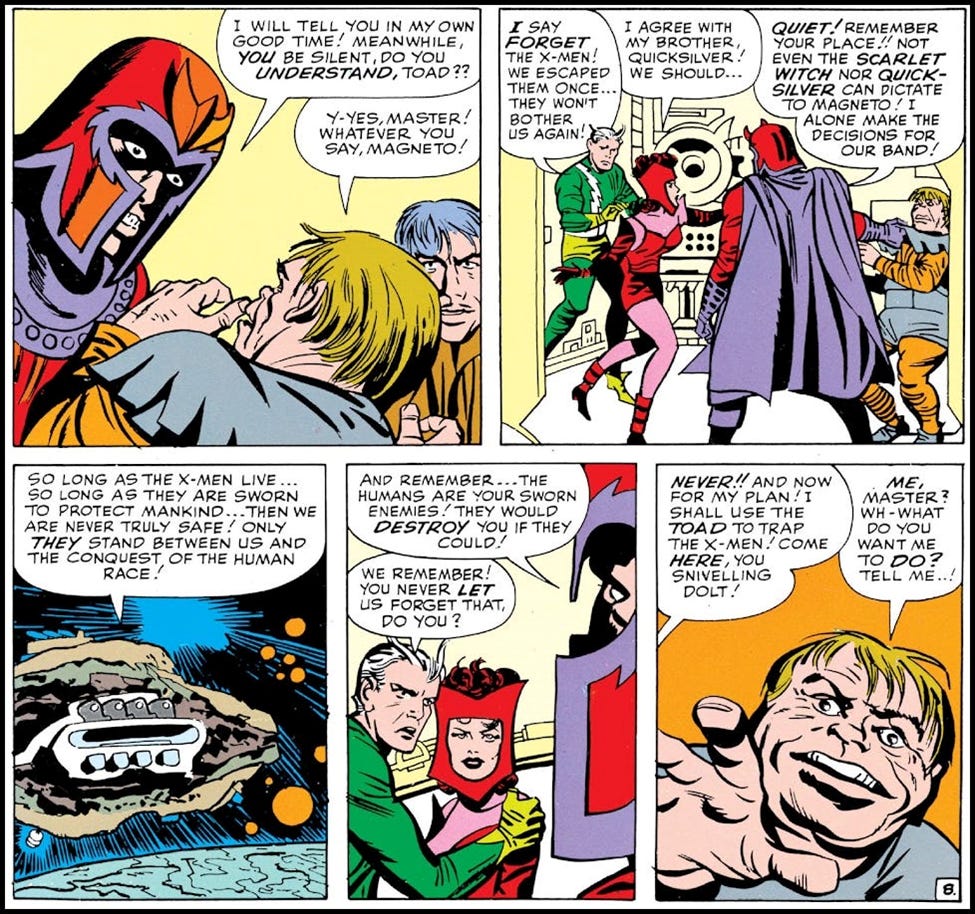
This brings us to the most obvious of the problems that dogged the X-Men’s first sally: the villains sucked.
This doesn’t apply to the malefactors introduced when Kirby and Lee (but yeah, mostly Kirby) were writing the book. Characters like Magneto and his Brotherhood of Evil Mutants, Juggernaut, the Sentinels, and even the Vanisher made enough of an impression on readers to appear and reappear and reappear and reappear over the decades. Kirby and Lee had a couple of misfires—Lucifer in particular was pretty embarrassing—but there’s a reason why so many of the X-Men’s earliest antagonists continued to be featured in their comics (and sometimes in other Marvel titles) for decades after their first appearances. They worked. Readers liked them. Magneto’s power set and his penchant for histrionics made him a dynamic and dramatic antagonist. The Blob was a could-have-been X-Man made unfit by moral defects, while the Scarlet Witch and Quicksilver were “noble” adversaries who reluctantly served an evil master out of obligation. Juggernaut, Xavier’s wicked stepbrother, possessed monstrous physical strength in contrast to the Professor’s mental powers. The Sentinels and Master Mold were a space-age allegory for rightist purity spirals: created to hunt down mutants, the battle robots quickly decide that the best way to protect humanity is to enslave it. There’s an appealing, elemental simplicity to these baddies.
Once Kirby moves on from the book, new additions to its rogue’s gallery become entirely forgettable. Most are either ludicrously gimmicky Silver Age supervillains who make the Monarch from The Venture Brothers seem subtle by comparison, or tepid imitations of the monstrous alien baddies Kirby invented and was capable of making memorable. You will never hear a comic book nerd complain that “Grotesk the Sub-Human” had untapped potential and ought to have staged a comeback.
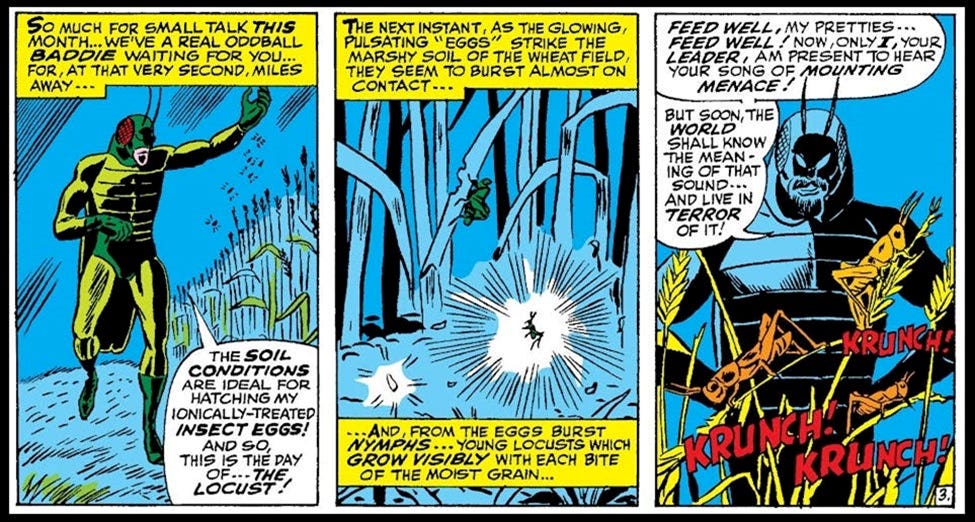
But yes, let’s talk about what happened after Kirby and Lee left X-Men.
Kirby stopped drawing the book after issue #11, but was still credited with “layouts” up to issue #17. The term minimizes what he was actually doing: plotting and storyboarding, setting things up for another penciler to follow through with. He continued to do character design, too: even though Werner Roth (under the pseudonym Jay Gavin) penciled X-Men #14, where the Sentinels make their first appearance, the robots’ aesthetic screams Kirby.
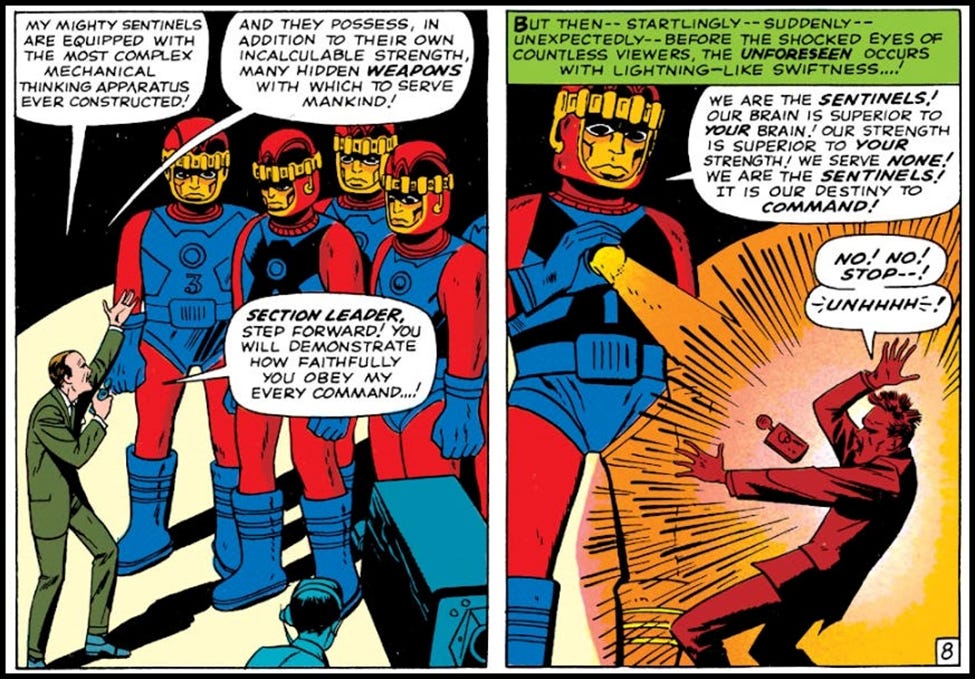
In issue #20, writer Roy Thomas replaced Lee and joined Werner Roth to form X-Men’s new regular creative team. With Kirby no longer ghostwriting the book via page layouts, the training wheels came off. Both Thomas and Roth were basically competent at their jobs—and that’s the best that can be said about them as far as their work on X-Men is concerned. It’s not terrible, but it isn’t much to get excited about. Reading it for long stretches grows tedious.
I am sympathetic to Roy Thomas. He was one of Marvel’s first notable writers whose surname wasn’t Kirby or Lee. He had runs on a lot of titles you’ve definitely heard of before and created characters whose names you probably recognize: Carol Danvers (lately Captain Marvel), Ultron, Ghost Rider, Red Sonja, Vision, Luke Cage, etc. While I don’t have a lot of soaring praise for most of his work on X-Men, he’s entitled to credit for providing the basic template of what came later, guiding the book from a mostly episodic villain-of-the-month affair towards its more familiar superhero soap opera format. He ramps up the Cyclops angst. He yoinks the Danger Room training sequences in favor of having the X-Men going out and about and doing normie stuff between missions. He mixes things up by having Jean’s parents pull her from Xavier’s to send her off to college. He even gives the series its first long-term story arc as the gang attempts to foil the designs of a shadowy organization called Factor Three.11
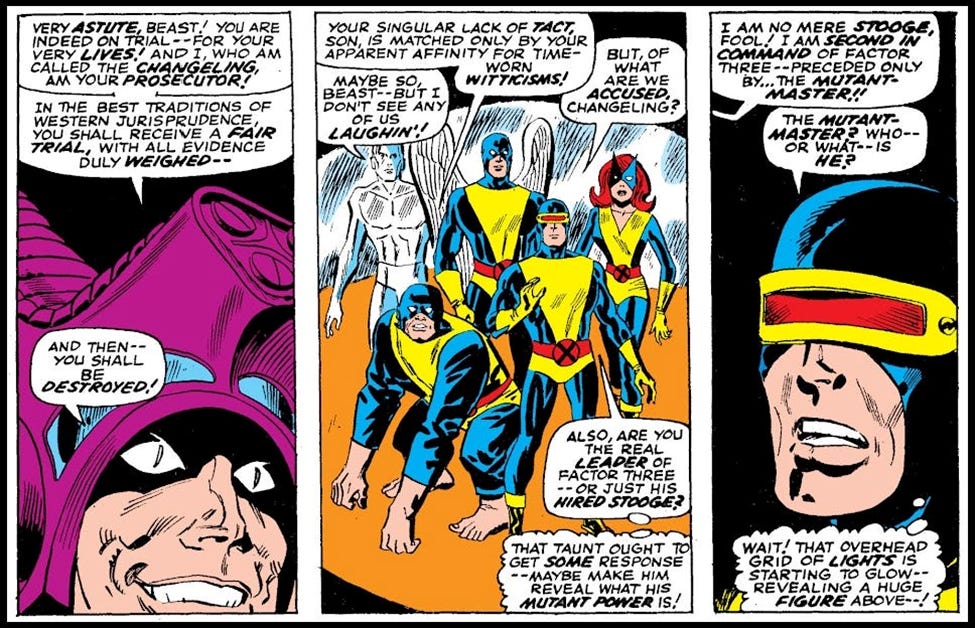
Of course, most X-Men fans over the decades never heard of Factor Three, or of its leader, the mysterious Mutant Master. Characters and concepts that thrilled nobody to begin with tend not to get revisited later on.
Things might have gone better if Stan Lee hadn’t kept Thomas on so short a leash. In a 1982 interview, Thomas recounted that Lee was conservative and skittish regarding proposals to change the book’s essential formula. The X-Men were Cyclops, Angel, Beast, Iceman, and Marvel Girl, and regular cast members were not to be added or substracted. A temporary team-up with the Mimic and the introduction of Banshee as a foe who becomes a sporadic ally read like wish-fulfillment exercises on Thomas’ part: he wanted a rotating cast, but couldn’t get around Lee’s editorial veto power.12 He also wanted the team put in individualized costumes, and did get his wish—after bugging and arguing with Lee about it for the better part of two years.
I have even more sympathy for Werner Roth. As an artist, he’s—well, he’s fine. He needed a paycheck and Marvel needed illustrators, so they were stuck with each other. Clearly he had been instructed to imitate Kirby’s style, and did so to the best of his ability—but it wasn’t his forte. Compared to Kirby’s crisp, kinetic action scenes, Roth’s appear rather stiff and static.
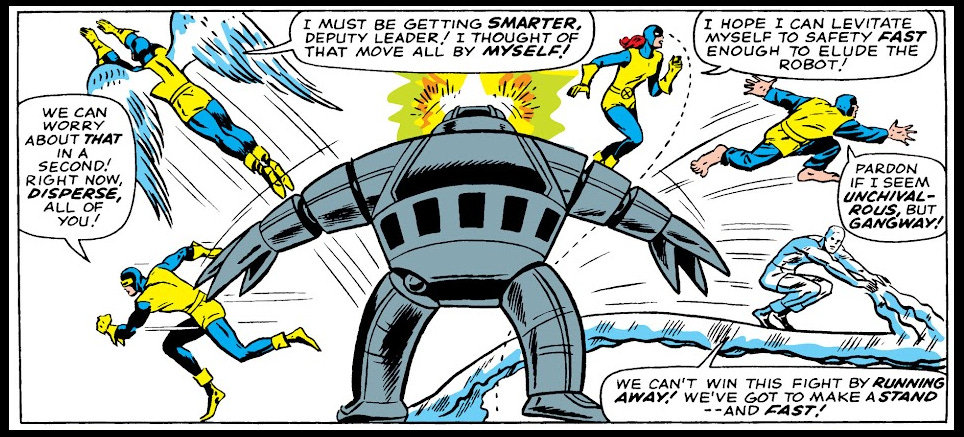
Roy Thomas said as much in that 1982 interview, coming just short of casting aspersions on his late partner by way of euphemism:
Well, Werner was a very nice man . . .
[W]e had a very nice relationship and Werner was a very good artist. The only problem was that he was a little like someone like Jose Delbo on Wonder Woman now; he was just a very quiet artist. He could draw very well, but he was just not going to excite anyone.
What he means is that Roth wasn’t the kind of artist you’d want drawing a superhero comic. His portfolio up until that point had been full of westerns and romance comics, and it was probably a bad idea to put him on a job that requiring an art style more dynamic than what was suitable for, say, Lorna the Jungle Girl and Superman’s Girl Friend, Lois Lane (both of which were on his CV). The scenes where Scott and Jean pine for each other inside of their thought bubbles have a disproportionate weight because quiet moments like these play to Roth’s strengths as an illustrator.
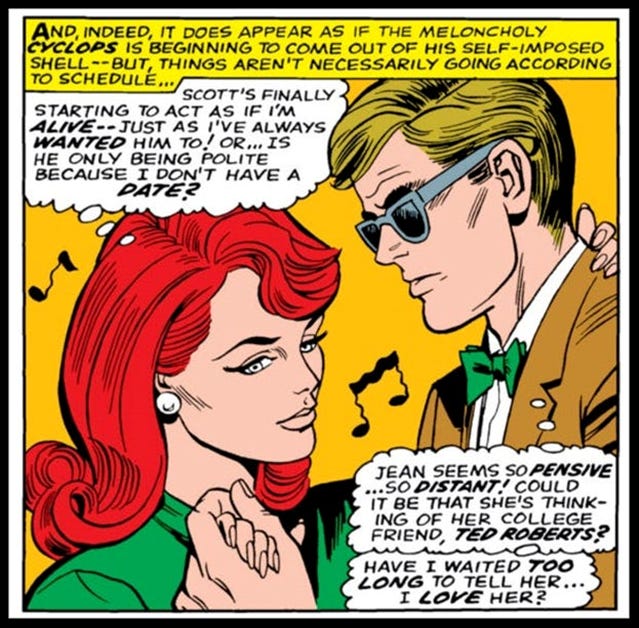
But X-Men increasingly needed to be loud and exciting to justify its slot in Marvel’s parsimonious release schedule, and Roth’s pencils weren’t doing much for it in that regard. It didn’t help that Thomas was also writing Avengers, and I wouldn’t be at all surprised if he was saving his better ideas for the book people actually cared about.
Thomas stepped away for a year after issue #44, and was replaced by writers Gary Friedrich (who would later co-create Ghost Rider) and Arnold Drake (who would later come up with the Guardians of the Galaxy). The pencillers revolved for a while. The book didn’t get much better. For most of its original run, X-Men is a middling Silver Age hero monthly that doesn’t seem to know what it’s doing—or what it wants to be doing. As the pressure upon the book mounts, you see ideas and gimmicks bandied about, one after another:
Hey, let’s dress them up in new costumes to give the book some visual flair and variety. Maybe that’ll help? (We’ll tell Stan it was his idea.)13
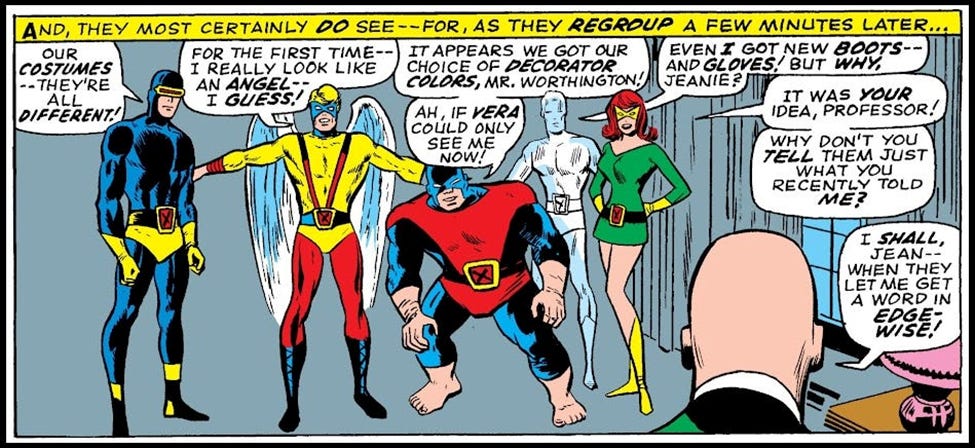
Hey, let’s split each issue between the ongoing A-story and multi-chapter B-stories about the origins of each cast member.
Hey, let’s have Professor Xavier fake his death and leave the X-Men to operate without him.
Hey, let’s have the FBI split the team up for a while.
Hey, let’s do a “cross-over” with a more popular series—say, Avengers—where readers have to buy two issues of each book to read the entire four-chapter story.
Hey, let’s do a cover gimmick where we have individual cast members headline specific issues, so we can see who’s the most popular and then calibrate upcoming stories in terms of who or what actually seems to be selling.
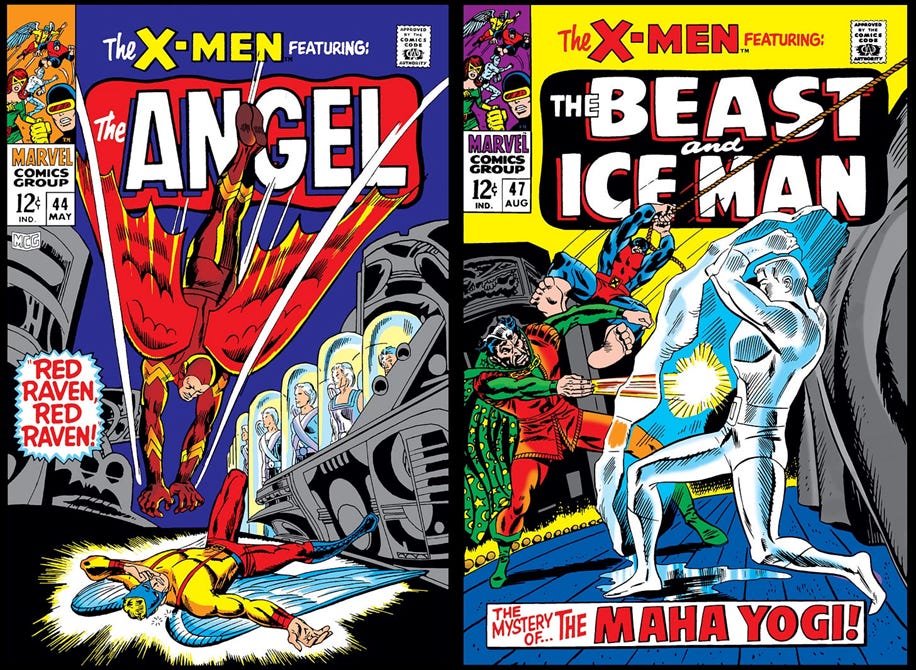
I began to wonder if I was judging early X-Men too harshly—if maybe I was bringing unreasonable expectations to a Silver Age superhero comic. So I went and sifted through some 1967–68 issues of Fantastic Four (which at that point were still a Kirby/Lee product) to get a sense of what was happening over in one of the more popular Marvel books. The difference was astonishing. First-decade Fantastic Four is so much more charming and fun than first-decade X-Men. If 1960s comic connoisseurs regarded X-Men as a dreary Fantastic Four clone that couldn’t quite carry it off, they had excellent reason.
It’s telling that when Kirby has Mister Fantastic & co. fighting the short-lived villain (and Kalibak template) Blastaar in Fantastic Four #63, the energetic spectacle of it is actually kind of exciting. When Blastaar appears again in X-Men #53, it’s . . . meh. Something doesn’t click. Granted, this is one of the lousiest individual issues of the entire lot—but still.
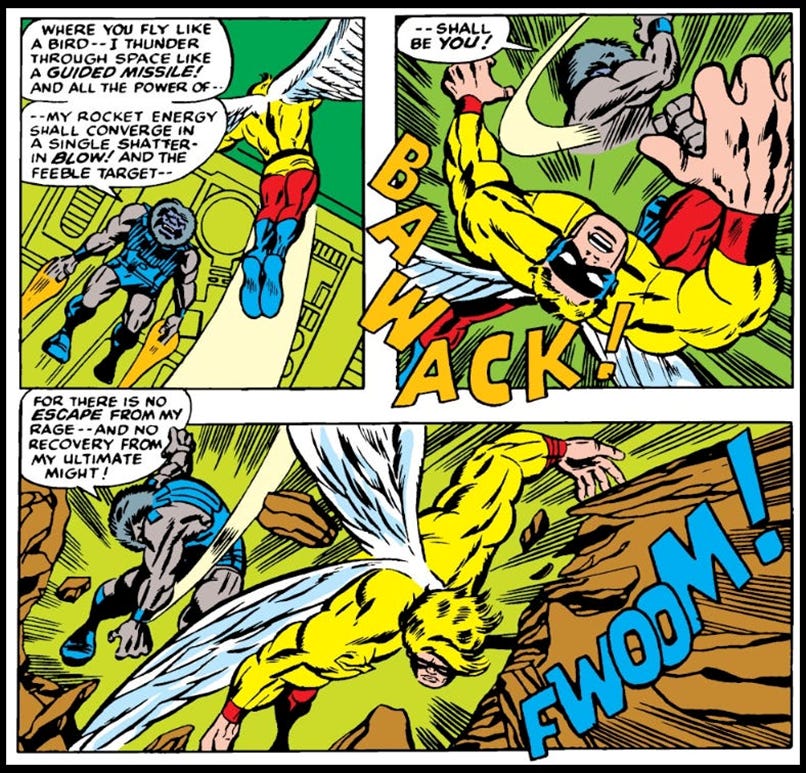
Going back and reading early X-Men comics can be a puzzling experience if you’re already familiar with them. You know the characters and the premise, and you know how it’s all supposed to come together and work—but it just doesn’t. To borrow some prose from William Faulkner’s Absalom, Abasalom! (yes, let’s use high literature to talk about low literature), it’s like watching for a chemical reaction that fails to occur:
There they are, yet something is missing; they are like a chemical formula exhumed along with letters from that forgotten chest . . . familiar in shape and sense, the name and presence of volatile and sentient forces; you bring them together in the proportions called for, but nothing happens; you re-read, tedious and intent, poring, making sure that you have forgotten nothing, made no miscalculations; you bring them together again and again nothing happens . . .
Perhaps the problem was there from the beginning, but it becomes increasingly pronounced after Kirby and Lee move on. X-Men is, at best, equal to the sum of its parts. It falters at coalescing into something more, and is unable to reproduce what seems so simple and obvious in the Fantastic Four recipe.
One Chris Sims maintains that what beleaguered X-Men was precisely its inability to conscientiously replicate Marvel’s earlier successes:
[T]he problem is that it was really [Kirby and Lee’s] first attempt at building on what they’d already done. It’s a refinement rather than an innovation, pieced together from bits and pieces that worked in their other hits. The problem is that those other hits were themselves still being refined as an ongoing process, and they were way more interesting, which made X-Men redundant.
It had the hook of ostracized and isolated teens, but that was done way better in Spider-Man, the book that laid the foundation of the modern superhero. The team bickered while showing off their super-powers and had Angel and Cyclops competing for Marvel Girl’s affections, but that was nowhere near as good as the strained family relationship in Fantastic Four. They were outsiders in a world that didn’t understand if they were heroes or villains, but, you know, that’s the Hulk’s entire deal. X-Men was the first comic that tried to mash all that up -- it’s the first real product of the Marvel Age -- but it didn’t do anything better.
The eternal question of the curious would-be reader of superhero comics is: “what’s a good entry point?” With the X-Men, the beginning is one of the worst places to start.
The book does, however, go out with a bang when Roy Thomas reprises his authorial role in issue #56 and is joined by a newcomer: a young freelance artist named Neal Adams.
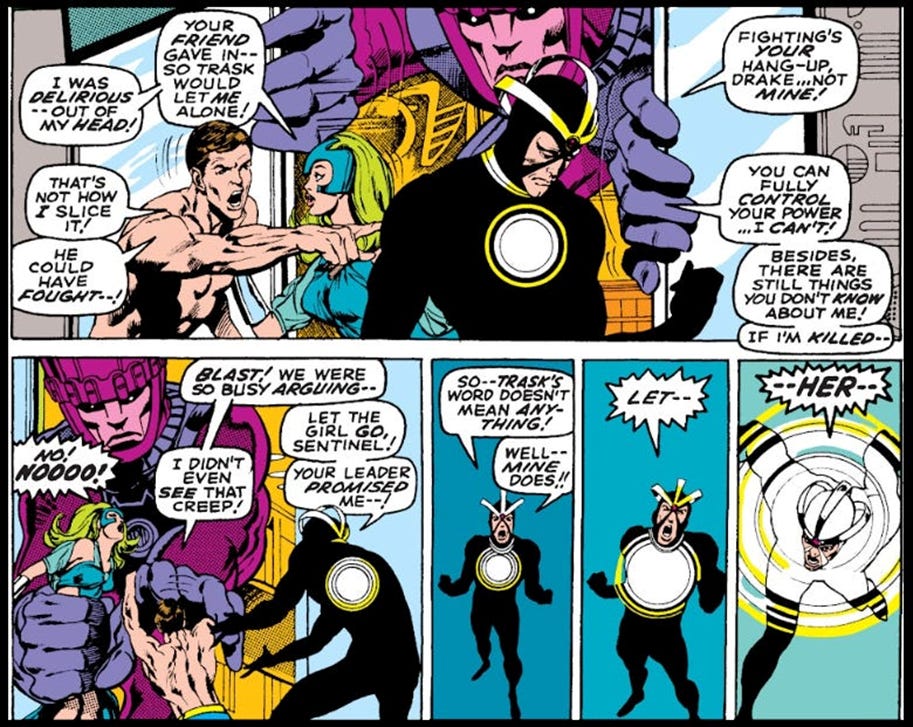
Austin Gorton provides an except of Adams recounting his involvement with X-Men:
[Stan Lee] just said, “What do you want to do?” I said, “Well, what’s your worst-selling title?” and he says, “X-Men. We’re going to cancel in two issues.” “Right,” I said, “I’d like to do X-Men.” When Stan asks me why, I say, “Because if you’re going to cancel it in two issues, you’re probably not going to pay much attention to it and I can pretty much do what I want.” “Fine,” he says, “you do X-Men, but after we cancel it, you have to an important book like Avengers.”
I’m quoting from a quotation here; go look at Gorton’s take on how Adams not only saved the X-Men from oblivion, but changed the whole complexion of American comic books. Like The Simpsons’ effect on TV sitcoms, Adams’ influence on comics is so far-reaching and profound that a naïve viewer is unlikely to see anything special about him at a glance because he’s doing nothing they haven’t already seen before—and they’ve already seen it before because he set a new industry standard.
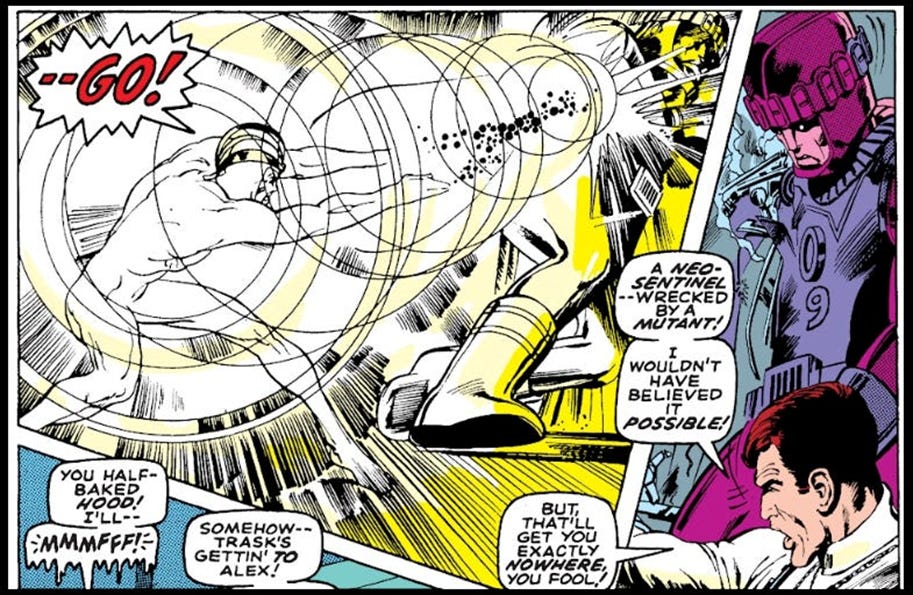
The Thomas/Adams collaboration is actually pretty darned good. Whether it’s because Adams was more exciting to work with than Roth and galvanized Thomas’ imagination, or because Adams’ pencil work and grid-breaking layouts are just that much of an improvement, the overall quality of the book improves by an order of magnitude during its final year. We finally begin seeing some of the previously untapped potential in the premise, the characters, the dynamics. Thomas even gets to have Polaris and Havok (introduced during Arnold Drake’s authorial stint) stick around as unofficial team members. Issue #56 is where X-Men finally starts to feel like—well, like an X-Men comic. It was enough to keep the book going for another ten issues instead of two, and Adams drew eight of them.
In issue #57, Werner Roth draws the series’ last B-story: a day-in-the-life vignette narrated by Jean. It’s a lot of fluff, and I suspect writer Linda Fitte wrote the scenes about telekinesis helping with cooking and housework through grit teeth—but it’s quaintly charming (provided you can get past all the trad femininity), and it allows Roth to bow out of X-Men doing the kind of illustration work he’s actually good at.
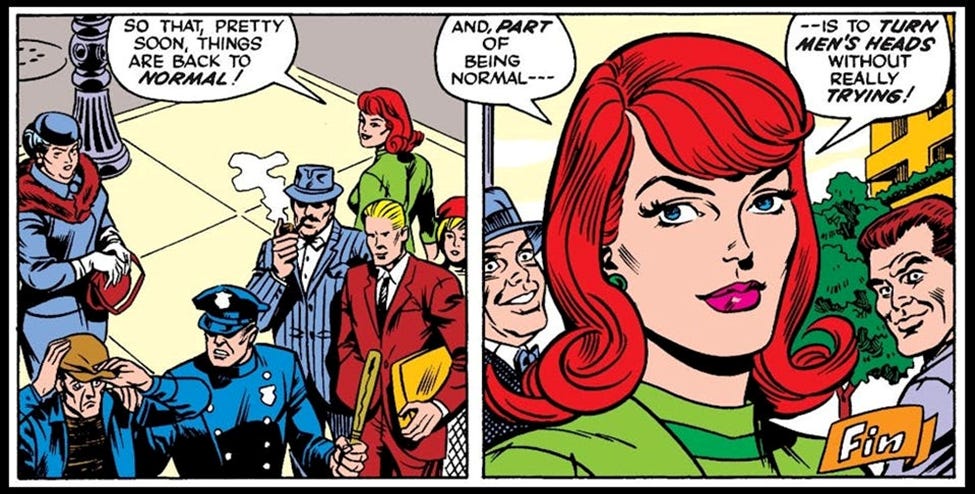
X-Men was canned after #66. New numbered issues continued to appear on newsstands and magazine racks, but were reprints of earlier ones. The X-Men seem to have been popular enough to keep in circulation—Adams’ time drawing their book definitely had something to do with that—but not popular enough to warrant paying a creative team for new material. So it goes.
There’s one last thing worth noting. During their 1963–1970 run, the X-Men noticeably aged. They “graduated” in issue #7. Jean goes to college. Scott briefly gets a job at a radio station. At one point, blink and you’ll miss it, he mentions going to a bar and getting a drink. But during the last several issues, a tagline starts to appear on the front cover, above the title logo: THE STRANGEST TEENS OF ALL! It’s like the fifth season of a high school sitcom trying to pretend that its actors haven’t already passed their twentieth birthdays.
I’d like to briefly turn our attention to an obsessive oldhead superfan named Chris Tolworthy, who has written a lot of online Marvel criticism over the years. In one screed, he observes that 1968 marked the end of “real time” and the inauguration of staggered “Marvel Time” in the company’s in-universe narrative:
On 8th November 2010 on his Formspring account, [Marvel editor] Tom Brevoort stated unequivocally that Franklin is 8 years old and it is 13 years since Fantastic Four number 1. In other words, 5 years passed between FF1 (published late 1961) and Annual 6 (published early 1968), when in real time, 6 1/2 years had passed.. However, the art and other evidence suggests that Franklin may be around 6, indicating that 7 of the 13 Marvel years took place between 1961 and 1968. A couple of years later Brevoort approached the question in a different way, stating it even more clearly:
“In the earliest days, Stan didn’t have any use for anything beyond the broadest version of continuity. And it’s no wonder—he didn’t think these new characters would last for five years when he started, let alone fifty. So he had the characters aging more or less in real time, and it was only after seven or eight years that he started to realize that he needed to slow things down in order to allow for greater longevity” (source)
A close examination of the stories confirms that. Until 1968 at least, Marvel comics took place in real time.
1968, Tolworthy claims, was also “The Year Marvel Sold Out”—and the start of Marvel Time was a component of this. He quotes Sean Howe’s Marvel Comics: The Untold Story:
For the last year or two, Lee had conveyed to his writers that Marvel's stories should have only 'the illusion of change,' that the characters should never evolve too much, lest their portrayals conflict with what licensees had planned for other media.
The implications:
Merchandising began to grow in 1966 and 1967, and by 1968 Marvel could see its attraction: licensing deals are one hundred percent guaranteed no-risk profit! Today [20XX?] Marvel is almost entirely a brand management company with only a small percentage of its money coming from comics. The comics exist to serve the brands, and so character development - the basis of a realistic story - is against Marvel's short and medium term financial interests. . . .
Note that Marvel Time is designed to let writers write the same kind of stories with the same characters again and again. This only works if you don't pay much attention to the last time a character did the same thing.
Food for thought—but we’re getting way ahead of things here.
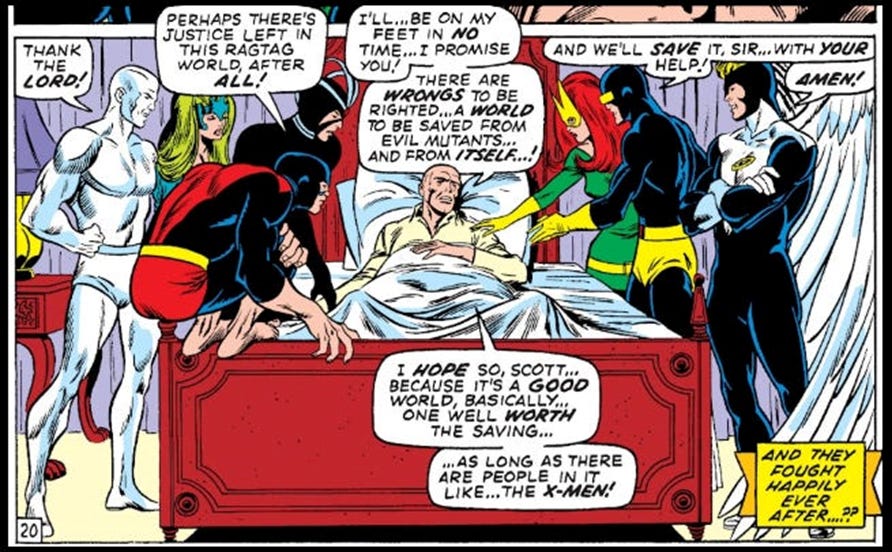
That was X-Men, then. I suppose there’s nothing left to do but to glance at the yearbook.
VALEDICTORIAN: Cyclops. I mean, come on.
NON-CYCLOPS VALEDICTORIAN: Beast, on the basis that he was the only X-Man who did much of anything between the first run’s cancellation in 1970 and its revival in 1975.
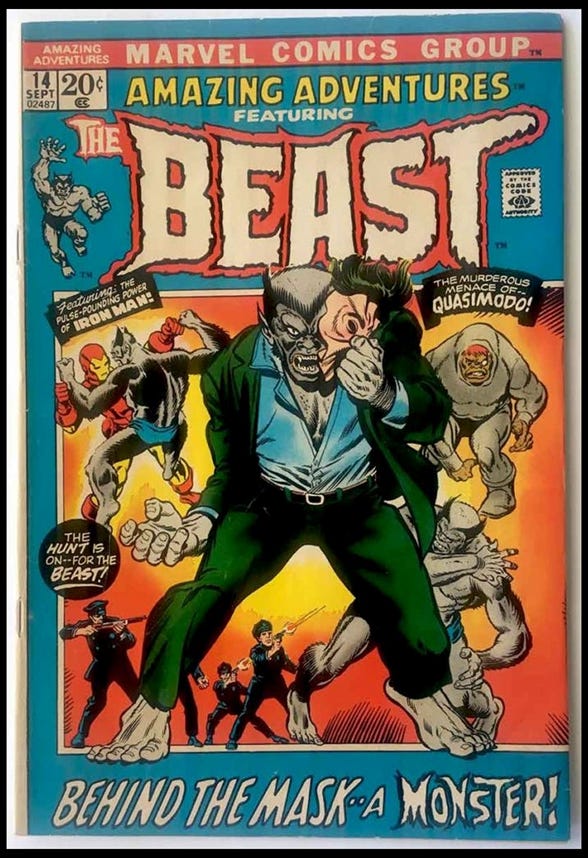
(See note below about a short-lived flowering of horror comics in the 1970s.)
DROPOUT: N/A. They’re the original five X-Men.
MALEDICTORIAN: Magneto. I mean, come on.
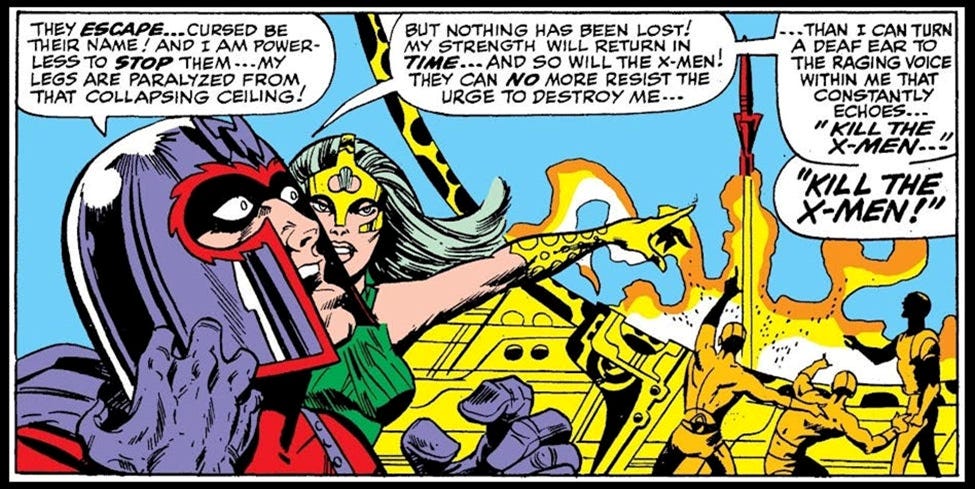
Prevailing opinion holds that Magneto owes his status as a true classic to what came later: his tragic origins and his perception of himself as the revolutionary leader of an oppressed people taking extreme but necessary measures to secure their safety. But it’s fun to look back to a time when his defining traits as a character were “a little extra” and “crazypants.”
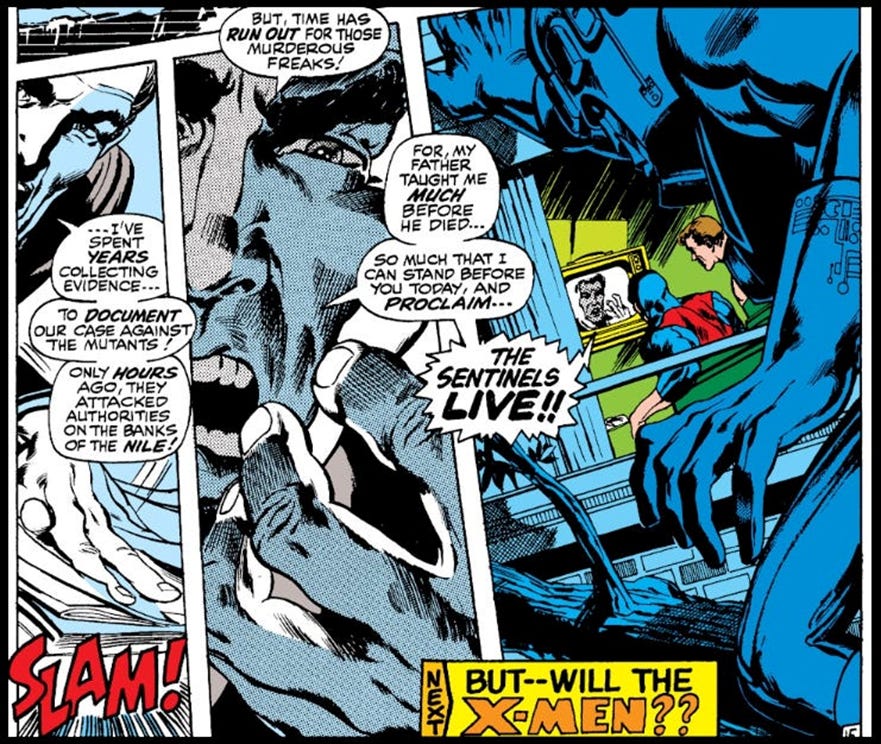
NON-MAGNETO MALEDICTORIANS: The Sentinels. Sometimes concepts take on a life and logic of their own as comic book serials are passed between creative teams over the decades. Ever since debuting as the result of a “oh hey why don’t we have our heroes fight uppity robots for the next three issues?” brainstorm, the Sentinels have time and time again proved themselves the X-Men’s deadliest threat, whether they’re being employed as someone else’s mindless weapons or achieving sentience and doing genocide for themselves.
BEST STORYLINE: I’ve got to give it to X-Men versus the Sentinels, round two. Neal Adams, man.
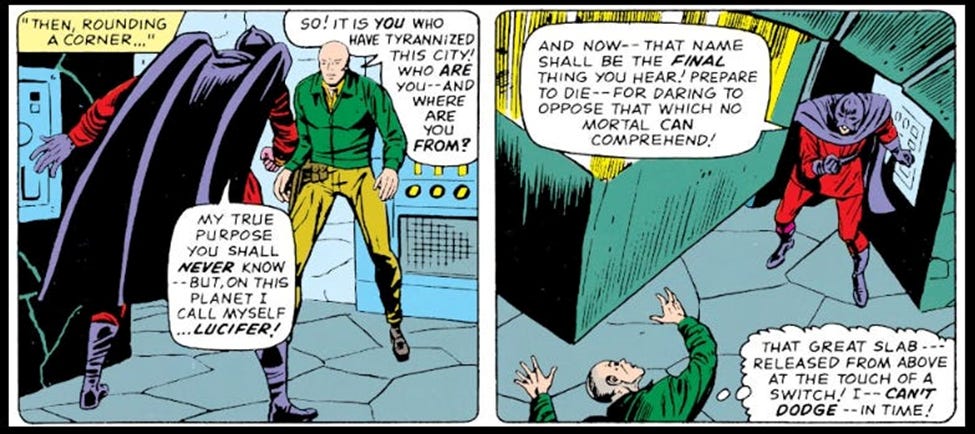
WORST STORYLINE: I’d have to think about it—and I don’t want to. So much of early X-Men simply fails to leave an impression, and the bad stuff isn’t even awful enough to be memorable. Let’s just give it to everything involving the villain Lucifer. If fans in later decades were usually unclear as to how Professor Xavier ended up in a wheelchair, it was because the writers and editors didn’t want to remind anyone that a chonky neckbeard in a homemade Magneto costume did it.
THE 1970s
Ah, the 1970s—the dawn of the Bronze Age of Comics Books. In this decade:
Everyone wanted to draw like Neal Adams.
The Joker gave up his “Clown Prince of Crime” schtick for good and reverted to his 1940s psycho-killer persona.
Batman and Green Lantern teamed up and argued about politics in The Brave and the Bold.
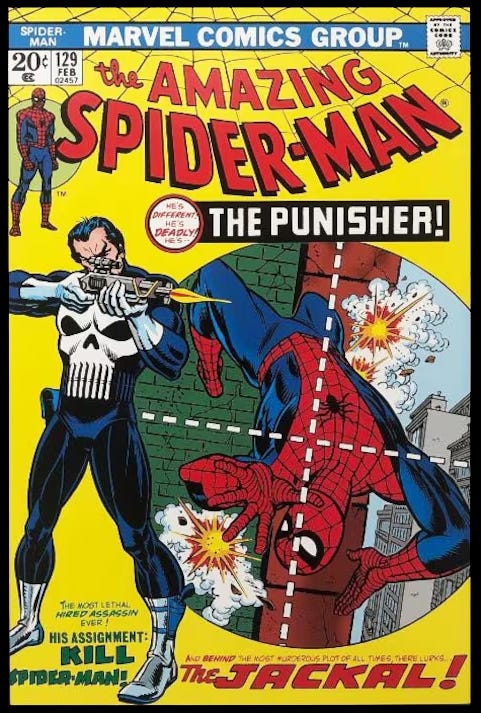
The Punisher debuted as a villain-of-the-month in The Amazing Spider-Man, confronting Spidey as an ex-Marine bent on exterminating New York’s criminal element. It is implied that he was discharged from fighting in Vietnam.
Later, in the pages of Marvel Team-Up, Spider-Man fought the Silver Samurai on the set of Saturday Night Live to rescue John Belushi.
Jack Kirby left Marvel for DC, and then came back to Marvel. Everyone screwed him over wherever he went.
Superheroes diversified. Green Lantern John Stewart, Luke Cage, Misty Knight, Black Lightning, et al. brought some much-needed color (lame joke) into comic books.
The Comics Code Authority relaxed certain of its restrictions to permit cautionary tales about urban crime and drug abuse. It also changed its rules to allow the depiction of vampires, ghouls, werewolves, etc. in comic books (provided they were “handled in the classic tradition such as Frankenstein, Dracula, and other high calibre literary works”), resulting in a brief horror comic renaissance.
In brief: the post-Silver Age re-grittification of comic books began here.
We won’t dwell on this decade for long because we’re looking at X-Men teen-team books, and there aren’t any of them here to contextualize. But 1975 saw the release of the Giant-Size X-Men one-shot, written by Len Wein and penciled by Dave Cockrum. It introduces an All-New, All-Different squad of international X-Men and sends them to the living island of Krakoa to rescue the original team.
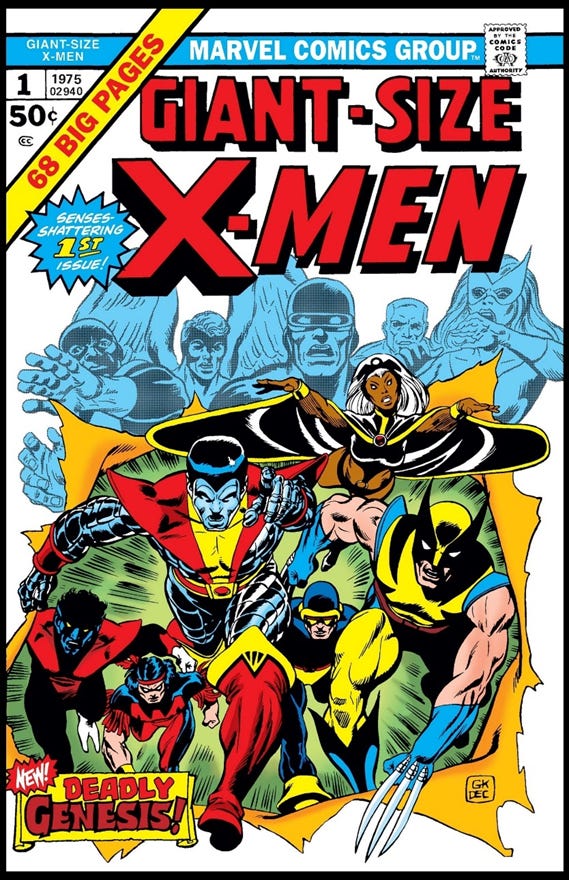
The “Strangest Teens of All Time!” conceit that nominally defined the X-Men finally gets ash-canned. Maybe a couple members of the new crew are in their very late teens, but most appear to be in their early twenties.14 Banshee (allowed to be an official team member at last) is clearly over thirty, and Wolverine already seems like he’s been around the block a few times.
Two months after Giant-Size X-Men hit the newsstands and magazine racks, the X-Men serial came out of reruns and resumed telling new stories with issue #94. Cockrum remained on pencils, and a young writer named Chris Claremont got in the author’s seat. Let’s see what he brings to the table!
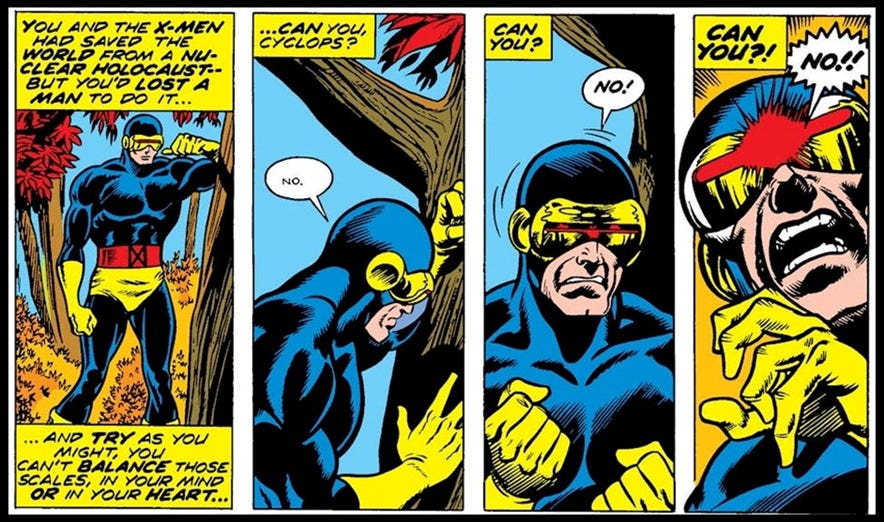
Well…okay. Okay, but it does get better. Like, legendarily better. You can read about that elsewhere, though.
NEXT: The Chris & Louise Variety Hour
More than the books’ content, their advertisements tell the story of who their main audience was. All those mail-order joke kits and “be a muscleman like me” products weren’t aimed at female readers.
For comparison’s sake: the single best-selling American comic book of 2024—the first issue of Absolute Batman—sold something like 400,000 copies.
A few characters you have heard of disappeared from newsstands, too. The original Flash and Green Lantern were put out to pasture in 1951. (Not permanently, of course.) Captain America, bereft of Nazis to fight, was reworked as the protagonist of a horror comic—which went so well that his book was cancelled in 1950. A 1954 relaunch with a “Captain America, Commie Smasher” rebrand was discontinued after three issues.
Some (but not all) items from the Code:
Crimes shall never be presented in such a way as to create sympathy for the criminal, to promote distrust of the forces of law and justice, or to inspire others with a desire to imitate criminals.
Scenes of excessive violence shall be prohibited. Scenes of brutal torture, excessive and unnecessary knife and gunplay, physical agony, the gory and gruesome crime shall be eliminated.
Criminals shall not be presented so as to be rendered glamorous or to occupy a position which creates a desire for emulation.
Policemen, judges, government officials, and respected institutions shall never be presented in such a way as to create disrespect for established authority.
In every instance good shall triumph over evil and the criminal punished for his misdeeds.
Females shall be drawn realistically without exaggeration of any physical qualities.
Suggestive and salacious illustration or suggestive posture is unacceptable.
Sex perversion or any inference to same is strictly forbidden.
All scenes of horror, excessive bloodshed, gory or gruesome crimes, depravity, lust, sadism, masochism shall not be permitted.
No comic magazine shall use the words “horror” or “terror” in its title.
Professor X suggests that his own X-gene is the result of his parents’ living near a secret nuclear testing site. The chronology doesn’t make much sense: unless there were undocumented tests prior to 1945, Chuck would have been the only American soldier under the age of ten who served in the Korean War. But the point is that the X-Men were, like the Fantastic Four and the Hulk, very much a pop-cultural product of the Atomic Age.
She gains it around issue fortysomething, and we’re told that the Professor taught her how to read minds. Even in the context of the still-developing lore regarding the X-gene and mutant powers, that wasn’t how it was supposed to work. It will be retconned later on.
In early Marvel comics, “female” is a character archetype in and of itself. Psylocke, Rogue, Storm, et al. are still a long ways off.
The covers and interior taglines frequently declare the X-Men to be “the strangest” of something or other. The repetition of the qualifier makes it even less convincing. And, yes, “fighting team” is the early Marvel nomenclature for what the Fantastic Four and the X-Men are supposed to be. (Think about it, though: if you were trying to explain the Justice League or the Avengers to someone who’s totally unfamiliar with superhero media, and couldn’t use the word “superhero,” what would you call them?)
During a subsequent visit in a late 1960s issue, Coffee A Go-Go seems to have turned into a hippie haunt.
This is not to downplay the abominable practice of persecuting people believed to be witches (it still happens in some parts of the world) or to suggest that, say, a racist lynching has no similarities to it.
We can also thank him for coining the term “optic blast” and phasing out “power beam.”
Thomas also wanted Banshee to be a lady (because, you know, banshees are supposed to be female), but Stan had something to say about that, too. (In short: it would be a bad look to have the X-Men ganging up on and fighting a woman.)
Note that Jean made the new costumes because women do be sewing. (It was a different time.)
In a podcast interview, Claremont sets Colossus’ age at eighteen. He also pronounces “Xavier” as “Zah-vier.”
I so rarely know how to write that the book I read is bad in a book report.
Hey, do you know what other fictional tradfem uses telekinesis for practical stuff, and be sewing? Rarity of My Little Pony. Heh, the problem with 'girl' as a personality trait, is the lack of other types of girls. But you know this. Heck, Peppermint Patty was only in 1966, I could chill about it.