
X-Men Generations (Part 2)
The Epic Eighties
Preamble here, part one here. Still probably best viewed on something other than a smartphone.
THE 1980s
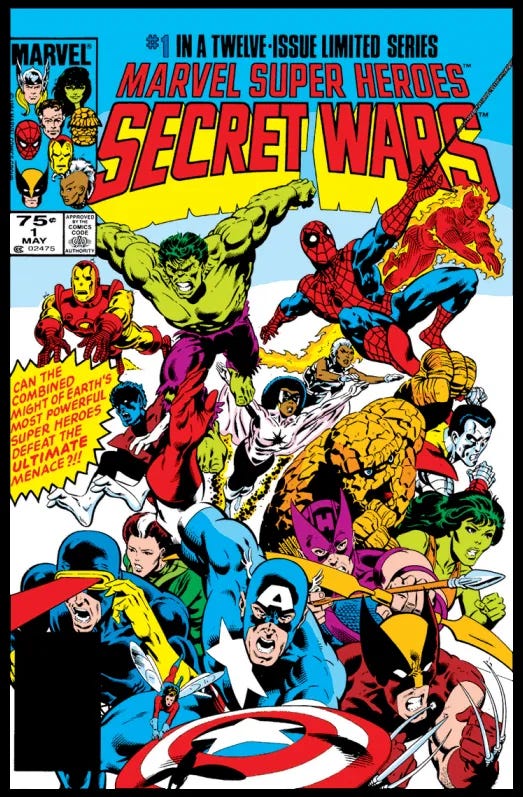
Ah, the halcyon eighties. Since there’s a lot of ground to cover below, let’s cut the preamble short and only say that this was a very good time to be into comic books. (Or at least it must have been—I was mostly paging through Little Golden Books.)
For our purposes here, we need to note two big developments that came out of the decade. Coincidentally, they’re not unlike what occurred across the political economy of the United States during the same decade: profound changes to the way the comic book industry did business that appeared to make sense and paid off wonderfully in the short term, but wrought debilitating problems in the long run.
The first was the comic book EVENT, epitomized by ballyhooed limited series like Marvel’s Secret Wars and DC’s Crisis on Infinite Earths, and large-scale crossover stories such as Marvel’s “Inferno” and DC’s “Invasion.”1 The EVENT is analogous to (and informed) the role of an Avengers movie in the economy of the Marvel Cinematic Universe: big cast, bigger spectacle, biggerer hype—plus big storyline implications and big FOMO to motivate fans to buy in. During the eighties, Marvel and DC discovered that EVENTS were dependable cash cows, for better and for worse (but mostly for worse). I expect we’ll have a lot more to say about the phenomenon when we eventually lurch from the aughts into the twenty-tens, but as far as the 1980s are concerned, Secret Wars, Crisis on Infinite Earths, Inferno, etc. were smash hits that oldheads typically speak well of—and not entirely without reason.
While the art and science of the EVENT would increasingly distort hero comics’ storytelling over the next four decades, it pales in significance to the industry’s embrace of the direct market model. What this entailed, in short, was a move away from selling product at newsstands (as well as supermarkets, pharmacies, convenience stores, gas stations, etc.) and towards a focus on designated comic book shops.
General retailers typically have an arrangement with magazine publishers which lets them return unsold issues for a refund. DC, Marvel, & co. understandably hated doing this. As comic book shops burgeoned into a retail institution on the level of the record store, publishers worked out a new agreement in which they would sell them unreturnable stock at a discount.
So: if a Stop n’ Shop orders fifty issues of Action Comics for a given month and sells only forty of them, it rips off the covers off the remaining ten and returns them to DC Comics to get its money back. (Good thing they were printed on cheapo paper, keeping production costs low.) Stop n’ Shop only has so much space on its rack, so it’s out with the old, in with the new. But if Android’s Dungeon buys fifty issues direct, it pays less for them than Stop n’ Shop—and if it sells forty of them, it drops the ten unsold copies in the miscellaneous back-issues bin to be snatched up by collectors.
Keith Dallas outlines the impact of the direct market model in American Comic Book Chronicles: The 1980s:
Ask comic book aficionados about the 1980s and many will immediately reference such seminal publications as Alan Moore and Dave Gibbons’ Watchmen, Frank Miller’s Dark Knight, and Art Spiegelman’s Maus. Others will mention such crowd-pleasing series as Marvel Comics’ Uncanny X-Men, Amazing Spider-Man, or Secret Wars. Even others will point to the decade’s plethora of new creator-owned titles, like Kevin Eastman and Peter Laird’s Teenage Mutant Ninja Turtles, Mike Baron and Steve Rude’s Nexus, Howard Chaykin’s American Flagg!, or Los Bros. Hernandez’s Love and Rockets.
…[N]one of these publications would have been printed if not for the proliferation and ascension of a new sales venue for comic books: the specialty comic book stores known as The Direct Market. As the 1980s dawned, the comic book industry was in critical condition due to the dwindling sales supplied by newsstand outlets. By the time the 1980s ended, however, the industry’s fortunes had reversed as the Direct Market had fully replaced the newsstand as the principal point-of-sale for comic books.
Walmart wasn’t going to stock cassettes or CDs by bands who’d just released their debut album on Sub Pop, and Stop n’ Shop wasn’t going to stock Watchmen. For the former, you’d go to a record store and have it recommended to you by committed music nerds. For the latter, you’d go to your local comic book store and have it recommended to you by committed comic nerds. The direct market model not only gave smaller publishers, new titles, and more experimental works a space where they could get noticed and win over readers—and facilitated serial-form storytelling by making back-issues more available—but solved a potentially fatal problem in the evolving magazine landscape that had beleaguered even the industry’s biggest players. Keith Dallas again:
Comic books had been part of the newsstand since the comic book industry’s infancy in the 1930s, but by 1980 it was clear that the newsstand wholesalers had lost the incentive to provide its retailers with comic books to sell, primarily because their profit margin distributing $0.40 and $0.50 comic books was significantly lower than what could be had distributing the more expensive magazines, like Time and Sports Illustrated—both of which retailed for $1.50 in 1980. As DC Comics editor Dick Giordano explained in a 1981 Comics Journal interview, comic books had become an afterthought to the newsstand market:
Comic books are considered fodder. If [the newsstand distributor has] that much room in the back of the truck, they’ll put that many comics, and they don’t bother to check them by title. “Just grab a handful of comics, Charlie, and throw it in the truck.” Is that a way to sell a comic book? (Groth, “Brushes & Blue Pencils” 54)
Consequently, the sell-through rates—the percentage of shipped books which actually get sold to consumers—kept falling. Since the newsstand market could return all unsold copies to the publishers for a full refund, the financial consequences for the comic book industry become obvious: when wholesalers don’t bother to distribute comic books to their retailers, only to get a refund for them, the publishers can’t even recoup the cost of printing, never mind the greater cost of production.
But by the end of the 1980s, the success of the direct market model had comic publishers sitting pretty. Sales had rebounded; their products were earning critical plaudits and amassing popular hype. They had every reason to believe it would smooth sailing from there on out. There was no way they’d be so foolish as to ruin their good fortune by, say, pumping air into a market bubble whose implosion would wipe out most of their distributors and those small retailers on which they’d grown dependent—and it’s not like there was a new communications technology in the pipeline that would soon rewrite all the rules for publishing and commerce.
. . . .
At any rate, when we last left the X-Men in 1975, Chris Claremont had taken over as the author of their revived serial and Cyclops was screaming NO!!! at the narration boxes.
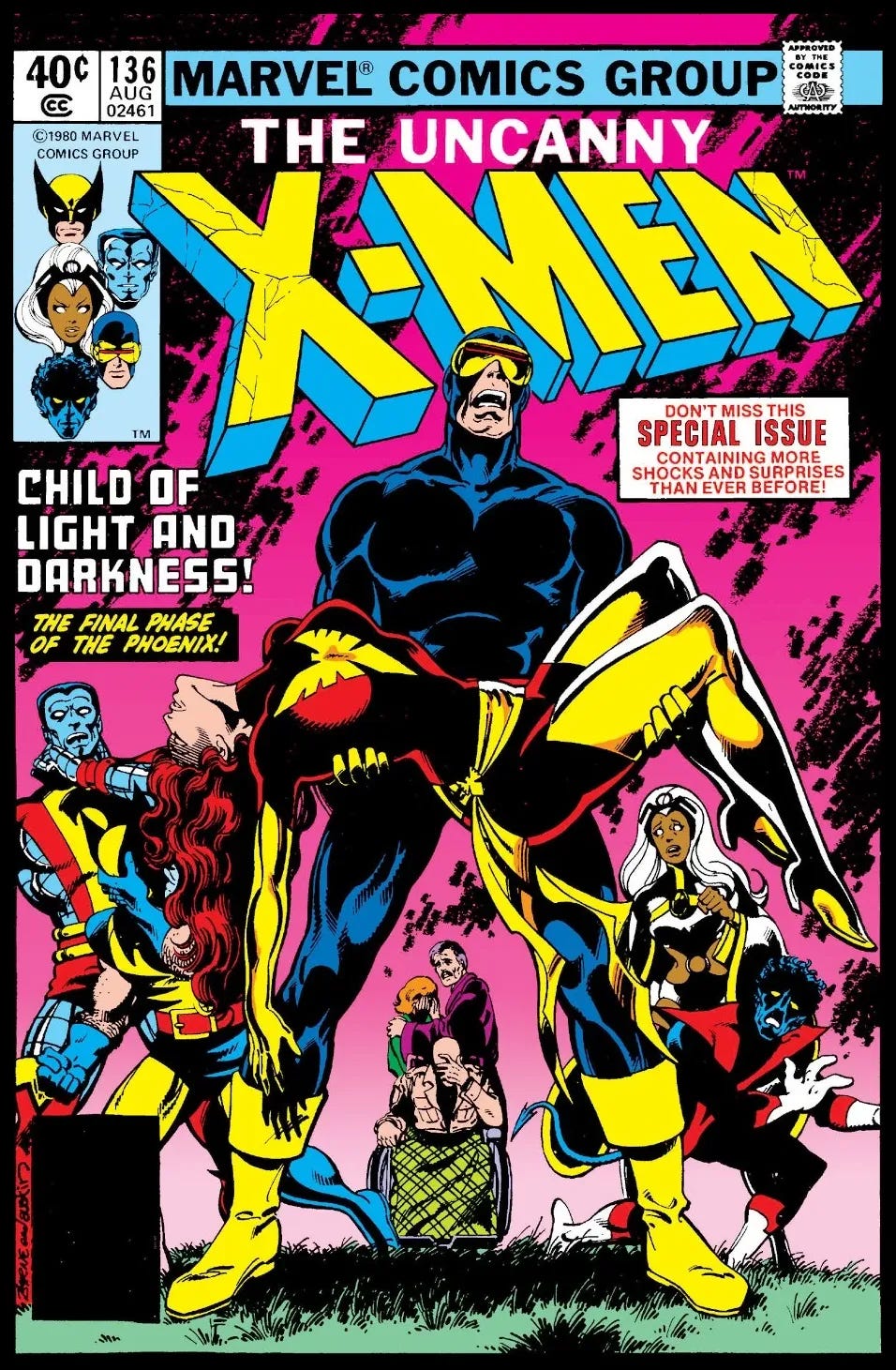
Claremont may not have created the X-Men, but he made the X-Men. Every Marvel book with an “X” in its title published in the last thirty-five years is, in one way or another, in dialogue with Claremont’s Uncanny X-Men.2
For sixteen years—1975 to 1991—Uncanny X-Men was Claremont’s personal fiefdom within the Marvel Universe, and its impact cannot be overstated. He transformed one of the weakest items in Marvel’s 1960s lineup into the company’s hottest property and one of the all-time best mainline superhero comic books. Under Claremont, the series became a smart superhero soap opera with chosen-family dynamics, an evolving status quo, a long-term view of plotting, and amazing flexibility with regard to genre. I can’t pinpoint exactly where it happens—it isn’t right away—but it gets good. It gets really good. Bearing in mind that it’s still a mainstream superhero rag and has no pretensions of transcending or interrogating the genre (don’t expect Watchmen or Invincible, in other words), I can’t recommend the Claremont run enough. It’s such wonderful fun. I can dip into it at nearly any point and easily lose myself for an hour or longer.
If you’ve ever had the pleasure of watching the original Star Trek TV show, you’ll have some understanding of Uncanny X-Men’s appeal. Its sensibilities are dated; it’s often melodramatic and sometimes silly, and knows it can only go so far in challenging the expectations of a mass audience. But it’s earnest and intelligent, generally buoyant, rarely unexciting, expertly paced, and features a stellar ensemble cast. I can’t find it now—it may have been on Twitter—but Gail Simone (Birds of Prey, Secret Six) once said something to the effect that Uncanny X-Men was a gateway into superhero comics for a generation of young women, and it’s not hard to understand why. For one thing, it’s as much a character-driven drama as an action-adventure affair; Claremont understood that a spectacular fight scene is basically wasted if it isn’t used as an opportunity to develop the cast’s personalities and relationships. For another, Claremont’s female characters are really powerful, and written to be taken seriously. It’s worth pointing out that he had Storm (i.e., a woman of color) leading the X-Men for several years, and the straight white males who constituted the majority of his audience ate it right up. Uncanny X-Men exemplifies the lost art of composing socially progressive popular fiction with a minimum of pontificating and smug pandering.
Its politics, however, are not radical, but firmly rooted in the postwar Western liberal consensus and its ideals. The X-Men don’t seek to overturn the status quo, but to serve and thereby improve it. They’re about assimilationism, incrementalism, and faith that the arc of history bends slowly but inexorably towards justice. This was all inherent to the original 1960s series, of course, but Claremont’s introspective X-Men more explicitly address and wrestle with it. Their job isn’t just to save the world from supervillains and terrorists, or to police the more wicked and dangerous members of their kind, or even to behave as a model minority, but to be morally better than the thankless bigots who still want to see them ostracized, locked up, or dead, even after they’ve saved the world on multiple occasions. Of all this, fighting supervillains is the easy part.
While it would be a while yet before creators and fans worked to crystallize the Mutant Metaphor as LGBT allegory, it is not hard to read Claremont’s run as an exaggerated story of a communal queer house. You can definitely read about it elsewhere—but once you perceive any quantum of queer subtext in Uncanny X-Men, you start seeing it all over the place. Claremont’s X-Men are essentially marginalized persons with a history of trauma and great big libidos who live together and help one another work out their issues—all while going on superhero adventures. Among the other spandex-clad Marvel do-gooders, they constitute a subcultural pocket. They’re outsiders.
Claremont deliberately kept the Metaphor nebulous, writing superpowered mutants as a fabulist proxy for objects of social prejudice per se rather than consistently mapping them over any specific real-world group or groups. He retcons the fearsome Magneto as a Jewish survivor of the Holocaust with a legible foundation for his “seize power or be victimized” outlook; whereas the original X-Men series framed the conflict between Xavier and Magneto as “good versus evil,” Uncanny X-Men begins to reframe their ideological differences as “peaceful assimilationism versus revolutionary separatism.”3 Elsewhere, he introduces the fictional island nation-state Genosha as a thinly-veiled attack on South African Apartheid. The Morlocks—an underground community of mutants whose members are mostly too deformed to pass for normal—act as a more lucid metaphor for dangerous tribalism grounded on marginalization than the did the original Brotherhood of Evil Mutants. In one memorable New Mutants instance, a teenage boy with the power to create three-dimensional photonic “sculptures” is threatened with being outed, and subsequently kills himself rather than face the social blowback.
Probably what’s most remarkable about Claremont’s Uncanny X-Men is its refusal to cling or loop back to a baseline status quo. If you’d read the comics up until graduating high school in 1980, and then didn’t glance at a single issue before buying one for old time’s sake at a gas station in 1988 (which you could still do at that point, in spite of the industry’s direct-market pivot), you’d have been gobsmacked by how different everything was. By that point, only three members (Storm, Colossus, and Wolverine) of the 1975 team’s lineup were still around; the rest (Dazzler, Havok, Longshot, Psylocke, and Rogue) were later arrivals. Professor X had been written out of the book and there was no indication that he’d ever return on a permanent basis. The X-Men had left the old mansion behind and had no reason to return to it. As far as Claremont was concerned, the story of the X-Men ought to go in one direction: forward. It’s difficult to fully appreciate in retrospect, but I understand that one of the thrills of reading Uncanny X-Men was the sense that anything could happen. When Batman had his back broken in the 1990s, there was no question that his hanging up his cape and rolling around in a wheelchair was a temporary state of affairs. When Jean Grey died, when Storm was depowered, and when Magneto renounced his violent supremacist ideology and joined the X-Men, Claremont intended for these developments to permanently stick.
Given the success of Uncanny X-Men, it would have been naïve to suppose that Marvel wouldn’t want to capitalize on the property with spin-off titles. Between 1982 and 1988, four new X-Men-adjacent titles were launched. We will be looking at two of them, starting with…4
THE NEW MUTANTS
(1982–1991)
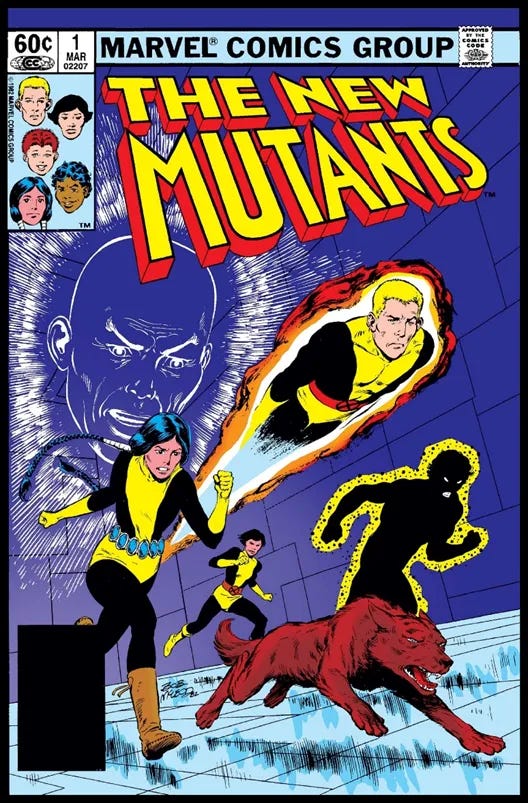
In an interview with the Epic Marvel Podcast, Chris Claremont claims his hand was forced:
It all got catalyzed by the discovery that another group of creators at Marvel were thinking in terms of creating a team of young mutants and doing them as an offshoot of the Avengers or somewhere else, and [editor Louise Simonson and I] decided . . . we weren’t gonna let that happen. So that catalyzed our focus, our thoughts, our determination, and we turned The New Mutants from concept into reality . . . And again, the functional rationale for the team was, they’re kids. What do kids do? They go to school. And that was it.
It seems Claremont was protective—or possessive—of the X-Men and of mutant characters in general. Whatever else was in the works and whoever was planning it, he saw it as an attempt to infringe on his territory.
The team was assembled in a one-shot under the Marvel Graphic Novel imprint in September 1982, drawn by Bob McLeod and authored by Claremont. The first issue of The New Mutants followed in November, still drawn by Bob and written by Chris.
In a sense, New Mutants represented a truer “next generation” book than Giant-Size X-Men. The All-New, All-Different X-Men of 1975 were already grown up and perfectly capable of surviving a deadly escapade to rescue the original crew. The New Mutants, on the other hand, come to Xavier as students with pretty much no experience in mutant superheroics (apart from their Marvel Graphic Novel “pilot”). The Professor, for his part, resumes his erstwhile role of teacher after acting as the adult X-Men’s advisor, patron, and landlord for several years of publication time.
This was Claremont’s take on the 1963 X-Men concept: five teenagers in identical uniforms learning to master their mutant abilities under the tutelage of Professor Xavier. They have spats, struggle with their marginal status as an offshoot of Homo sapiens that baseline humans fear and distrust, and go on adventures together—just like the original Strangest Teen-Agers of All Time.
From the beginning, there’s one major difference: Xavier makes clear to the new kids that he has no interest in molding them into a Fighting Team. That phase of his career is over, he says. “If you ever wish a justification for who and what and why you are—both as human beings and mutants—this is it,” the Professor tells his new students in issue #5. “Not fighting villains or evil mutants, but simply helping people.” The New Mutants are to be students at a school where they cultivate their talents and learn to use them for the general good—not to become battlefield operatives like the original X-Men.
That…isn’t how things pan out. New Mutants is a fun comic to look at in its entirety because it starts off as one thing and turns into something else completely. As we saw last time, the original X-Men changed hands between various artists and writers during its seven-year run—and while it did evolve during the course of going from Point A to Point B, it was a fairly consistent series from beginning to end. Looking at the journey of New Mutants, on the other hand, is like watching Little Women morphing into Starship Troopers.
Probably the best way to do an overview of this series is to bracket it off into eras defined by their creative teams. So let’s start with…
I. The Claremont Run
(Issues #1–54)
I’m finding it difficult to do a writeup of Claremont’s New Mutants—for a number of reasons.
The first is that New Mutants can’t be treated in isolation from Uncanny X-Men: it’s practically a companion series, a parallel narrative written by the same author at the same time. Not only do the two books’ stories occur more or less simultaneously and intersect from time to time, Claremont exports the ethos and themes of his better-known book to its lesser-known spin-off. The temptation towards mission creep is powerful here.
The second is that Claremont is a thoughtful writer and his New Mutants has just enough in the way of actual substance to warrant the kind of “serious” treatment I told myself I’m not here to do. Again—mission creep. Third: this book built the template for almost every other “junior X-team” series we’ll be looking at from here on out, so it’s worth examining closely—though I’m not sure how closely.
I think a safe place to begin is to look at the main cast.
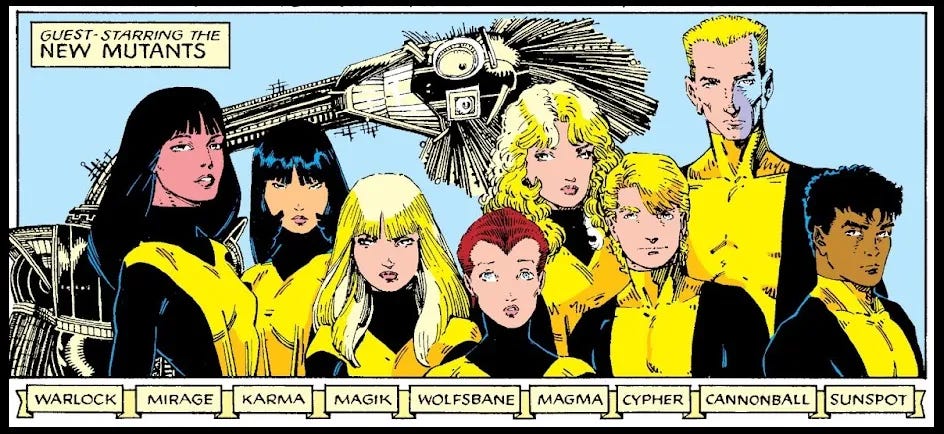
Dani Moonstar. (Forget her superhero names; neither “Psyche” nor “Mirage” ever stuck. She’s just Dani, and I believe that says something about what a finely rounded character she became.) Cheyenne. Scrappy action girl. To start with, she has the power to create “spirit-forms,” three-dimensional illusions of a person’s deepest fears. Without going into unnecessary detail, it evolves over time. In her first appearance she has a psychic connection with animals (an “oof” might be appropriate here), but this eventually gets narrowed down to a telepathic rapport with wolf-mode Rahne. Her character arc is about learning to trust Xavier, growing from a rebel and a loner into a leader, becoming a Valkyrie (really), and uttering spurious Native American-isms that are kind of embarrassing in hindsight.5 (It was a different time.)
Sam Guthrie (Cannonball). Nominally group’s the co-leader. Hayseed boy from a big family in rural Kentucky. Previously employed as a coal miner. Part working-class gentleman, part lanky goober. His mutant power involves launching himself through the air with a propulsive “blast field.” His character arc is about finding his confidence, reconciling his humble origins to his exciting new life, and repeatedly mentioning that he’s nigh invulnerable when he’s blastin’ (in case any first-time readers need to know).
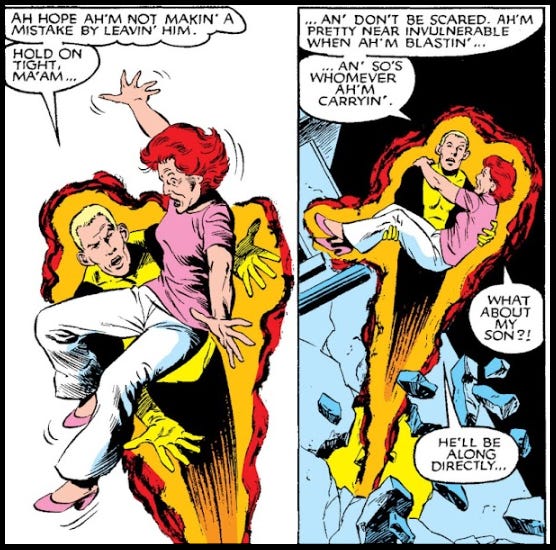
Xi’an “Shan” Coy Manh (Karma).6 Vietnamese. Psychic possession powers. Has clearly been through some shit. The oldest of the group and its initial den leader. Serious and scrupulous. Family-oriented. She actually debuted a couple of years earlier in Marvel Team-Up #100, written by Claremont and drawn by Frank Miller. Her arc tends towards…huh. Hmmm. Well, quiet and composed personalities are square pegs in the round slots of superhero fiction, and unlike Cyclops (the original X-Square), Shan doesn’t have a superpower that can be easily exploited for drama and angst. Claremont never seems to know quite what to do with her. She gets written out of New Mutants not even once, but twice.
Roberto DaCosta (Sunspot). Afro-Brazilian. Hot-headed soccer jock. Comes from money. Enjoys Magnum PI. Absorbs solar energy and converts it into strength. His arc flirts with the idea that he’s at risk of growing into his father (a ruthless businessman and card-carrying Hellfire Club member), but the silhouetted way he’s drawn in his solar-energy form is usually what’s most interesting about him here. If you’re ever planning to read (or perhaps reread) New Mutants, take a shot every time it is mentioned that Berto is Strong But Not Invulnerable.
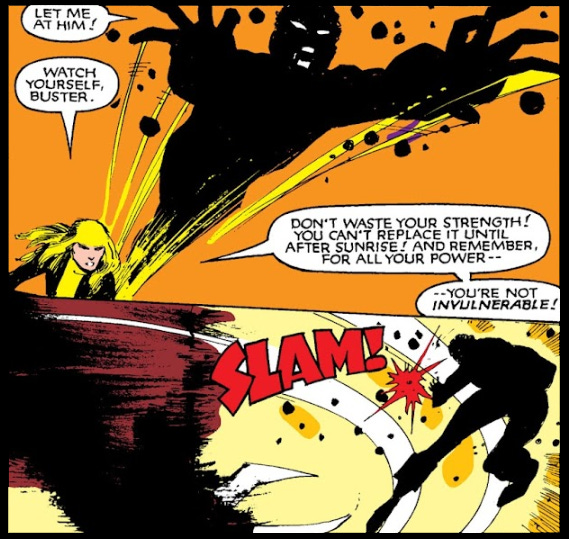
Rahne Sinclair (Wolfsbane). Demure and insecure Scottish lass who had a toxic fundamentalist Christian upbringing. She’s got a sort of lycanthropic metamorph thing going on: not only can she turn into a wolf, but an intermediate human/wolf hybrid form. Her arc is about a change of perspective: she’s been programmed to loathe herself and judge others as demon spawn and sinners, and in the course of the series she gradually gets deprogrammed. The psychic rapport she shares with Dani in her wolf form may or may not be homoerotic, depending on whom you ask.
During the book’s second year, the student body receives four additions:
Amara Aquilla (Magma). Aristocratic. Blonde. Volcanic powers. As much as I would like to say she’s from South America and leave it at that, Amara comes from Nova Roma, an ancient Roman settlement in the Andes where historical and cultural progress has, improbably, been frozen solid for two millennia. She’s got a “girl in a strange land” thing going on: her character arc is about getting adjusted to a new culture and a new family. She’s also sort of like an echo of Havok in the original X-Men—yes, we’re already at the point where we can say that a new thing resembles an old thing—in that she’s too powerful, causing earthquakes and volcanic eruptions in the vicinity if she loses her composure. Once she settles in, she doesn’t have much to do but invoke the names of Roman deities and throw lava at things during action scenes.
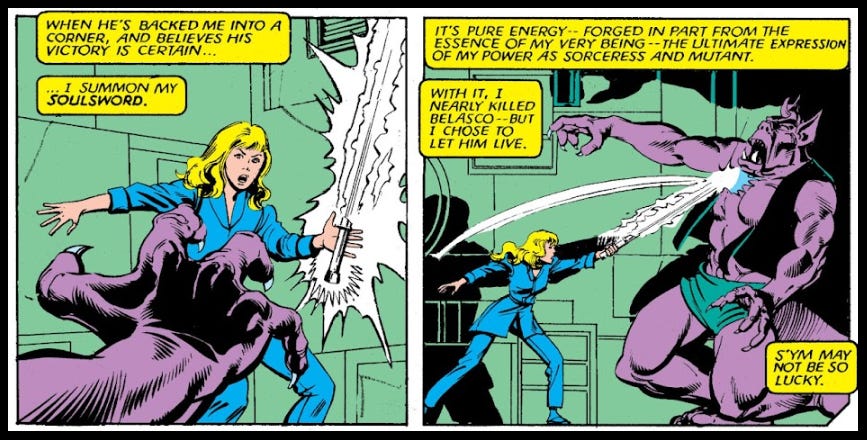
Illyana Rasputin (Magik). Russian. The younger sister of X-Man Colossus. Possesses teleportation powers that involve opening “stepping disk” portals that just so happen to run through a hellish otherworld called Limbo, and sometimes spit people out into the past or the future. One day when she was seven years old, she was yanked into Limbo. When the X-Men got her out a few hours later, she was seven years older and not keen on talking about what happened to her. (To find out, read the now-classic Magik limited series! —Ed.) In addition to her teleportation powers and expertise in Eldritch Magicks, Illyana also wields a Soulsword, The Ultimate Expression Of Her Power As A Sorceress And Mutant (as Claremont tells us a hundred times).
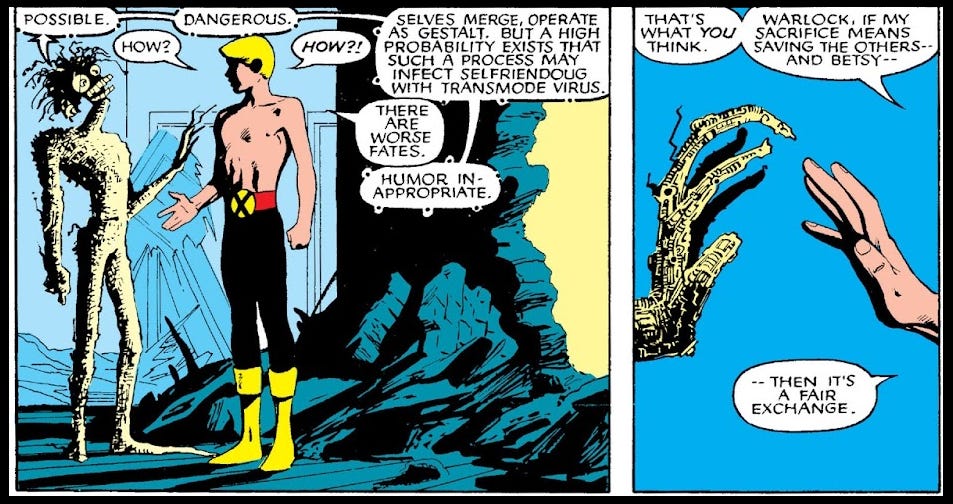
Doug Ramsey (Cypher). Westchester County townie. His mutant power is understanding languages. All languages. Can’t do much in a fight, though. Despite having the objectively dullest design and least flashy ability of the bunch, Doug apparently commands the most sex appeal: Kitty Pryde, Rahne, and Betsy Braddock(!) all have a thing for him at one point or another. His arc starts to be about realizing how amazing and useful his gift really is, but he gets killed off by another writer before it can come to fruition. For a while, he’ll be analogous to Jason Todd in the Batman comics as the dead youth who haunts the living as the ghost of their failures—and then both of them come back to life during the aughts. (Them’s comic books for you.)
Warlock. Techno-organic space alien. He’s a shapeshifter and has a life-draining death touch, but what makes him a mutant is his being the only individual of his species with the capacity for empathy and kindness.7 For the most part, Warlock acts as a mascot and source of comic relief, though he does grow serious from time to time—usually when his tyrannical, planet-breaking father Magus comes knocking. He also gets close to Doug. Like, really close. Under his skin and inside of his cells close. All of this may or may not be homoerotic, depending on whom you ask.
Depending on how you look at it, Claremont is either really good at writing teenaged characters, or doesn’t quite know how to do it. I think it hinges on one’s conception of adolescents.
The New Mutants speak and act more or less the way Claremont has the X-Men speaking and acting, but perhaps with feet just a degree or two colder and behind-the-ear areas a few drops wetter. We know they’re kids because they’re smaller than the X-Men, because the grownups treat them like kids, and because they usually defer to the adults in the room. For the most part, they behave like grownups situated as children. They’re not flippant, gratuitously quippy, or given to childish pursuits; a model disciplinarian like Professor Xavier would probably show them the door if they were. The New Mutants are simply untested. They’re still figuring themselves out.
Teens are commonly regarded as being incompletely adult—and if Claremont doesn’t go so far as to write a scene where his teen cast slips into X-Men costumes that are much too large for them, the superpowers he gives the group’s original five members impress more or less the same point upon the reader.
Compared to the X-Men, the New Mutants are endowed with rather rudimentary abilities. Roberto is strong enough to lift a sedan over his head—but unlike Colossus, he’ll get wounded or killed by a bullet. Sam can fly like Angel, Banshee, and Rogue—but, true to his “Cannonball” sobriquet, the way he flies precludes maneuverability and control, and for a while he’s prone to crashing into obstacles and wiping out. Compared to the Professor’s vast suite of psychic abilities, Dani and Shan’s powers are severely limited in scope. In her werewolf form, Rahne is neither as tough or durable as Wolverine, nor as agile as Nightcrawler. For lack of a better word, Claremont infantilizes the original five New Mutants by giving them extranormal abilities that don’t stack up against their elders’, and the gap is roughly analogous to the developmental differences between a fourteen-year-old and a twenty-four-year-old. It helps the reader to draw a distinction between the kids and the grownups when both teams feature in superhero soap opera comics, and the kids’ relative immaturity isn’t an overblown point of emphasis.
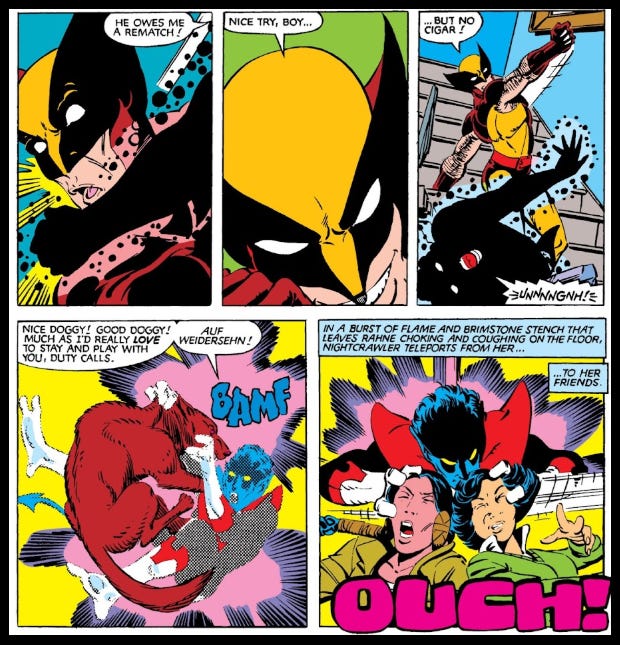
The New Mutants pilot story under the Marvel Graphic Novel imprint establishes a trope that will recur throughout the X-Books for the next forty years: the traumatic X-gene activation. The original 1960s series only grazed the topic, and Claremont doesn’t do much flashing back to the All-New, All-Different X-Men’s origin stories in Uncanny X-Men. New Mutants is where he looks more closely at what happens when a child’s mutant powers begin to manifest during or just after puberty (another sexuality metaphor). Rahne goes werewolf for the first time and has a frenzied congregation of superstitious Christians chasing after her with rifles and torches. During a soccer game, a suddenly glowing Roberto tosses another player halfway across the field before a crowd of frightened spectators. Dani starts throwing visions of her loved ones’ deaths in front of their faces. It’d be hard enough for a teenager to discover they’re indelibly different from everyone else they know (again, imagine realizing you’re seriously same-sex attracted in a twentieth-century milieu where even discussing such a thing is beyond the pale), and to this the comic-book fantasy adds a forced outing often accompanied by howling witnesses and collateral damage.
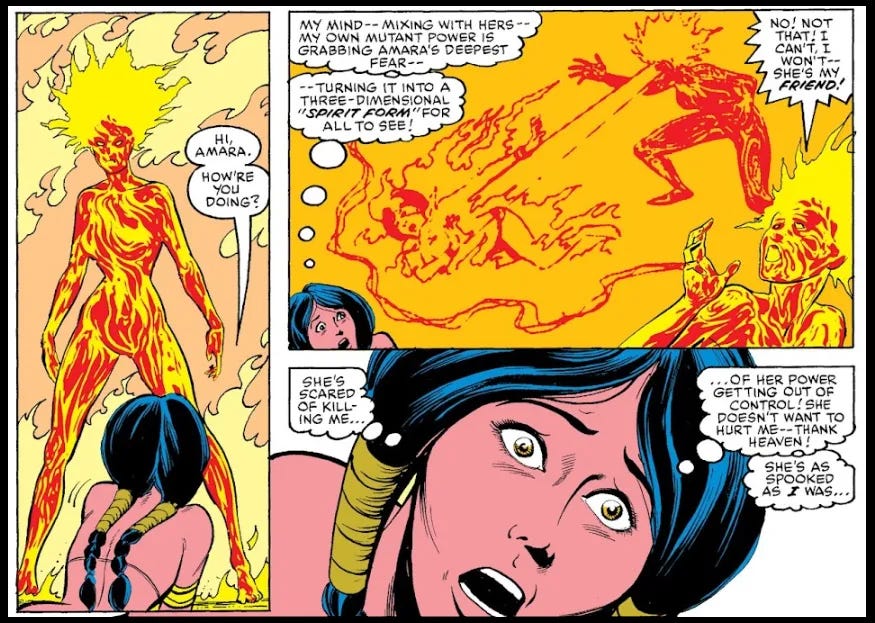
On the topic of mutant powers: X-Men characters are usually most interesting as characters when their special abilities are more than just weapons they take into fights against mad scientists, terrorists, and wicked super-people. Peter David understood this perfectly: in his X-Factor books, he writes the super-speedster Quicksilver as a perennial grouch and a prick because everyone in his world is always doing everything a hundred times slower than he’d like them to, and Multiple Man as being plagued by indecision because he sees the world from too many different angles to settle on any one course of action. Zeb Wells, writing the back-to-life and grown-up Doug Ramsey in the late aughts and early twenty-tens, characterizes him as aloof, unblinking, and unsettlingly calm because he “reads” and comprehends basically everything happening around him. Not long ago, Wells retconned Empath as having acquired his mutant power at a much earlier age than normal: turns out he was never a sociopath to begin with, but being able to control his family’s emotional responses to his actions developmentally twisted him— and he secretly cherishes his Krakoa-era crew because, after violently refusing to put up with his shit, they begin to like and accept him without him forcing them to. Et cetera. It’s interesting (and actually pretty smart) stuff.
But this all came after Claremont. Perhaps he was not so eager to write his characters as being set fundamentally askew by their mutant powers because it wouldn’t have comported with the twentieth-century liberal universalism to which Uncanny X-Men subscribes. The whole point of the X-Men (as Claremont understands them) is that they’re people who happen to have superpowers, and who ultimately don’t want those powers to define them as persons. During Claremont’s run, no character communicated this better than Storm. Of the cast of Uncanny X-Men, she was always the one who most reveled in using her mutant abilities. When she had them permanently stripped away during the acclaimed “Lifedeath” story (but not really permanently), she didn’t pack up her things and go off to lead a normal civilian life—she grew even tougher and became a stronger leader figure than before. Summoning blizzards, throwing bolts of lightning, and flying around on updrafts turned out to be inessential to who she was.
In a similar sense, what makes Dani such an interesting character throughout Claremont’s New Mutants run is precisely the lousiness of her mutant power. When the gang gets into one of those superpowered action brawls they’re theoretically not supposed to get into, Dani’s spirit-forms can throw their foes off their balance for a minute or so, but aren’t good for much else. As a means of doing character work, yanking out and putting on display an image of a person’s most awful fear functions a lot better in concept than in practice. And yet, Claremont writes Dani such that she’s a compelling and indispensable character in spite of her flimsy superhero gimmick, not because of it. Her mutant power will repeatedly take different forms under different writers for a couple of decades; for a while she’ll lose it, like Storm did, and was inarguably improved by its loss. From the very beginning it was extraneous to her character.
Warlock, the team mascot, also deserves some attention. In a less thoughtful hero rag, he’d be an absolute monster, fashioning his limbs into machetes and guns, or just shooting out tendrils and using his touch o’ death to reduce the New Mutants’ foes to piles of dust. It isn’t that Warlock can’t do these things—Claremont makes clear that he’s capable of it—he doesn’t want to. The most unhuman and the most powerful of the New Mutants is also the most innocent and the gentlest of them.
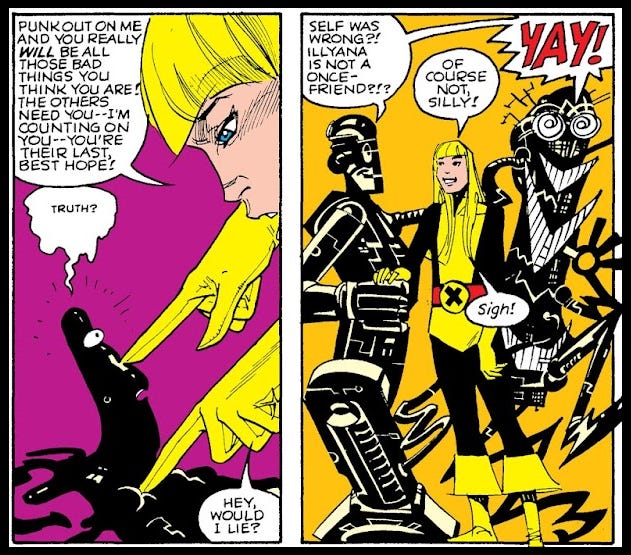
And then we have Doug. Ah—poor Doug.
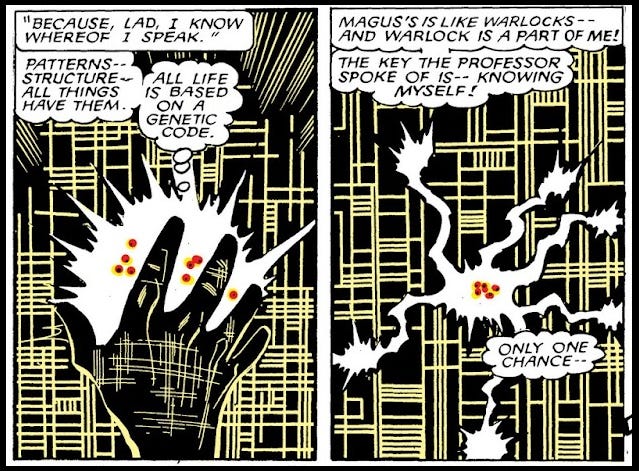
He was Claremont’s boldest New Mutants creation: a character on a superteam whose special power is understanding language. He can’t shoot lasers out of his face, he can’t stop a speeding train with his fist, he can’t fly, he can’t telepathically erase and rewrite memories—he even lacks Dani’s athleticism and moxie. Doug just talks to people and reads things. He was a shot at developing a different kind of character for what Claremont hoped could be a different kind of Marvel hero book, and the problem was that New Mutants wasn’t so different a 1980s Marvel book.
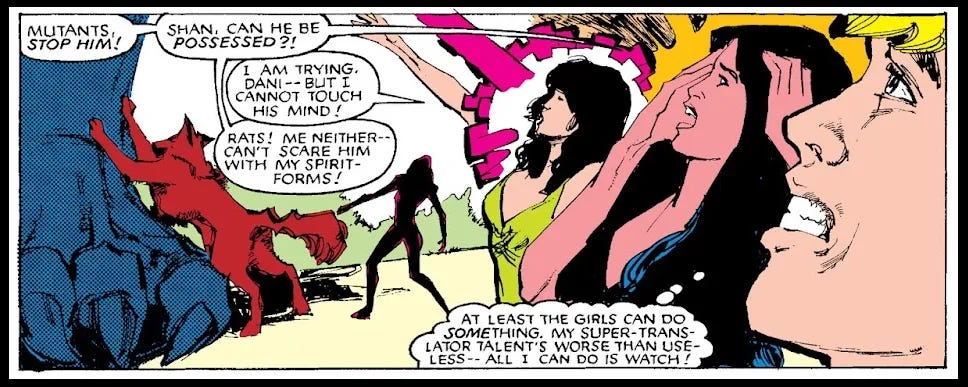
I can imagine Doug thriving as the protagonist of a late-eighties Vertigo title where readers weren’t expecting at least one super-powered brawl a month, and where figures with special powers or abilities weren’t rated in terms of how much utility and firepower they brought to a physical confrontation. Someone like Grant Morrison could have done a lot of interesting stuff with a character whose whole schtick consists of perceiving structure and pattern. Claremont, for the most part, isn’t the kind of writer whose sensibilities bend in that direction. But I believe he was playing a long game with Doug: underselling him as a guy who’s strictly useful as a translator, only to gradually reveal the awesome potential of what he can really do.
But then he stopped writing New Mutants, and his successor killed off Doug—because not only did fans of comic book spectacle find him dull, but because even the book’s artist complained that he was boring to draw.
For most of Claremont’s run, there’s a peculiar dissonance between what the series has to be and what the author wanted it to be. Claremont (on the Epic Marvel Podcast) again:
[The New Mutants] were not ever intended, conceptually, to be superheroes. It’s just that circumstances kept throwing them into situations where they had to become superheroes. And the salable aspect, I suppose, the marketable aspect of New Mutants compared to X-Men was the New Mutants, more often than not, in the process of saving the day in the issue screwed up. They made mistakes. They got hurt. People got hurt. They learned things. They occasionally had to be recused themselves. That’s why they wore the common uniform of the school rather than individual outfits like the X-Men.
All of this is perfectly reasonable. But the glaring problem from the get-go is that New Mutants spun off from Uncanny X-Men, a book had been an action/adventure superhero affair from day one. New Mutants is constrained to follow suit, which means the team has to be superheroes whether or not it’s what the Professor wants or what Claremont intended. No matter where they go or what they do, they must face off against people or beings that mean to kill or capture them, and save lives and/or life on Earth in the bargain. The conceptual difference between the adult X-Team and the student X-Team becomes practically immaterial.
The gang takes a day trip to the local shopping mall—and a giant robot attacks! They go out to a rock concert—and hostile alien appears! They settle in for a quiet night at the mansion—and demon bursts in to pick a fight! The crew gets invited to a swim party at a local high school—but it’s a ruse set up by agents of the Shadow King, and all but two of them are kidnapped! It all makes one wonder why the Professor ever bothered dispatching the X-Men on missions. With every malevolent entity in the world apparently looking to rough up his students, Xavier and company could have saved a lot of time (and jet fuel) by just staying put and waiting for their foes to come to them.
But we’ve vaulted ahead. Let’s loop back to the beginning.
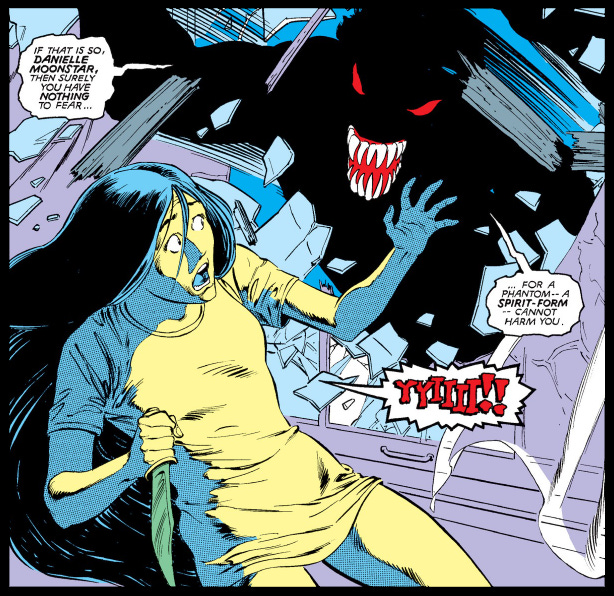
It’s fair to say that New Mutants gets off to a rocky start. There’s a lot of “season one” awkwardness as Claremont tries to figure out the character beats, sources of narrative conflict and tension, and what kind of stories he can tell with his first made-from-whole-cloth mutant cast and “students first” premise.
He throws ideas at the wall to see what might stick. Professor Xavier turns out to have recruited the gang under the influence of an alien parasite looking for fresh young bodies to shoot its eggs into, and the X-Men have to rescue them. The gang links up with a group of motorcycle-riding vigilante stuntmen called “Team America” (remember, these were the Reagan years) and get in a scrape with some terrorists. Afterwards they go to Brazil, fight a Mr. T lookalike, get tied up in the internecine politics of an ancient Roman colony at the font of the Amazon, and do battle with an immortal sorceress. At this point we’re only a year in, and the series already feels like it’s gone off the rails.
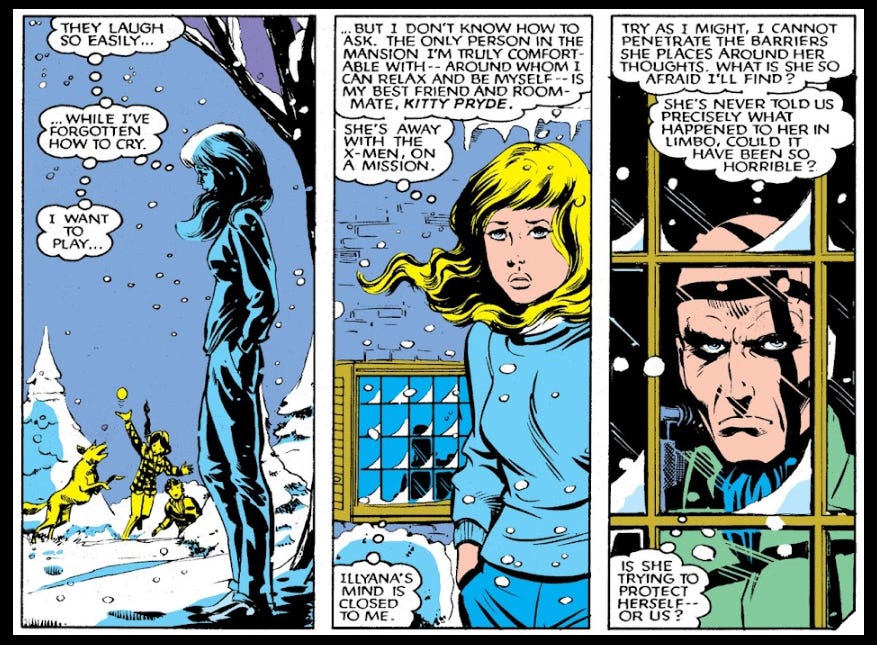
In the book’s second year, three developments put it back on track. The first is the introduction of Illyana, imported from Claremont’s four-issue Magik limited series. I must have Star Trek on the brain, since the comparison that immediately comes to mind is the arrival of Worf in Deep Space Nine: Illyana does so much to round off the cast that New Mutants’ first year and a half without her feels like a false start. Her presence also seems like an admission that the book’s foundational “students, not superheroes” philosophy was already dead in the water. She’s another of Claremont’s ludicrously powerful female characters, written as having enrolled in Xavier’s school not for the sake of learning to better use her powers, but to be socialized with other children her age after spending half her life in captivity. She comes loaded for bear with arcane spells, a magic sword, and pet demons, and it’s silly to expect the book will spend much time waiting to pit the gang up against some variety of baddie on whom Illyana can train her eldritch armaments.
Illyana proves to be such a solid character that she makes some of her castmates redundant. Shan came into the book as a “big sister” type, older than the rest of the New Mutants and theoretically positioned to be the voice of experience who’s more knowledgeable and mature than her peers. Even from the beginning, that’s not how she shook out, and Illyana’s presence nixes any possibility of Shan assuming that role when she returns after a two-year absence (in publication time). Amara joins the ensemble as someone from another culture having a hard time adjusting to life in the United States; Illyana soon usurps her bit as a young woman standing astride two worlds, reducing Amara to a battlefield cannon with a pretty face. She even contends with Dani for the role of the New Mutants’ principal “action girl” character, and it is only Claremont’s personal investment in Dani that prevents Illyana from pushing her off to the side. Having written a book with Wolverine on its cast for the better part of a decade, the author had some experience striking a balance between New Mutants’ designated main character and the castmate with the most intrinsic star power.
Perhaps most importantly, Illyana’s personal arc gives New Mutants an eventuality it can safely approach. The reader is made to understand the character is on a clock, and when it counts down to zero, she becomes a full-on demon sorceress supervillain. This is a clever move for a coming-of-age story told through a comic book serial. Typically, once some prescribed developmental milestone is reached, the coming-of-age tale is supposed to end—but the exigencies of selling a monthly comic book over as many years as possible demand that its characters incrementally creep towards the threshold of maturity without actually attaining it.8 Through Illyana, New Mutants acquires a functional substitute for an initiation into adulthood, a looming point on the horizon towards which its overarching plot can progress and advance beyond without fulfilling the intrinsic promise of its premise and negating its reason to continue. At some point, she’s going to snap—and her friends will probably have to save her from herself and/or save the world from her.
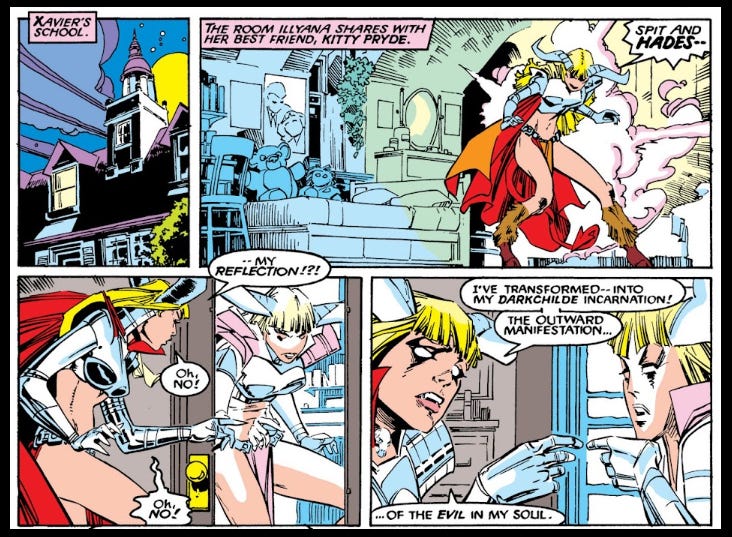
With the introduction of the Hellions in issue #16, New Mutants achieves liftoff. Some background might be needed here.
Fairly early in his Uncanny X-Men run, Claremont created the Hellfire Club and its Inner Circle as a different breed of supervillain. Its leaders Sebastian Shaw (the Black King) and Emma Frost (the White Queen) are wealthy mutant schemers and power brokers playing a long game towards world domination. The Club’s public façade as a flamboyant Manhattan gentlemen’s lodge where millionaires and politicians smoke cigars and drank brandy together makes it a difficult target; the X-Men can’t deal with Shaw and Frost by simply busting into their headquarters and shooting eye-lasers and lightning bolts at everyone. Whenever the Hellfire Club moves against them, our heroes typically find themselves on their back feet.
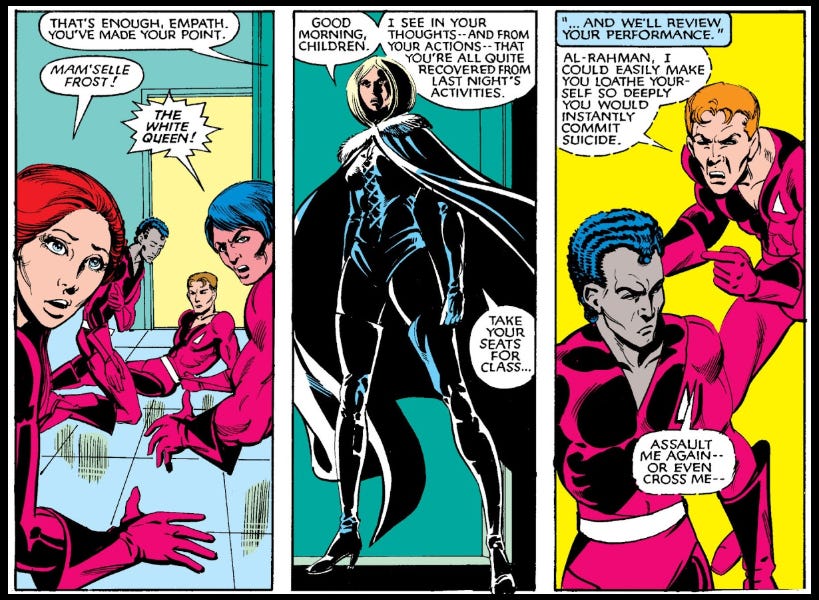
In Uncanny X-Men, it is revealed that Emma Frost just so happens to be the chairperson of the prestigious Massachusetts Academy boarding school. In New Mutants, we discover she’s set up a secret training facility beneath the campus to groom a cadre of young mutants as Hellfire Club enforcers.
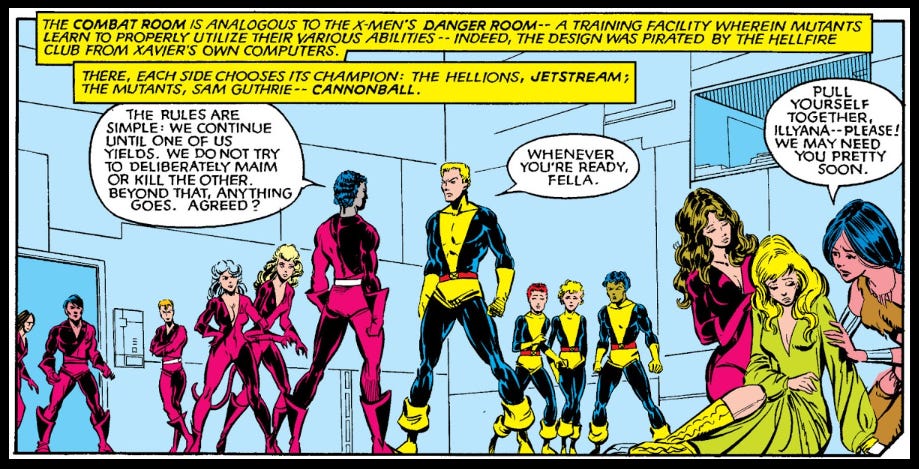
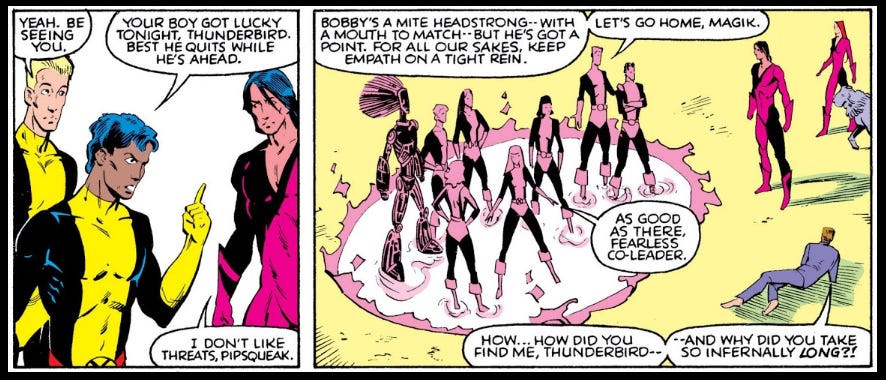
Frost’s Hellions are the Misfits to Xavier’s Jem and the Holograms: a cosmopolitan crew of teenaged mutants our heroes can confront on more or less equal footing (and who have cooler uniforms to boot). Claremont sets up the correspondences between the groups early on, and continues developing them with successive encounters. Team leader Dani finds a counterpart in James (Thunderbird), a serious and principled Apache who takes his sobriquet from his brother John and has an axe to grind with Professor Xavier.9 Sam and Haroun (Jetstream), the flying men of their respective teams, become dueling rivals in short order. Mean-girl blonde Jenny (Roulette) takes a shine to nice-boy blonde Doug. Illyana was probably intended to have a foil in Marie (Tarot), who’s got the magic-flavored ability to bring tarot card images to life, but her functional opposite number is Manuel (Empath)—powerful, hard to control, and plainly evil.10
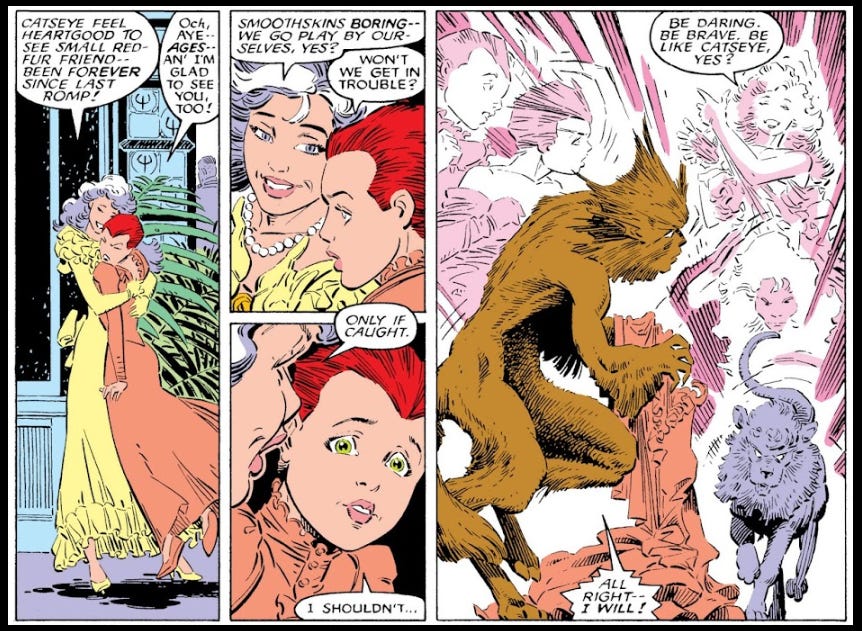
Probably the most interesting pair-off is between Rahne and Sharon (Catseye), a metamorph who thinks of her leonine form as her “real” self and has a peculiar way of speaking. Around the time the Hellions debuted, Rahne was wracked by religious guilt for daring to enjoy being in her wolf-form—and I’d guess that Claremont introduced Catseye with an eye towards giving her a simpatico pal who could help her work through some of it. The underdevelopment of their friendship seems like a missed opportunity in hindsight (and doubly so if homoerotic subtext tickles one’s fancy), but sometimes that’s what happens when a writer has a lot of plates he needs to keep spinning.
With the exception of Empath, the Hellions can’t appropriately be called villains. They’re rivals and foils. They don’t want to murder or brutalize the New Mutants, but show them up. They’d probably be friends if they weren’t on opposing teams from rival schools—and Austin Gorton observes Claremont implying that certain members of each group would feel more at home on the other side. (Later on, Louise Simonson writes out Amara by having her transfer to the Massachusetts Academy.) Comic book super-people and and their super-antagonists don’t often get to have a sustained dynamic like this, and a “junior team” series like New Mutants provides a context where it makes sense. It’s a testament to Claremont’s facility for character work that the (usually) bloodless competition between the teams never feels trivial or low-stakes.
For all of this, the Hellions only make a handful of appearances throughout New Mutants. I’d like to say they’re underused, but in the world of comic books, that’s as much as saying I’m glad they never had the chance to grow stale from overexposure.
New Mutants enters its most acclaimed phase when Bill Sienkiewicz becomes its regular penciller in issue #18 —which happens to be the first chapter of the three-issue “Demon Bear” arc, the series’ best-known outing and the main basis of its ill-fated 2020 cinematic adaptation.
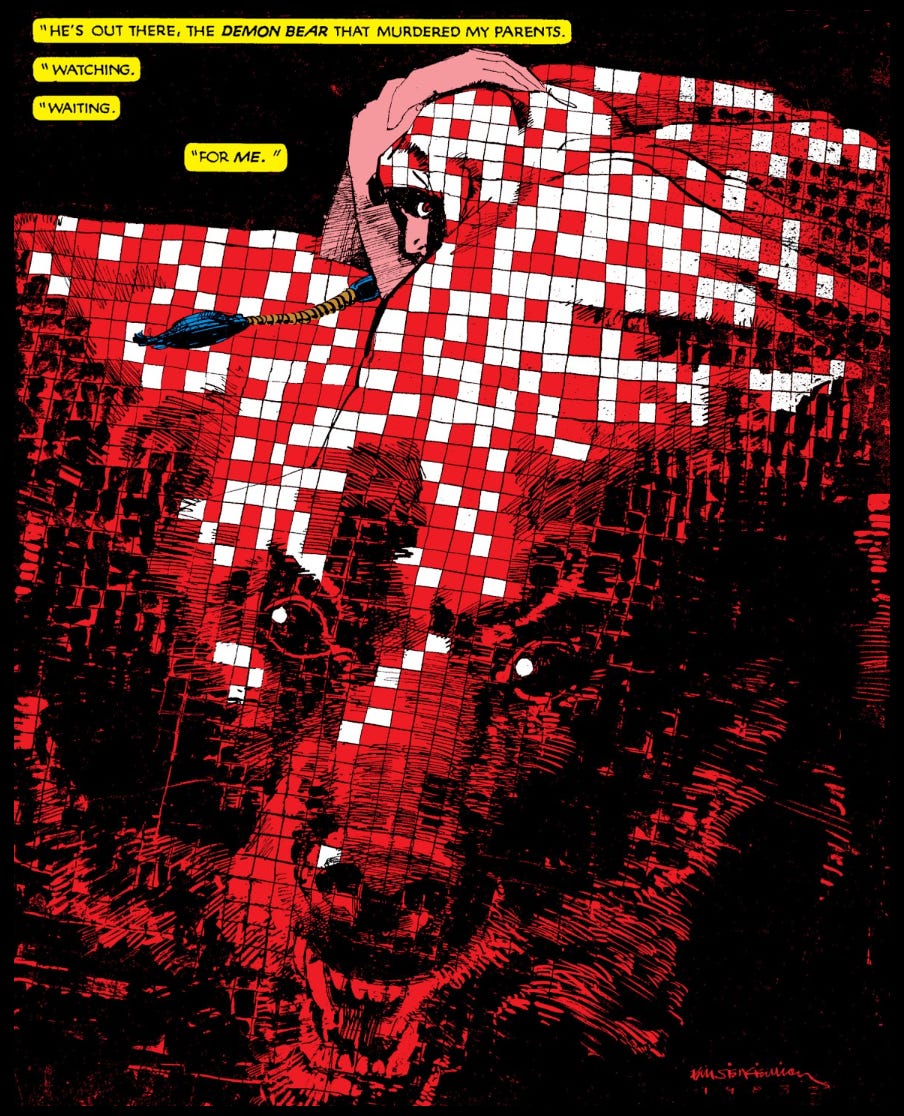
I’m realizing now that when I heaped praise on Claremont’s golden years writing X-Men comics in the 1980s, I really ought to have mentioned how fortunate he was to have been paired with artists who can accurately be called industry luminaries: John Byrne, John Romita Jr., Alan Davis, Paul Smith, Marc Silvestri, Jim Lee, and so on. In comics, excellent writing can sometimes compensate for merely adequate art; sometimes eye-candy illustrations can make up for mediocre writing (as we’ll see next time). Claremont’s run on Uncanny X-Men owes its legendary status to setting new standards for its writing and artwork.
Sienkiewicz, however, is in a class of his own. If I had no qualms about denigrating the work of his peers, I might say that while Byrne, Romita, et al. are illustrators, Sienkiewicz is an artist. I lack the technical vocabulary to specify what his work does. Most comic book nerds default to terms like “surrealist” and “expressionist,” and I suppose that’s what we’ll have to settle for. Apparently he was heavily influenced by Ralph Steadman at the time, so maybe we ought to characterize the Sienkiewicz run as “Fear and Loathing in New Mutants.”
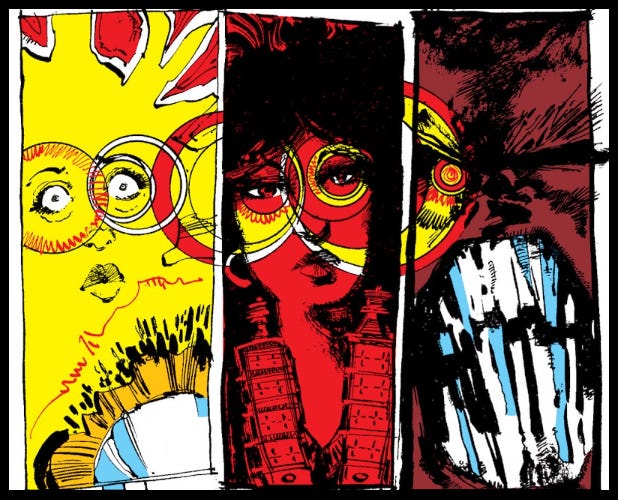
The effect of Sienkiewicz’s presence on New Mutants is analogous to the galvanizing arrival of Neil Adams on X-Men during the last year of its original run. This was an artist who demanded to be utilized to the full extent of his talents, and stories about heroic motorcycle stuntmen and mean townies crank-calling a school instructor weren’t going to cut it. He gave Claremont a challenge, an occasion to rise to. It would be easy to say Claremont answered that challenge by making New Mutants into a darker book, but that wouldn’t necessarily have been an improvement in and of itself. The real breakthrough has to do with a heightening of intensity. It’s as though the author’s “students, not superheroes” conception of the series prevented him from taking it out of second gear and really testing its engine, and Sienkiewicz goaded him into shifting into overdrive.
Even though he was on the book as penciller for just a little more than a year (but stuck around a while longer as its inker, providing some measure of stylistic continuity), New Mutants may well have followed the path of the 1960s iteration of X-Men if Sienkiewicz hadn’t forced Claremont to up his game.
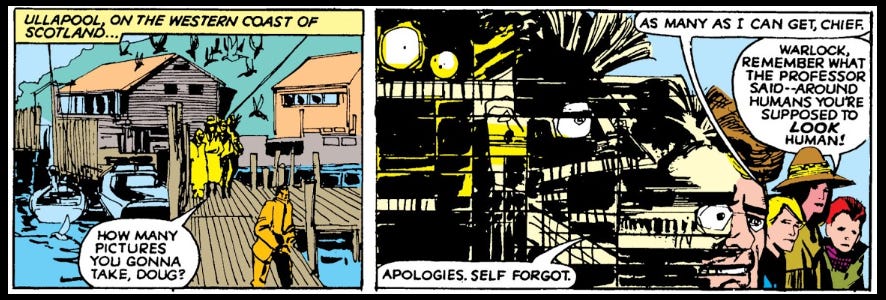
After the Demon Bear, we’re introduced to Warlock, who seems to have been created purely for the purpose of giving Sienkiewicz crazy shit to draw on any occasion. The character doesn’t transition into his quirky mascot role until after Sienkiewicz departs. He couldn’t have: Sienkiewicz never lets the reader forget how utterly (and often unsettlingly) alien Warlock is.
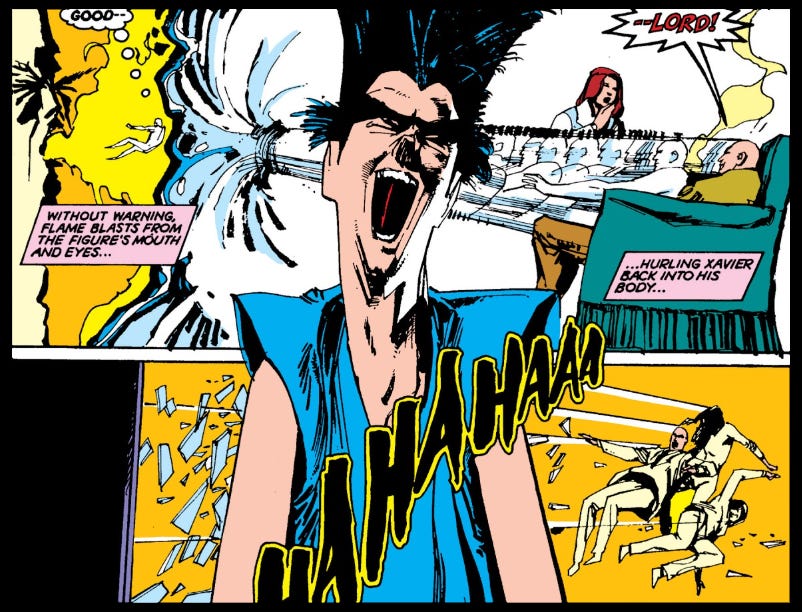
Sienkiewicz also co-creates David Haller, the troubled adolescent son Professor Xavier never knew he had. The seed of the three-issue “Legion” arc was planted way back in New Mutants #1 by way of a passing allusion, so Claremont at least had an idea of an idea for a story—and it’s fortunate that he waited for nearly two years of publication time to come around to writing it. There’s no way Legion would have shaped up as he did as a character, or had such a memorably nightmarish introduction, if Claremont was still working with Bob McLeod or Sal Buscema. Even if either of them had champed at the bit to draw a couple of issues taking place in the chaotic, phantasmagoric mindscape of a person with dissociative identity disorder whose personalities were literally at war with one another, it’s doubtful they could have executed it with such finesse. (Nor, probably, would Haller have the odd but striking hairstyle that’s been the character’s visual signature for forty years and running.)
As long as we’re going down a reel of Sienkiewicz’s greatest hits on New Mutants: his final couple of issues involve the reappearance of Shan, who had apparently been killed off in issue #6. Turns out she was merely possessed by Professor Xavier’s old nemesis Amahl Farouk (aka the Shadow King), now a free-roaming psychic demon. Having been a fat bastard in life, Farouk luxuriates in his new body by stuffing food into it—and poor Shan grows morbidly, hideously obese.11 Again, I’d wager that Claremont didn’t have this in mind when he foreshadowed Shan’s possession in the book’s early issues, or at least wouldn’t have thought to take it to such an extreme if taking things to hallucinatory extremes wasn’t his collaborator’s forte.
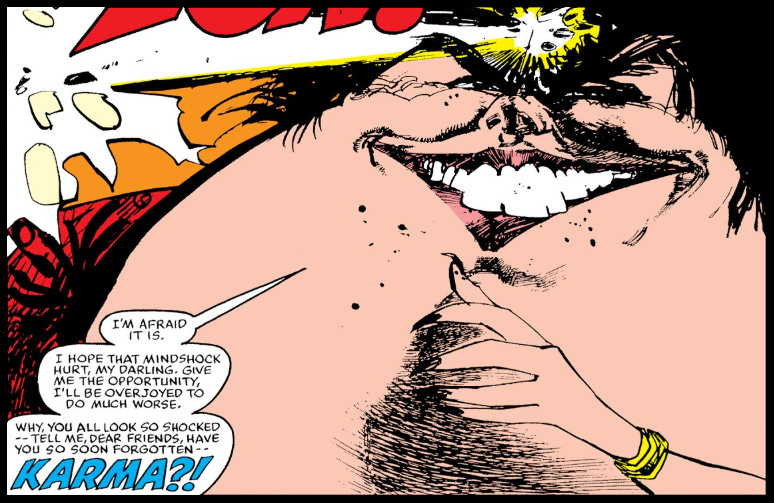
Obviously the New Mutants can’t be the same book after Sienkiewicz stops drawing it—but going forward, Claremont brings an energy and confidence to the series that it lacked before the Demon Bear lumbered onto the scene.
Rather than give an overview of everything that happens during Claremont’s last two years on the book—and risk making this much longer than it already is or needs to be—I’ll just call attention to one particular development. Over in Uncanny X-Men #200, a repentant Magneto is exculpated of his crimes against humanity by a United Nations tribunal. (It’s easier to swallow if you read it.) Meanwhile, Xavier has to leave the Earth for comic-book reasons we don’t need to get into here. Before departing, he gives his former nemesis the keys to the X-Mansion and admonishes him to continue his work.
In New Mutants #35, Magneto introduces himself to the gang as their new teacher and headmaster. He shortly encounters a steep learning curve: the students aren’t altogether eager to trust a former mutant supervillain and terrorist, and he’s more habituated to employing the stick than the carrot when it comes to discipline. But he gives it the old college try, and the scenario places him in the position of being a student of a kind himself. Most of what we see of Magneto during his brief 1980s redemption arc occurs in the pages of New Mutants, not Uncanny X-Men.
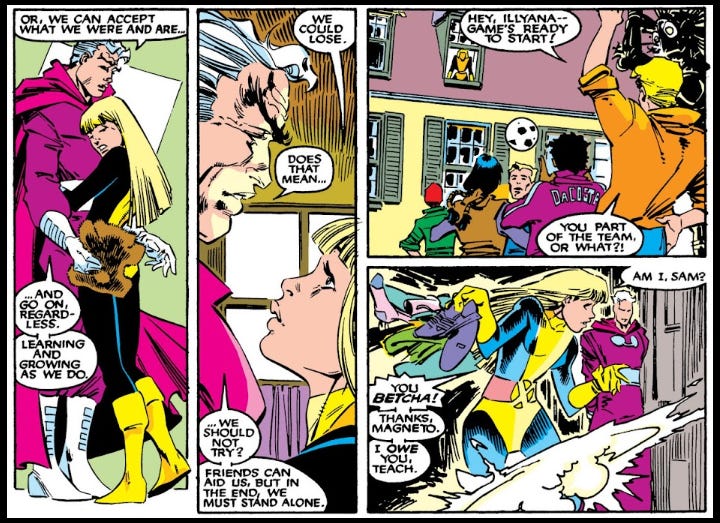
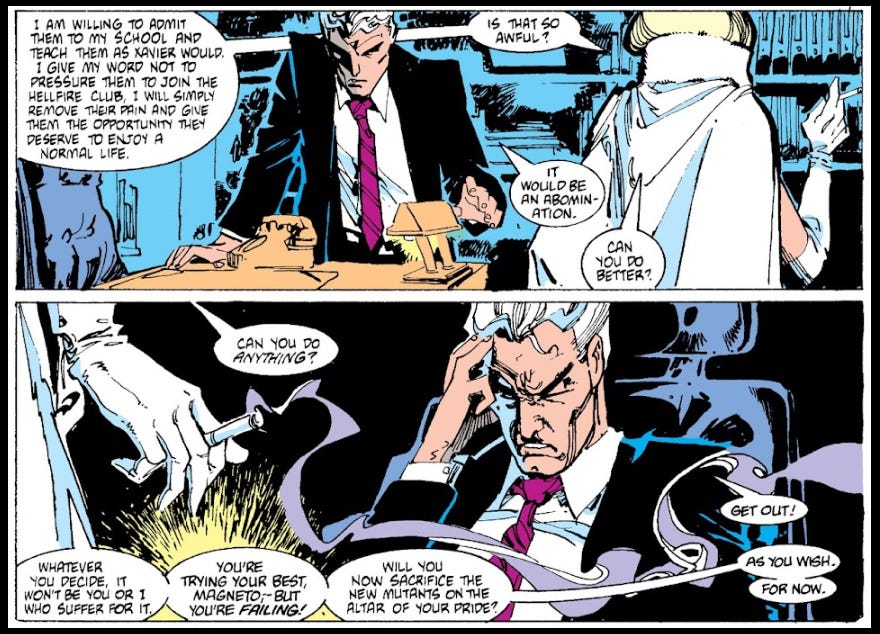
With Magneto on board, the drama between the New Mutants and Hellions acquires a new dimension as the rival schools’ headmasters enter into a complicated agonistic relationship of their own. Magneto, out of his element and on less certain footing than his predecessor, is more willing to talk to and occasionally bargain with Frost. Her function in the narrative wobbles from heartless, purely rotten supervillain antagonist towards acting as a more multifaceted character foil.
Both Magneto and Frost have checkered pasts, to the say the least. Magneto tries to be an effective mentor and a good influence, but struggles in his new position. Frost, a nasty piece of work and proud of it, is a more experienced teacher than Magneto, and even if her endgame is to indoctrinate and use the New Mutants, she probably cares for them (and her Hellions) more than she’ll allow herself to admit. The pair has a fascinating dynamic that simply wouldn’t work if the more scrupulous and self-assured Xavier was still in charge.
It ain’t quite Charles Dickens (and maybe not even Louisa Alcott), but it’s a smart and fun read—and pretty impressive for newsprint ephemera sold for 75 cents a chapter. But that’s generally true of Claremont’s 1975–1991 X-Men work.
II. Louise Simonson & Brett Blevins
(Issues #55–84)
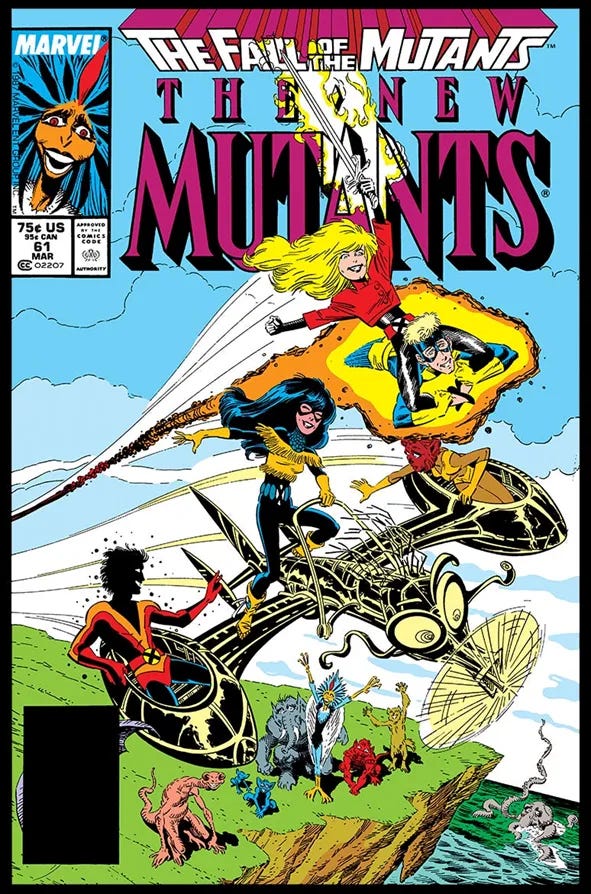
(Above: note the [trademarked] “Fall of the Mutants” logo over the title, and remember that this was the decade where EVENTS crept into the narrative economy of comic books.)
Once New Mutants gets rolling, it seldom looks or feels like an “X-Kids” book—and some decision-makers at Marvel evidently felt this was problem.
Claremont left after issue #54 to allocate more time to another project (a novel, I believe), and his authorial role on New Mutants was assumed by his former editor Louise “Weezie” Simonson. The substitution was only supposed to be temporary, but she ended up writing the series for over three years.
Claremont could not have realistically asked for a better collaborator than Simonson. The pair had an excellent working relationship when she was his editor on Uncanny X-Men in the early 1980s, and she fundamentally understood the X-Men as a concept. Her writing was somewhat more melodramatic and less nuanced than Claremont’s, and she was more willing to embrace comic-book silliness and leaps of logic—but even if we rank her as a lesser light, she deserves much of the credit for the X-Men’s successful evolution from an individual Marvel title to a de facto Marvel imprint.
That said, the quality of New Mutants precipitously dips once Simonson is on board. It’s possible that her run could have gone a lot better than it did—but, to begin with, an editorial decree to make the book more “teenagery” fell upon her to carry out. So for her very first issue, she pens a one-and-done 1980s after-school action special where Sam learns he doesn’t need to take drugs to be cool. Afterwards, the gang befriends a human/bird hybrid with an insatiable appetite for McDonalds McBurgers burgers n’ fries. The girls suddenly start talking about cUtE bOyS and caring more about fashion than before. Mischief and horseplay abound. Everyone acts completely out of character. Stupid, even.
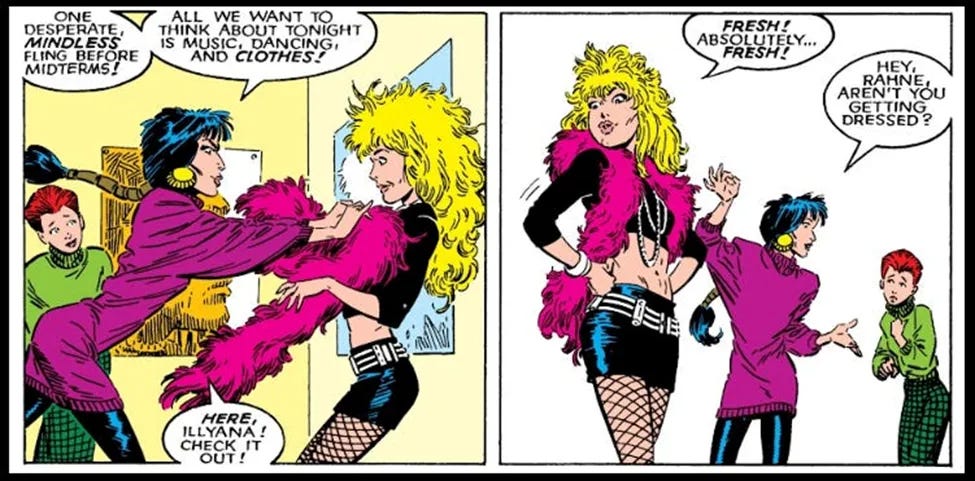
Simonson later admitted she overdid it. She course-corrects as time goes on, but on the whole it feels as though the gang’s shared coming-of-age narrative abruptly ran in reverse between issues and resumed years behind where Claremont left off.
For the first and main stretch of her run, Simonson was paired with regular penciller Brett Blevins, whose art . . . takes some getting used to. His style is emotive and kinetic and never dull to behold, but it’s idiosyncratic and cartoony almost to the point of gritty carnival caricature. The New Mutants are drawn smaller and slenderer than before, with oversized heads and big eyes, in service of making the book more youth-flavored.12 Warlock starts looking like a robotic noodle. Sam gets a cylindrical head, while at times Dani’s face shape wouldn’t seem out of place on Egyptian sculptures of Akhenaten and his family. When Doug smiles, he smiles like an Aryan stockbroker contemplating a hostile takeover.
We must also address the elephant in the room of the Blevins run: his squicky interest in the shapes of Illyana and Rahne’s bodies. He’s not loud about it—but he draws some of the pertest breasts and roundest butts in the Marvel Universe, and they’re all on underage female characters. Once you notice it, you can’t un-notice it.
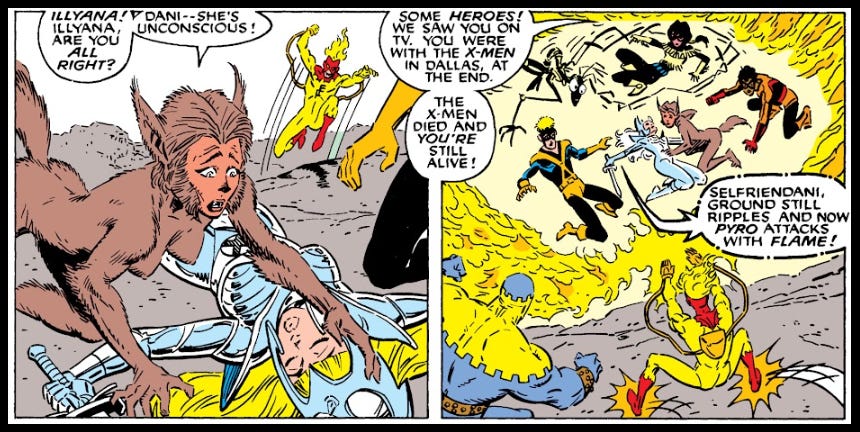
I understand that at some point after Claremont left New Mutants, somebody else at Marvel decided that Magneto ought to turn villain again. Judging just from the way Blevins draws the character—big bushy eyebrows, a permanent scowl, deep lines in his face, a smile that invariably comes across as sinister—I wouldn’t be surprised if he and Simonson planned to nudge the character back towards his red and purple helmet from the onset. For Simonson’s part, she writes Magneto as less of a stern but kind headmaster and more of a crotchety martinet than did Claremont, and he rapidly grows draconian and unhinged.
Maybe “nudge” is the wrong word. The foreshadowing isn’t subtle. Not much about the Simonson/Blevins run is.
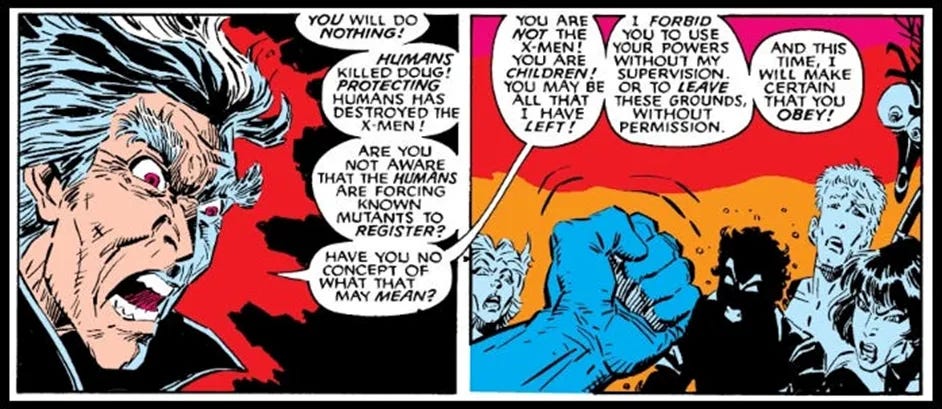
Oddly enough, Simonson’s Magneto takes Claremont’s ideas about New Mutants’ premise more seriously than Claremont. “Stop going out and having adventures and fighting supervillains!” he rages (not an actual quote). “You’re not supposed to be doing any of these things! You could get hurt or killed! You’re not superheroes! You’re students!” The narrative paints Magneto as a mulish, unreasonable bad guy for taking this position, and it’s as much as saying the quiet part out loud: if New Mutants’ original concept was ever to be adhered to, it wouldn’t have been a comic most Marvel fans would have deemed worth reading.
Among the other crimes typically attributed to Simonson and Blevins are the introductions of Bird-Brain and Gossamyr, temporary team members whom it’s almost a faux pas to admit to liking, and who manage to overstay their welcome even though neither lasts even ten consecutive issues. They’re also responsible for the Ani-Mator, a skanky mad scientist adversary whose archetype was already about a decade past its sell-by date, and who’s only remembered because he shoots and kills Doug. They also forget the Hellions exist (with the exception of Empath, whom they try to redeem for some reason)—and instead do stories about the Ani-Mator and Gossamyr. This can only be called an unforced error.
But one thing that can be said on behalf of the Simonson/Blevins run is that it avoids committing the deadliest sin of comic books. It isn’t boring. The Bird-Brain outing is cringe, but too weird not to be memorable. Their other despised original character Gossamyr is written and drawn as an ethereally beautiful alien girl who instinctively manipulates and messes with people, and is actually the larval form of a species that turns into a gigantic world-devouring monster as it matures. Weird! I believe Simonson has said her favorite issue was #64, where Warlock the eternally innocent alien notices that all of his friends are sad about Doug’s death and tries to cheer them up by exhuming his corpse and bringing it back home. What ensues is strangely touching, and more in line with Claremont’s original vision for the series than anything else that happens during the second half of its run—and it’s also seriously weird.
And I have to appreciate weird. I have to appreciate something that, in spite of editorial meddling and oversight, evinces such ingenuousness and such a lack of self-consciousness. Simonson and Blevins’ New Mutants isn’t trying to be cool or smart or deep, and for all the criticism that can and has been lobbed at it (I’ve seen some of the reader mail pages—ouch), it’s possessed of a melodramatic enthusiasm that serves it in good stead. I still buy and read the X-Books on and off these days (digitally, sad to say), and most would benefit from daring to be as messy and busy and bizarre as this phase of New Mutants.
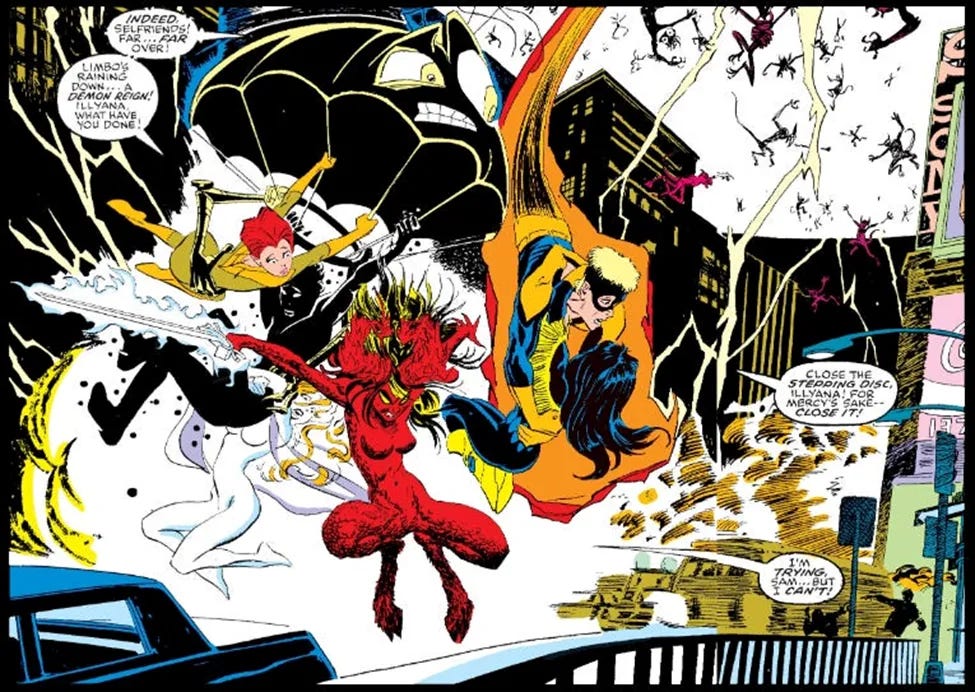
During the Simonson/Blevins run, Illyana’s downward spiral accelerates in anticipation of the Inferno EVENT—the climax of classic New Mutants, insofar as it ties up the long-running “Illyana slowly being corrupted and losing control” plot thread. In the immediate aftermath, the gang parts ways with Magneto after their headmaster announces he’s an evil asshole again and was never that invested in being a good guy to begin with. It’s just as well: the New Mutants have been functionally without a mentor for over a year of publication time. This just makes it official.
At this point, the book has a problem on its hands. Its foundational concept is shot: there’s no more teacher and no more school (the X-Mansion got blown up). Illyana, whose personal arc has long been the overarching narrative’s most reliable source of thrust, is gone. Having exhausted most of its short- and long-term dramatic resources, New Mutants stands at an impasse. If it were an independent comic, a manga, or a webtoon, it might have have either ended or went on hiatus at this point. But it was a Marvel comic, and Marvel comics usually don’t end until the higher-ups give them permission or tell them to end.
So Simonson spins the book’s wheels with a storyline that takes place in Asgard (province of the Marvel superhero version of Thor) and runs for the better part of a year. Why not? It spares New Mutants from having to work out its issues on terra firma, and certainly reads as though Simonson was stalling for time with a filler arc. This is where it finally does get boring.
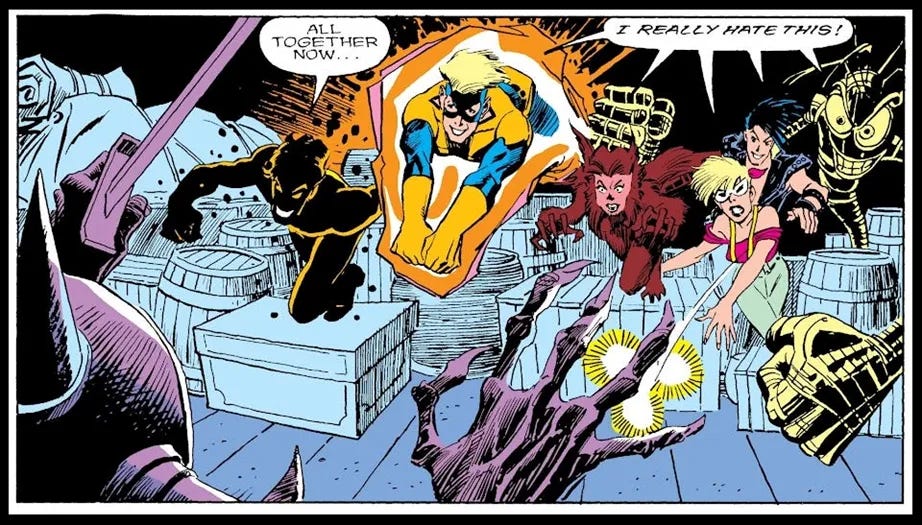
(Oh, yes—the roster received some additions. The only two who matter at all are Tabitha [Boom-Boom] and Julio [Rictor], seen above, second and third from the right. Going into more detail would entail writing about the X-Terminators limited series, and I don’t want to.)13
When all is said and done (at long last), Dani elects to stay behind in Asgard and do Valkyrie stuff. Again, why not? What’s one more longstanding pillar of the book demolished? Simonson never seemed as interested in Dani as Claremont was, and I think it’s obvious that Blevins didn’t like drawing her as much as Illyana and Rahne—for reasons indelicate to state.
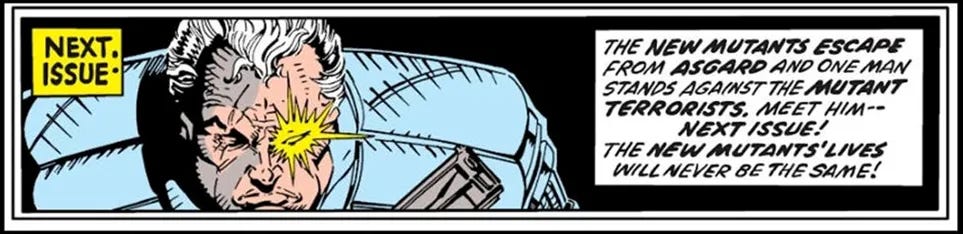
In the meantime, Blevins left New Mutants after issue #83. His replacement had already been announced to much promotional fanfare.
III. Louise Simonson & Rob Liefeld
(Issues #86–97)
Ah ha. Hahahahaha. Ah hohoho. Hee hee. Haaah. Heh.
Whoof.
Rob “Anatomy 101” Liefeld saved New Mutants. I hate to say it, but it’s true—even though he destroyed the book in the process.
Unless you’re old enough to have been there (and I’m not quite), it’s difficult to account for the rising star of young penciller Rob Liefeld. New Mutants was his first gig as the regular artist of an ongoing monthly, but he’d already made a splash in the comics world for his work on single issues and limited series for both DC and Marvel. What can we say about his art style? It was refreshingly different, perhaps. It was gristly and toothy and puffy and frizzy. It bulged. It got all up in your face.
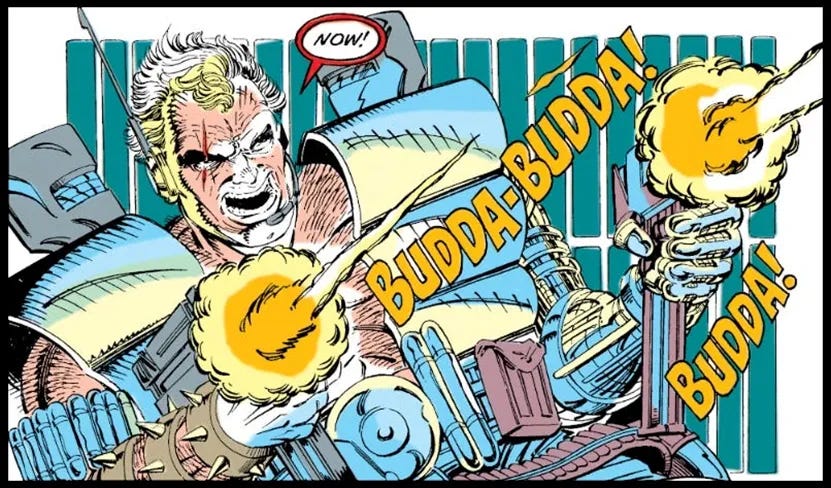
That’s not to say it was good, but dudes who read comic books in the late 1980s and early 1990s vibed with it. It was a pure product of its moment, like the Macarena or Limp Bizkit. And it somehow got worse over time—as though Liefeld was on his best behavior for his first several months on the job and then stopped giving a shit once the audition period was over and he was about as close to a household name as comic book illustrators can get.14
New Mutants #86, Liefeld’s first issue, teases a new character on the final page. The following month—January, 1990—that character made his landmark debut.
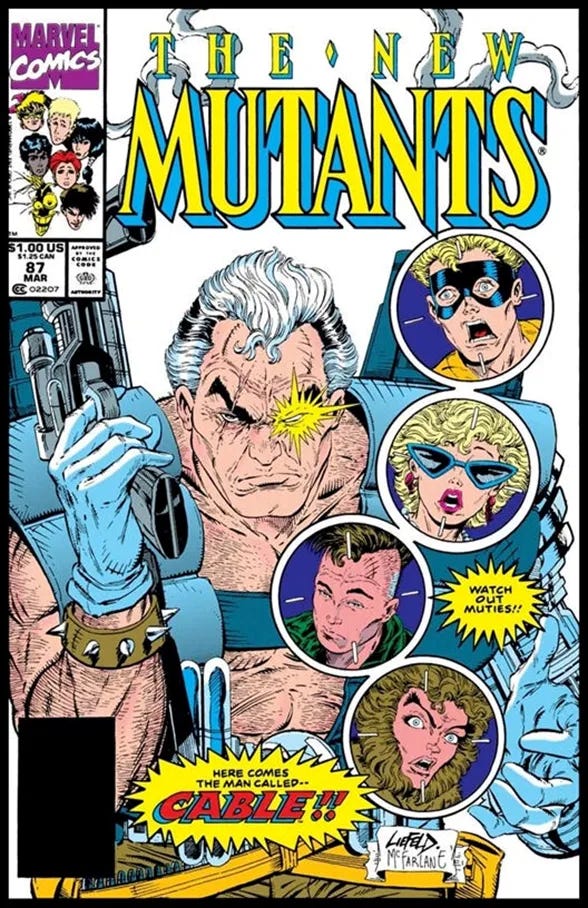
I’ve seen comic book nerds make the case that Cable was the last truly iconic X-Men character, and I suppose I have to agree with them. When I try to think of X-people introduced after him who had a comparable impact or as much staying power, the only name that comes to mind is Deadpool—another character Liefeld invented for New Mutants. Who else is even in the running? X-23, perhaps? Or maybe Bishop—and Bishop only happened because Cable happened first. [Postscript: I just now thought to check when Gambit made his first appearance—and, what do you know, it was a few months after Cable. I stand corrected.]
For all sorts of good and all sorts of bad reasons, Cable was a phenomenon. In New Mutants #93–94, he gets in a fight with Wolverine—and their collision wasn’t presented as “popular character condescends to make a guest appearance in an underperforming comic to boost its sales,” but as “ALL ABOARD THE HYPE TRAIN MOTHERFUCKERS!!!!” After less than a year of publication time, Cable was already regarded as a rival for Wolverine—and, like in professional wrestling, this sort of thing has less to do with weight class than popularity.
Eventually, Cable grows into a fully rounded character with an integral (though convoluted) place in the lore. In his first appearances, however, he’s just a big hard slab of a middle-aged cyborg commando with body armor and spikey bracelets and impractically large firearms and a neat glowing eye. I doubt Liefeld had much else in mind for him; he just wanted to draw what he wanted to draw. (Scroll back up and look at the headset Cable is wearing. It has no purpose. He is not in communication with anybody and has no reason to be wearing it. Liefeld thought it looked cool, though.)
In short order, Cable crosses paths with the New Mutants and adopts them as their new teacher and mentor. Why not? He needs help fighting terrorists, and the gang needs an adult. It happens so fast that you find yourself accepting it as a fait accompli by the next issue. I suspect a lot of longtime readers were relieved that the book had picked a direction to go in and was moving again.
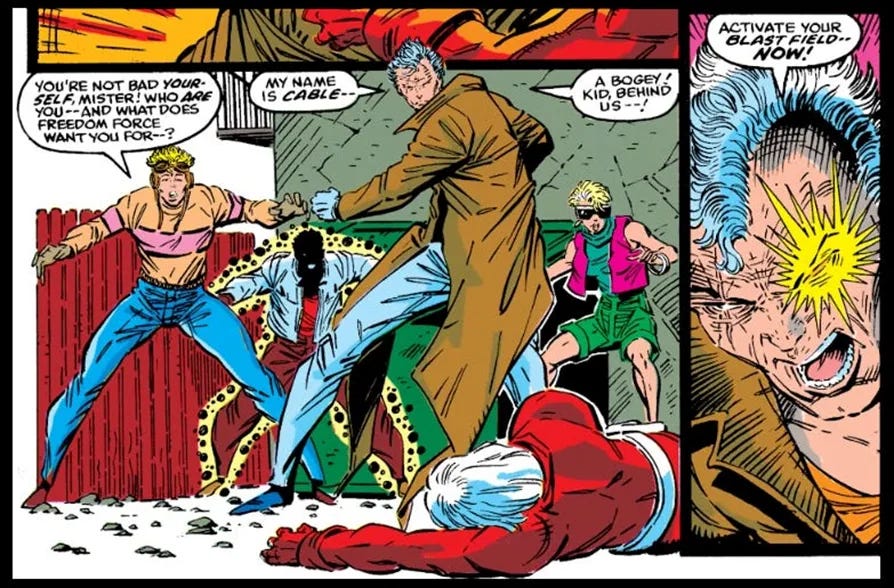
Many years ago, I owned a collected edition of the Simonson/Liefeld issues titled Cable and the New Mutants. The word CABLE was printed in great big letters at the top of the front cover. In itty-bitty letters far below: and The New Mutants. It fits: as soon as Cable shows up, he becomes New Mutants’ center of gravity. The series’ title characters are relegated to his supporting cast.
Cable and the gang set up shop in the abandoned sub-basement of the leveled X-Mansion. They fight the Blob in the streets, Sabretooth in the sewers, and visit shady East Asian port city pastiche Madripoor to contend with Stryfe and the Mutant Liberation Front (Liefeld’s attempt at a gritty new version of Magneto and the Brotherhood of Evil Mutants). Cable, unlike Xavier or Magneto, has no compunctions about bringing his students into combat situations.
Readers were into it. From the beginning, Claremont’s concept of the New Mutants as being kids who were never meant to go out seeking danger and fighting supervillains routinely ground up against the necessity of making them do exactly that in order to have a marketable Uncanny X-Men spin-off. Once Cable is calling the shots, the series can finally stop pretending. Yeah, the New Mutants are here to inflict violence upon nasty sons of bitches and save the world from evil mutants and terrorists and monsters, just like the X-Men. They always were.
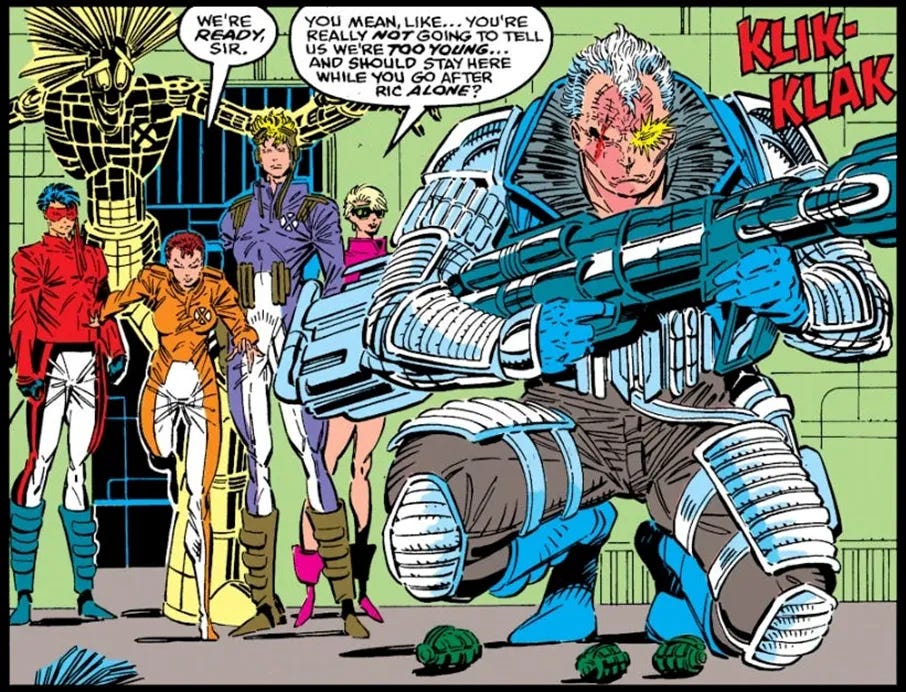
I would have liked to include more Liefeld art here, but it’s kind of hard to capture. Peter David once snarked that Liefeld’s pages are “pin-upped chaos.” The panels are huge. In the “Cable & The Gang Go to Madripoor” two-parter, there’s often just three or four to a page, drawn to look loud and exciting and in-your-face. Whether or not the illustrations depicted a coherent sequence of events or even added up on the level of the individual panel (look closely at Rahne up above; what’s happening there? and what’s with Cable’s foot?) was a matter of secondary importance.
Behind the scenes, editor Bob Harras was so convinced of the value of upstart artists like Liefeld that he started giving them much more than the usual latitude in determining the direction of the books they were working on. It did make sense: Liefeld belonged to a crop of star pencillers (with Jim Lee, Todd MacFarlane, Whilce Portacio, et al.) who were drumming up a lot of excitement and moving a lot of product, and Harras was eager to make them happy and keep them on the Marvel reservation. On New Mutants, Simonson reportedly wanted to do one thing (coming of age stories) and Liefeld wanted to do something completely different (GUNS SWORDS BLOOD MUSCLES), and Harras sided with Liefeld. I’m not totally clear on all the details, but I can guess: when a penciller gives a writer a bunch of drawn pages (possibly behind schedule) that go off-script and tells her here they are, this is it, and then her editor ghosts her when she requests some form of mediation or intervention, there’s just not a lot a corporate comic book writer can do.
Simonson did help to keep some of Liefeld’s worst instincts in check for a while. I can’t take credit for the observation, but in writing the book’s dialogue, she ensured that Cable got to do what Liefeld wanted (be a manly bad ass) while also acting as a more emotionally available mentor to the New Mutants than Xavier and Magneto usually were. She was able to make it make some sort of sense that the kids would warm up to and trust him. Though the status quo had radically changed, The New Mutants still felt more or less like a continuation of what it had been before Cable showed up.
Nevertheless, Simonson finally got fed up and left the book—and Marvel—after issue #97. (Claremont would follow her soon afterwards, for similar reasons.)15 Liefeld assumed complete creative control over The New Mutants.
IV. Rob Liefeld & Fabian Nicieza
(Issues #98–100)16
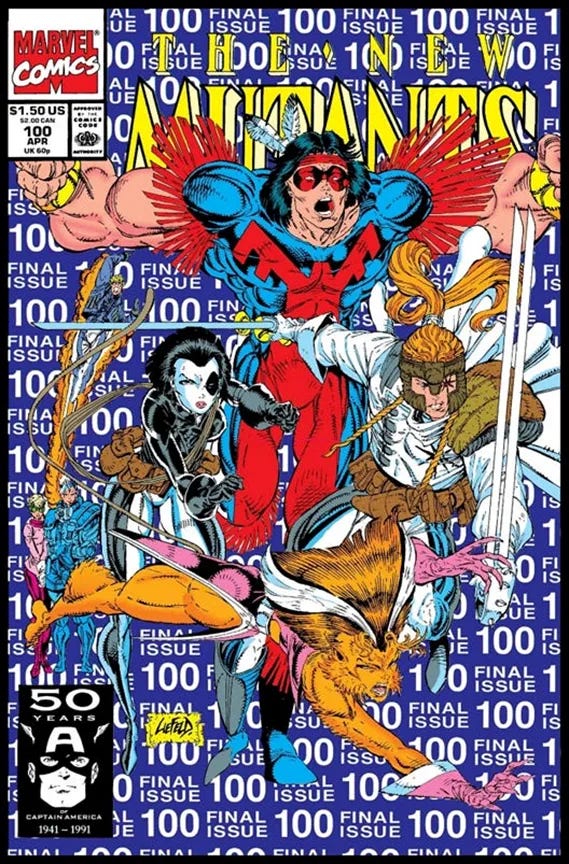
The credits of issue #98 attribute “plot & art” to Liefeld, and “script” to New Warriors writer Fabian Nicieza. The latter willingly took up the job that Simonson backed out of: penning dialogue to fit the story Liefeld was telling with his illustrated panels. If Nicieza was more amenable than Simonson, it was probably because he hadn’t been demoted to it.
Simonson’s last New Mutants issues coincided with the X-Tinction Agenda crossover EVENT, which did some work cleaning house for Liefeld. Rahne got written out of the book; whether it was because Peter David had earmarked her for his run on the soon-to-be reinvented X-Factor or because Liefeld wanted to draw a less-clothed variant of the same character (see below), I can’t guess. Warlock got killed off; there was no place for a friendly alien buddy character in Liefeld’s vision, and he probably didn’t enjoy drawing him.
At this point—late 1990—New Mutants enters into a pupal phase. It’s no longer the book it was before, and is transforming into something else entirely. Something bolder. Something edgier. Something more Nineties. Something dumber.
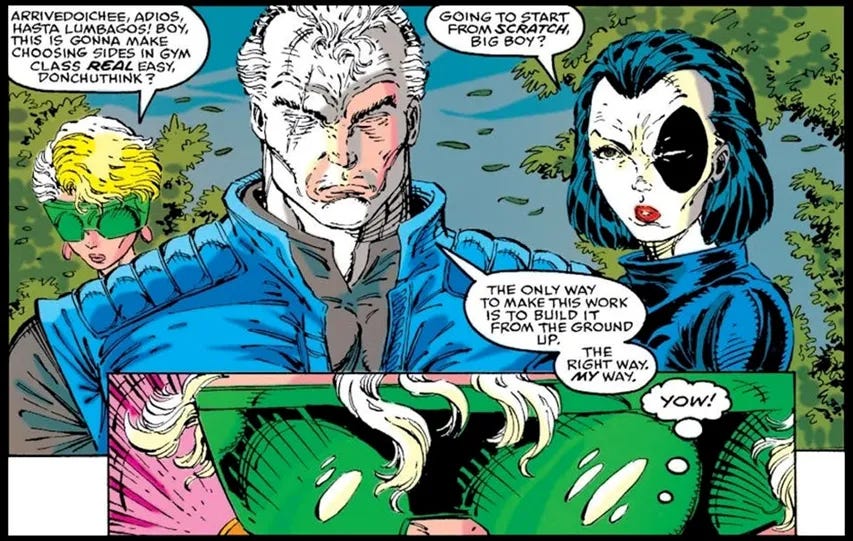
Liefeld and Cable simultaneously go mask-off. There’s a war a’ comin’, Cable says, and the New Mutants have to be ready for it. They’re gonna go underground and be an outlaw paramilitary strike force from now on, and anyone who can’t stomach that can take a damn hike. Without anyone holding Liefeld back, Cable gets to shoot people in the face (with bullets—none of that “incapacitating plasma beam” crap), and their buddies stand around all surprised because X-people ordinarily don’t handle low-tier goons with a sidearm. And thirteen-year-old boys reading the book go ooohhhhhh shit. And the Comics Code Authority goes eh, it’s fine.
After Berto and Ric walk out, the only pre-Liefeld cast members left are Sam and Tabitha. Fortunately, Liefeld has their replacements all lined up. He introduces Domino (younger sexier girl-Cable with a dalmatian’s eye-spot), Shatterstar (swords, stupid headpiece, violent tendencies), and Feral (basically Rahne, but with skimpier clothes, a vicious temperament, and no human form). The addition of Hellions defector James (now called “Warpath”) rounds off the new team.
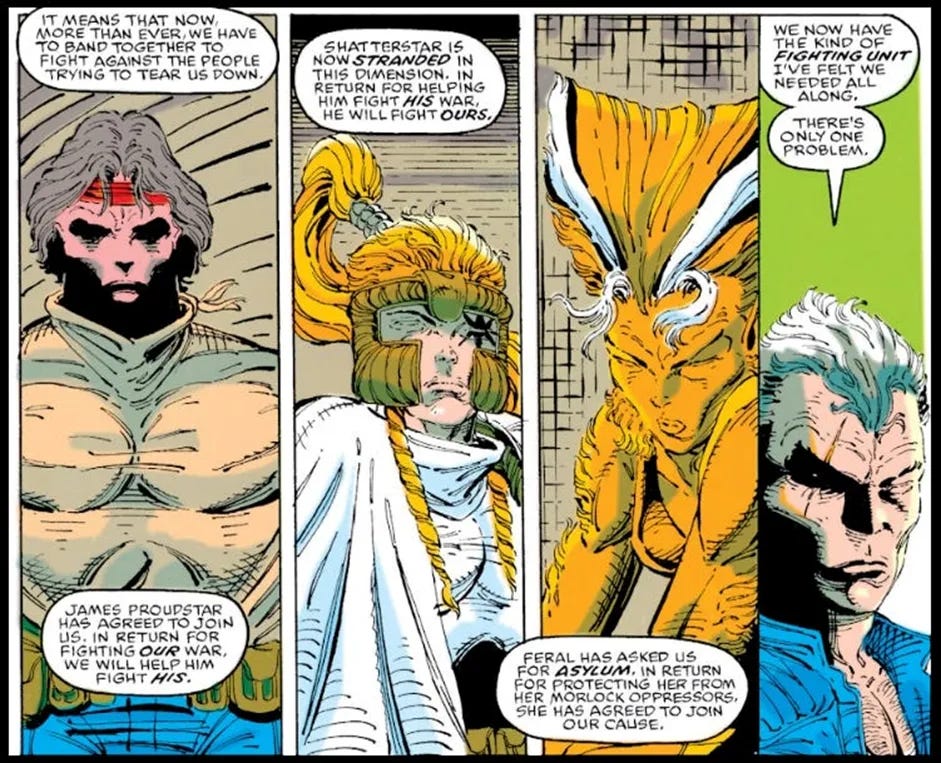
The series ended on issue #100. A few months later, it returned under the title of X-Force, picking up right where it left off. New Mutants was dead, and Rob Liefeld killed it.
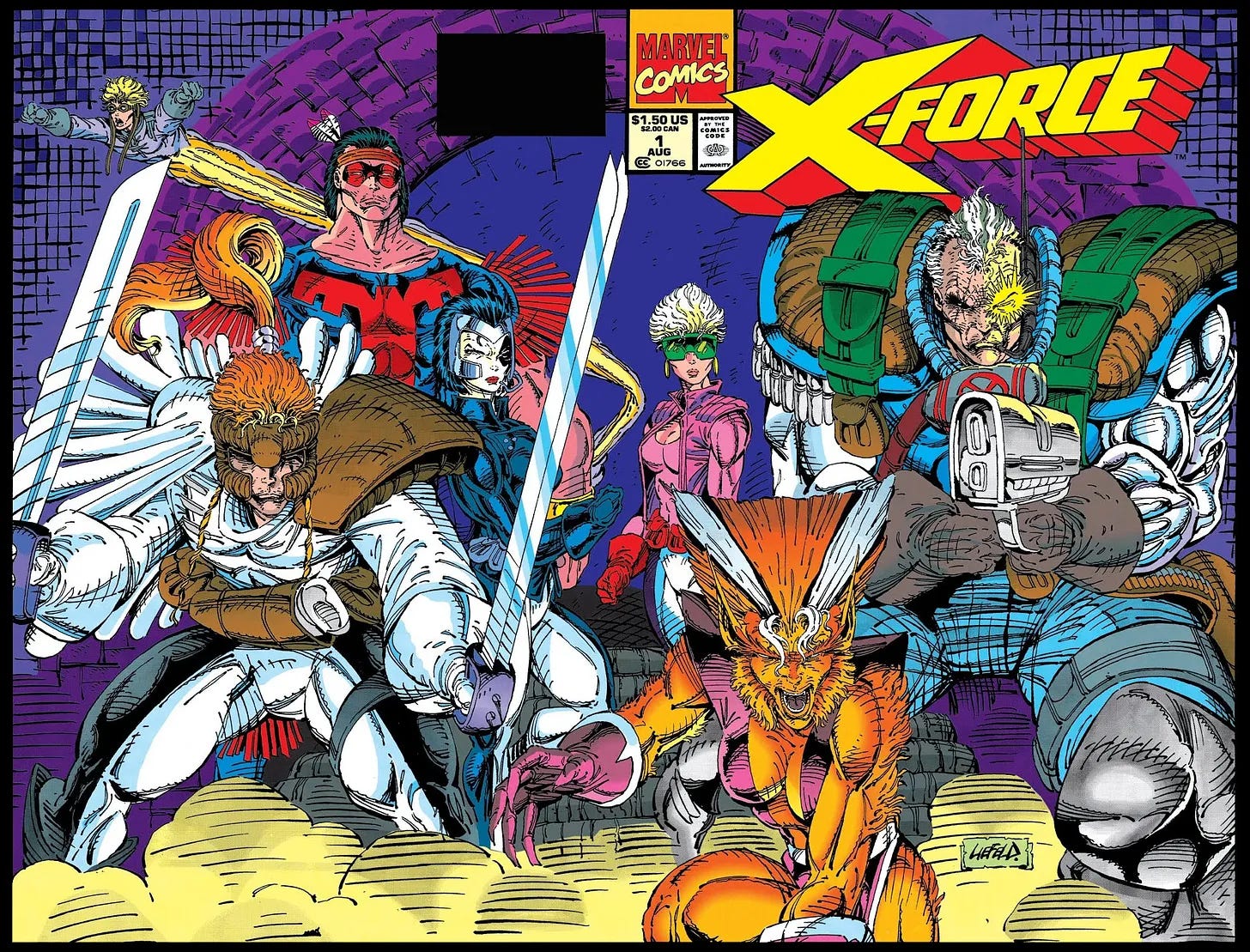
So why am I out here saying that Rob Liefeld saved New Mutants?
Liefeld unexpectedly left Marvel about a year into X-Force. At least in the short term, the plan after his departure was to stay the course: make the book more coherent, perhaps, but preserve its basic vibe. Roberto and Ric soon rejoin the team, but they’re not quite who they were when they left. They’re bulkier, bolder, more masculine. Dani eventually reappears, but not as a friend, and looking like something entirely other than the scrappy teenager she was in New Mutants.
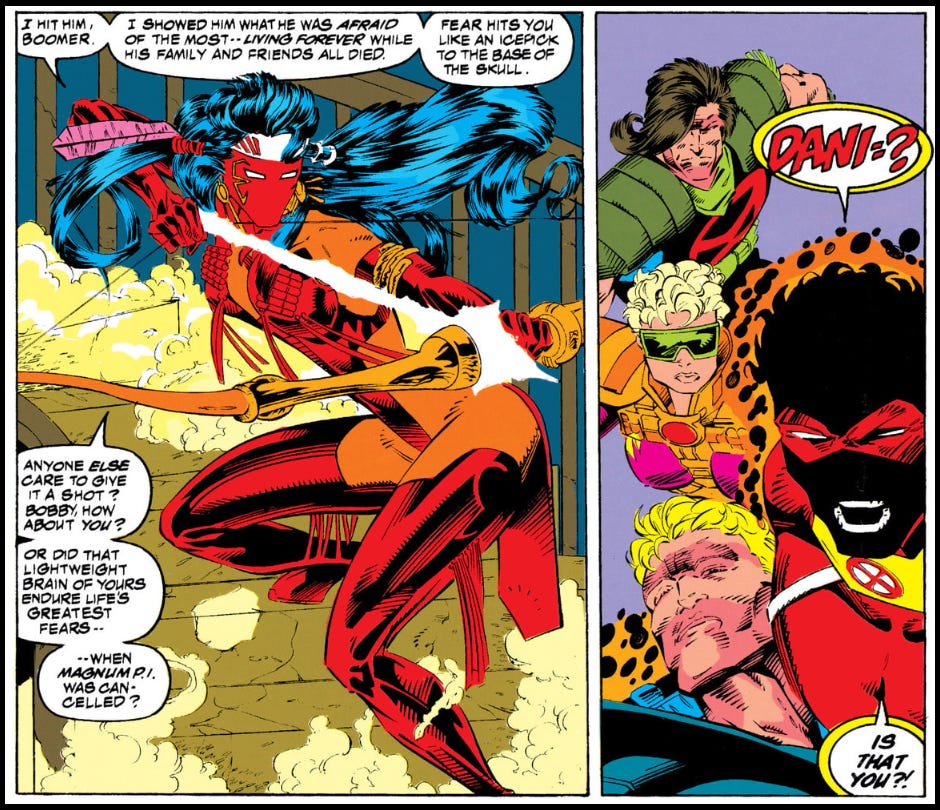
(No, seriously, the 1990s were a bizarre period for superhero comics. But more on that next time.)
I remember feeling a little surprised in 1992 (or thereabouts) when members of the X-Men referred to X-Force as “kids.” They certainly didn’t look like children—and having never read New Mutants, how was I supposed to know that the jacked and confident Sam (as drawn by Greg Capullo) was ever a doofy beanpole? Not that I had a grip on the degrees of adulthood between adolescence and middle age back then, but nothing about the characters in X-Force seemed child-coded to me. Heck, when I acquired that collection of the Simonson/Liefeld issues of New Mutants and got a little more background, I still assumed there’d been a significant in-universe time gap between the end of New Mutants and the beginning of X-Force.
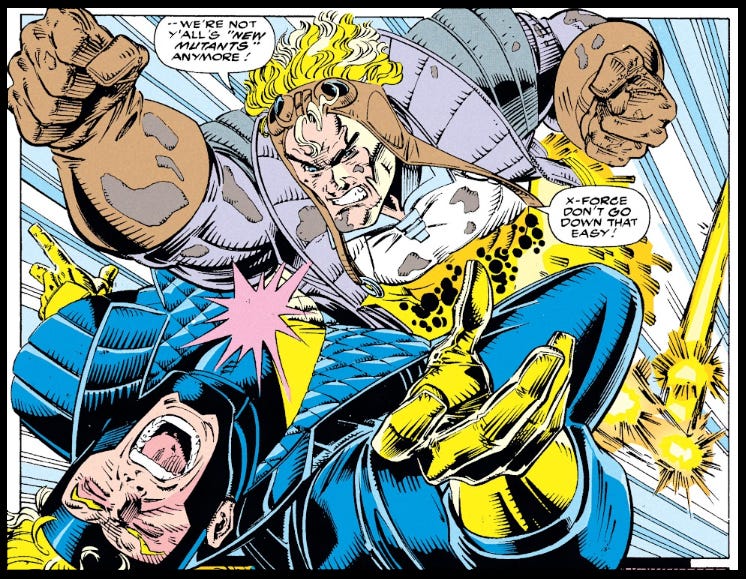
There wasn’t. It was just comic books rolling with a new creative direction, even if it didn’t make much sense, even if it was a bad idea to begin with. But by the time X-Force entered into a process of de-edgification, there was no use pretending it was possible to put the gang back in their student uniforms and re-enroll them in mutant high school. That ship had sailed.
If absolutely nothing else, Rob Liefeld deserves credit for forcing, by sheer dint of continuity-distorting hype, the stubbornly eternal present of the comic book timeline to advance when there was nothing at all preventing the New Mutants from remaining sixteen(ish) years old for another decade—or longer. Thanks to him, they were actually allowed to complete their coming-of-age story and grow up—even if it all happened in the dumbest way imaginable.
VALEDICTORIAN: Cable—obviously. After just a few issues, he commanded more star power than the entire cast of New Mutants after seven years of publication, and had a greater impact on the X-Men mythos and the comic book scene than any of them.
NON-CABLE VALEDICTORIANS: Tough one. I’d say it’s a two-way tie between Rahne and Illyana—arguably the book’s most developed cast members, and the ones who went on to do the most after it ended.
For two decades after New Mutants ended, Rahne was regularly featured in series that were neither New Mutants rebrands (i.e., X-Force) nor revivals. She had prominent roles in Peter David’s X-Factor (both its 1990s and 2000s iterations), post-Alan Davis Excalibur, Craig Kyle & Chris Yost’s X-Force (no relation to Rob Liefeld’s X-Force), and a late 2010s volume of Uncanny X-Men that I’d rather not say anything about. Too bad for Rahne that so many writers seem to get off on torturing her.17
Despite having been temporally reverted to her pre-Limbo seven-year-old self at the end of the Inferno EVENT and then killed by an AIDS metaphor (the Legacy Virus) in the early 1990s, Illyana returned to the world of the living in the late 2000s (comic books, everybody) and found writers eager to use her to her full potential—i.e., as a grown-up version of her New Mutants iteration. She hasn’t spent much time out of circulation since then, and is a consistent crowd-pleaser.
DROPOUT: Bird-Brain—obviously.
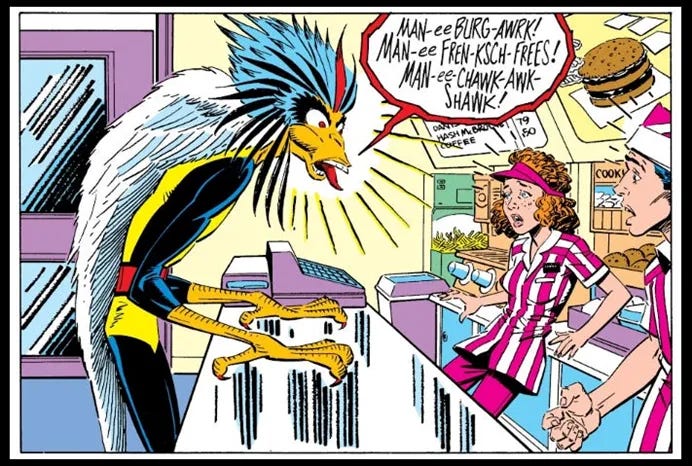
NON-BIRD-BRAIN DROPOUTS: Of the Claremont-era cast, it comes down to Amara and Shan. Both got written out with little ado, and neither went on to do terribly much outside of New Mutants revival books. I’m going to pick Amara purely because of her backstory shenanigans, presented here as a story in three acts.
1980s Chris Claremont: Amara is from the city of Nova Roma, a vestige of Roman civilization that somehow migrated from Europe to South America, preserved its traditional way of life, and remained isolated from the outside world for like 2000 years. Isn’t that neat?
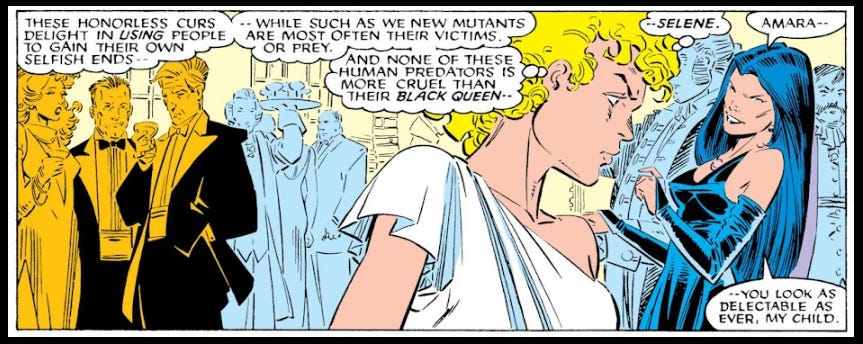
1990s Fabian Nicieza: Hey, I’m from South America—and Nova Roma is stupid. Plot twist: it was recently built by the immortal mutant sorceress Selene and populated with psychically brainwashed abductees who’ve been made to think they’ve lived in Nova Roma all their lives. Amara is actually a young woman from the United Kingdom.
2000s Chris Claremont: Oh look, here’s Amara, popping up completely out of nowhere in the last issue of X-Treme X-Men for no other reason than to say “hey by the way it turns out Nova Roma was real actually, yeah, we were cruelly tricked into believing it was a sham (somehow & for some reason), but it’s totally really a thing and fuck you Fabian.”
MALEDICTORIAN: Deadpool. Obvio
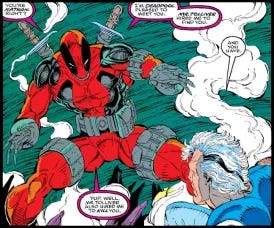
MALEDICTORIANS: The Hellions are New Mutants’ best antagonists by a wide margin—but they don’t make much of an impact on the X-mythos in the long term because all of them but Thunderbird/Warpath and Empath are made the victims of a morbid inaugural sacrifice to the post-Claremont 1990s in Uncanny X-Men #281–82.
In big-picture terms, the New Mutants’ most enduring original villain has to be Selene. We haven’t said much about her because she was introduced during the book’s ungainly pre-Sienkiewicz period as an immortal mutant sorceress operating in Nova Roma, and doesn’t do that much in New Mutants afterwards—except for joining the Hellfire Club as its Black Queen, attaining the status of full-blown X-Men adversary. In the late aughts, she’ll be the Big Bad of the Necrosha X EVENT (Marvel’s answer to DC’s Blackest Night EVENT).
BEST STORYLINE: Fox chose the Demon Bear story as the template for its New Mutants movie with good reason. However—I think I have to go with the gang’s first trip to Asgard in New Mutants Special Edition. The amount of character work Claremont gets done in what’s effectively a “summer vacation in Norseworld” three-parter is insane, and Arthur Adams’ artwork is simply jaw-dropping. Coming where it does in the series’ chronology, it demonstrates how much better Claremont understood New Mutants and what it could do and be after working with Sienkiewicz.
WORST STORYLINE: The gang’s long, long second visit to Asgard during the twilight of the Simonson/Blevins run. It’s so distended and so dull that the arrival of Rob bloody Liefeld can only be called an improvement.
Phew. I promise everything else we look at will go a lot quicker than that—partially because most of the “new New Mutants” books won’t run for anything even close to 100 issues, and partially because none of them are even half as influential or impactful.
X-FACTOR
(1986–1991)18
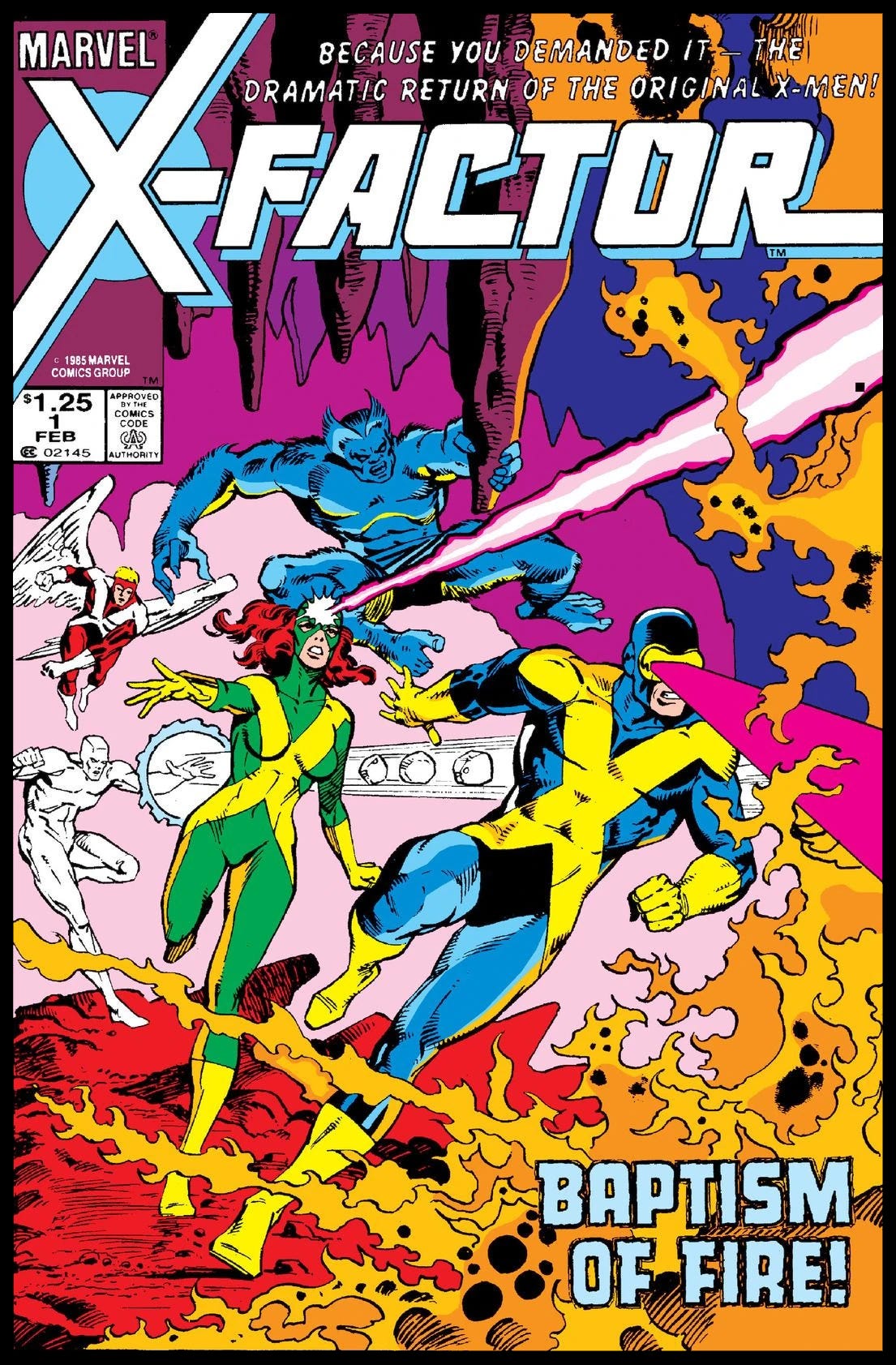
As I understand it, the idea came from Marvel’s editor-in-chief Jim Shooter.
By the mid-1980s, the teenaged 1960s iteration of the X-Men (Cyclops, Angel, Beast, Iceman, and Marvel Girl) was the stuff of dialogical allusion and editorial inserts (see issue #45! —Louise). When the All-New, All-Different X-Men revival launched in 1975, Chris Claremont dedicated the first scene of his first issue to breaking up the original team. All of them but Scott announce that they’ve decided to move out of Xavier’s mansion and get real jobs somewhere else. Jean returns a bit later, but Bobby, Hank, and Warren stay gone.
It’s easy to imagine how obvious the concept must have seemed a decade later. Let’s get the old band back together. We’re gonna reunite the X-Men of the 1960s for some serial-form superheroics now that they’re all grown up.
Most of the original five X-Men were available. Scott had retired to Alaska to live with his wife Madelyne and their infant son Nathan. Bobby, Hank, and Warren had been on another Marvel superteam called the Defenders for several years, but their book had recently been cancelled, leaving Bobby to get a job as an accountant and Hank to seek work in academia. The only problem was Jean: she was dead. She’d been dead since 1980. Worse, she died at the climax of the Dark Phoenix Saga, which remains to this day the X-Men storyline of which non-fans are probably most likely to have at least some awareness. It wasn’t the kind of comic book death that could be waved off with the usual oh she actually survived the fall, or oh her wound wasn’t fatal, or even oh, the devious unseen malefactor teleported her away at the last second before the explosion and held her captive for six months. Jean was dead as dead could be, and her death had been a big deal.
In X-Factor #1, written by Bob Layton, it is revealed that the “Jean realizes the full godlike potential of her psychic powers, changes her nom de guerre from ‘Marvel Girl’ to ‘Phoenix,’ eventually goes berserk, and during a moment of clarity gives up her life in order to protect the universe from herself” plot arc, as Claremont and John Byrne wrote it, didn’t actually play out that way. You see, Phoenix was really a cosmic entity masquerading as Jean, while the true Jean has been sleeping in suspended animation in a protective cocoon at the bottom of Jamaica Bay all this time.19 So now Reed Richards discovers Jean, brings her back to Manhattan, and notifies Warren. So now Cyclops gets the phone call and runs out on his wife and son to go see his high-school sweetheart without saying where he’s going or why, and then doesn’t even try to contact Madelyne for at least a few weeks. So now with Bobby and Hank arrived to see Jean, the original X-Men are reunited at last—so why not start a business together?!
Warren’s old friend Cameron Hodge has an idea: “X-Factor—Mutant Investigations and Solutions!”
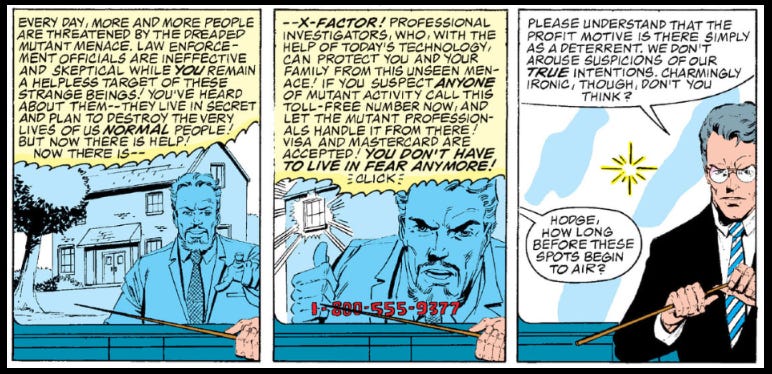
“People that suspect a mutant menace will call our toll-free number and report an incident!” Hodge explains. “We will then, in the guise of a team of psychologists and scientists, investigate the subject! In reality, our true goal is to isolate and protect the people who possess the X-Factor mutation in their genetic makeup.”
Basically, it’s like a version of Ghostbusters where Peter, Egon, Ray, and Winston reveal themselves as ghosts to the teenaged ghosts they bust, and then whisk them away to a secret location where they teach them how to be more effective and more pro-social spooks. If a confrontation goes awry and they end up having to fight a supervillain or a mad scientist, the gang changes into their X-costumes, which they conveniently wear under their mutant buster outfits.
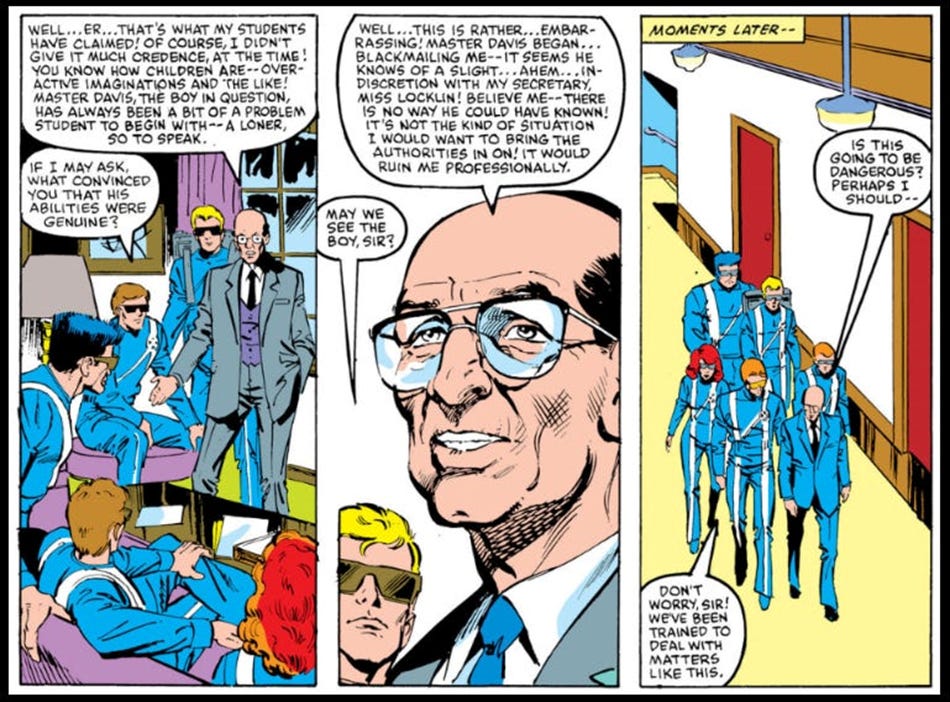
Chris Claremont was not happy about any of this, and even less happy that nobody involved in launching X-Factor asked him for his opinion. But try to see Marvel’s point of view: there was money to be made from selling a throwback to the 1960s iteration of the now-popular X-Men, and if that meant negating nearly a decade of storytelling on Claremont’s part—well, it’s wasn’t like anyone was going to stop buying comic books over it, right?
In X-Factor’s first five issues, Layton does all he can to wind the clock back twenty years. Jean is pre-Phoenix Marvel Girl again because now Jean never was Phoenix, and her power set is once again restricted to telekinesis. The Scott/Jean/Warren love triangle shows signs of realigning. By the end of issue #3, Hank loses the iconic furry blue look he got in the 1970s and reverts to his rather less iconic Jack Kirby design. And Bobby—well, let’s just say that the stuff that happened between him and Cloud in Defenders stays in Defenders. There’s horseplay and squabbling during training sessions again, just like when Jack Kirby and Stan Lee were setting the scene for a given month’s excursion. Whether these were Layton’s calls or had been prescribed by Shooter, I won’t guess.
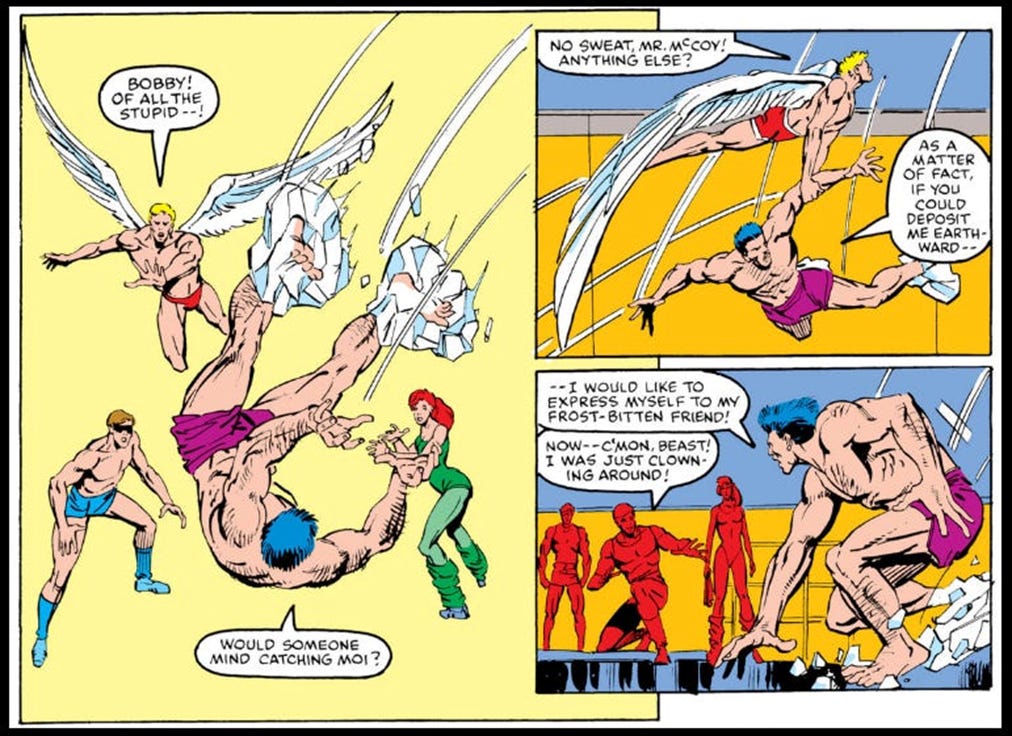
Even Layton’s dialogue feels like an intentional throwback to the 1960s. “They don’t call me Marvel Girl for nothing!” a weirdly chipper Jean quips as she uses her powers to carry Bobby up an elevator shaft. “One telekinetic elevator, at your service, Mr. Drake!” (And did you catch Cameron Hodge actually saying “mutant menace” up above?)
Fortunately, Layton only lasted until issue #5. Louise Simonson took over afterwards, and clearly saw her job on the book as the righting of a wrong:
I couldn't believe it. Chris called me. He was very upset. I said, 'oh, they wouldn't do that. That's just a rumor. Shooter told you he wasn't going to bring Phoenix back.' How wrong was I? Even then, I truly did not believe that Shooter would do a book like that without involving Chris. I was really appalled. I didn't think it was fair. That's my identifying with the creators, as opposed to thinking about X-Men as a commercial property. Maybe working with Chris affected me and made me believe that these were real, living, breathing people. Ripping those characters away from Chris just seemed like an appalling thing to do! I just felt terrible for Chris, knowing what those characters meant to him.
…[Cyclops] had been turned into somebody that he wasn't. He had simply abandoned his wife and child to join this other team and be with his old girlfriend without any guilt or soul-searching. That was nonsense! You'd think he'd at least call his wife. We spent the next three years kind of putting Cyclops back where he belonged. It was one of those things where the editorial realities were having an influence on the fantasy world the characters inhabited, making them behave in ways that weren't right. I think everybody hoped I could help Chris straighten it out and we did straighten it out in the end.
This is what I meant when I said earlier that Claremont could not have asked for a better collaborator. They saw eye-to-eye. They respected each other. Claremont was protective of his turf, and it says a lot about their working relationship that he trusted Simonson with New Mutants and X-Factor.
In issue #6, Simonson immediately gets to work calling out and repairing Shooter and Layton’s nonsense without being too obvious about it. In comic book serials, it’s poor form to take over a book and flagrantly reverse the choices of the previous author just a few months after the fact. If the original five X-Men were now making house calls dressed up as comic book ghostbusters, if Hank had been de-furried, and if X-Factor was set up to be about the group spiriting away and adopting imperiled teenagers, that was just how things were going to be until Simonson could guide the story towards the appropriate off-ramps and U-turns.
Scott rightfully agonizes over his new deadbeat husband/father status, and Jean rightfully chews him the hell out over it. Hank goes through a “my strength is increasing at the cost of my intellect!” arc so he’ll have something to do while he waits out the clock on getting his blue look back. The book’s “mutant-busters” gimmick gets phased out as X-Factor realizes they’re doing a lot more harm than good for human/mutant relations as a heavily advertised organization that promises to deal with mutant threats…permanently. Probably Simonson’s cleverest move is rewriting Cameron Hodge as a manipulative, villainous psychopath—because otherwise the only explanation as to why he’d rope his friends into a venture where they basically pretend to be freelance ICE agents, scaring the crap out of the mutant population and running TV ads vilifying them, is that he’s an imbecile and so is everyone in X-Factor.
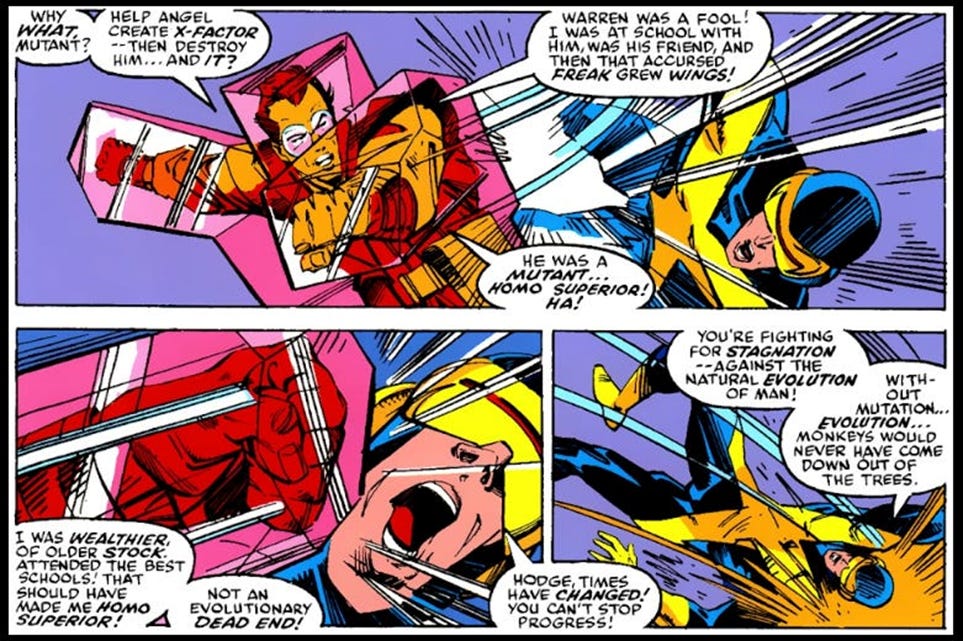
(On the art: in issue #10, Walt Simonson—best known for writing/drawing The Mighty Thor—becomes the book’s regular penciller, and remains until issue #39. It’s hard to imagine a writer/illustrator team collaborating any more closely than an actual married couple, and given that X-Factor is at its strongest when Walt’s on board, he and Weezie seem to have worked together quite well.)
After sloughing off the ill-conceived “mutant hunters” gimmick, X-Factor turns into a comic about a cadre of public-facing New York City superheroes, operating in the light after the X-Men basically fake their deaths and go off the grid. Up until this point, there has never been an iteration of an X-team that has gone so far in realizing Xavier’s dream of harmonious human/mutant relations. It won’t be long before the parade the city throws in the group’s honor is forgotten—the writers who inherit the X-Books from Claremont and Simonson will prefer to do pessimistic and dark stories about a world that stubbornly resists progress—but just for a little while, it’s nice to see a mutant team protecting a world (or at least a Manhattan) that doesn’t hate and fear them quite so much as before.
I believe the passage of time has rehabilitated Simonson’s reputation. Even though she was never quite the caliber of writer Claremont was during his golden years at Marvel, X-Factor at its best was the Pepsi to Uncanny X-Men’s Coca-Cola, and I’d be hard-pressed to call the series a mistake. In Simonson’s very first issue, she and artist Jackson Guice introduce Apocalypse, who soon becomes the X-Men’s best-known Big Bad—the Thanos to their Avengers, the Darkseid to their Justice League. Later, she oversees Warren’s transformation from Angel into his better-known (and much more interesting) iteration as Archangel, and sets Bobby on the path towards his ascension from a dude who makes ice to a gargantuanly powerful cryokinetic beast. She introduces Trish Tilby, a news reporter with whom Hank will be in a situationship for over a decade of publication time; she fishes Boom-Boom from oblivion after the character’s debut in the Secret Wars II EVENT book, co-creates future New Mutants Rictor and Skids, and gives the established Morlock character Caliban a compelling heel-turn arc.
In superhero comics, quality and popularity can often be gauged in terms of endurance within the continuity—and by this measure, Simonson’s X-Factor run was a soaring success. Most importantly, her work on the title helped to crystallize the reputation of the X-Men’s O5 as something really special—rather than the cast of the most mediocre series of Marvel’s breakout decade—and set them up for their reintegration into the expanded X-Men when the team went big into the 1990s.
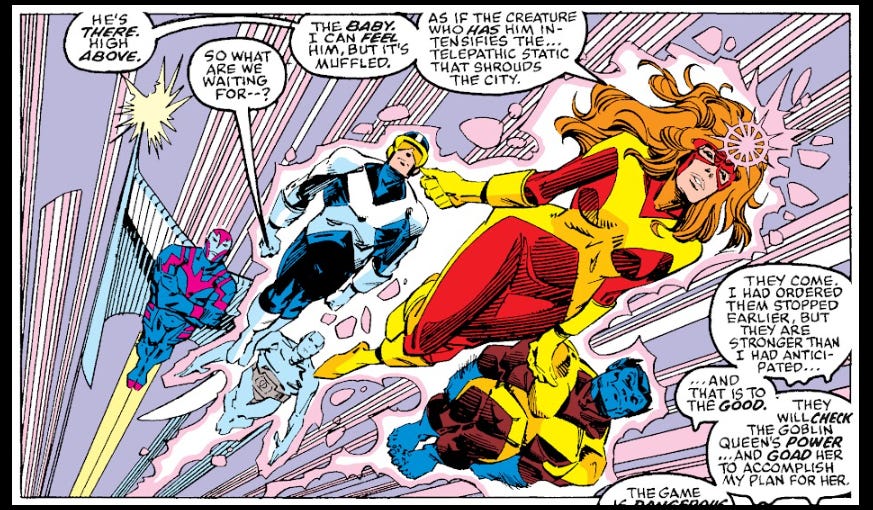
At the same time, Simonson and Claremont were stuck with X-Factor. They made the best of it, but it was still a situation that had been imposed upon them by their publisher, and which they were obligated to roll with. To be fair, this kind of thing wasn’t altogether uncommon: Claremont had originally intended for Jean to survive the Dark Phoenix Saga, but the higher-ups didn’t allow it. (Letting her off scot-free after she got drunk on her own power and murdered an entire planet would have been a rather limp outcome.) Claremont rolled with it, and it worked out for the best. We’ve already seen how it was decided that Magneto’s redemption arc should get rolled back—and while it’s probably fair to say that it could have gone better, Claremont still got to weigh in on how it should play out.
X-Factor, planned and launched without any input from Claremont, was different. It didn’t change the game so much as serve as a reminder that the old rules were still in effect. Claremont may have reinvented the X-Men (and arguably American comic books in general) by going about his work more like a novelist or a mangaka than a typical superhero comics writer—but he was able to do so only because his publisher had given him so much control over its stories and characters, and the space with which to play a long game with regard to plotting. The fact remained that the X-Men no more belonged to Claremont than Batman and Robin belonged to Bill Finger, Denny O’Neil, or even Bob Kane. At the end of the day, the X-Men were the intellectual property of Marvel Comics, and the company was in the business of capitalizing on its brands however it saw fit.
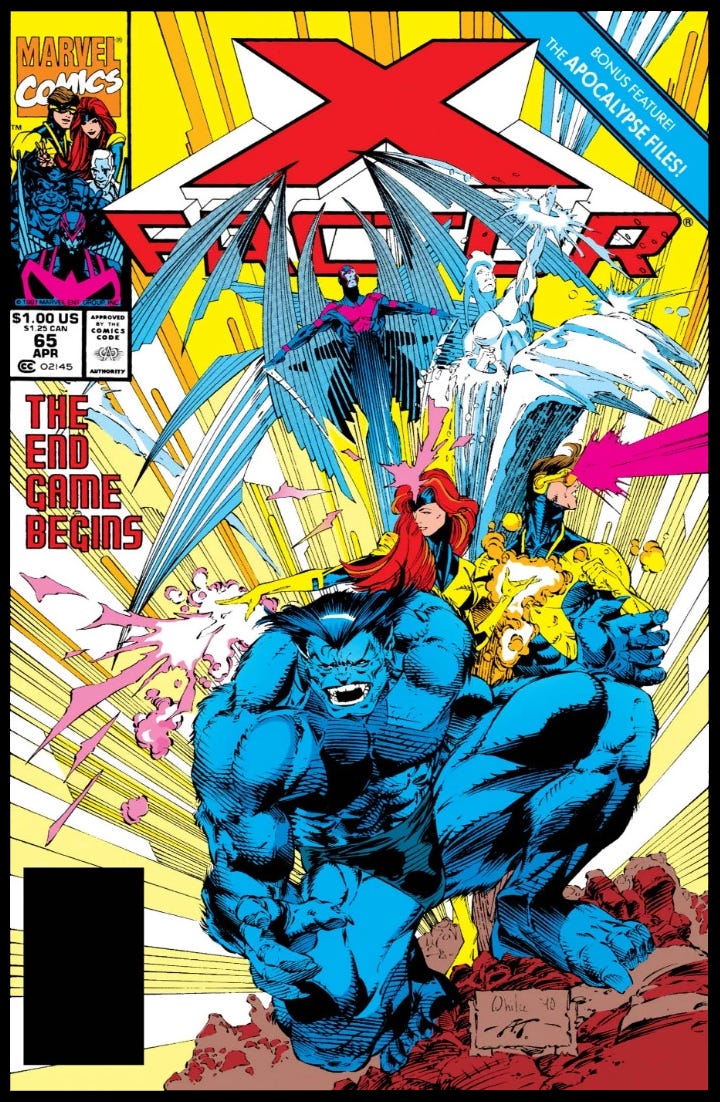
In the early 1980s, it was probably impossible to picture the X-Men ever running independently of Claremont. With the launch of X-Factor, that eventuality became a little easier to imagine. The series represented the first serious move towards turning the post-1975 X-Men into a true corporate franchise whose writers could brought in and swapped out as a matter of course.
NEXT: Not as good as you remember
Bonus: a limited series I gave up on writing about before I started.
FALLEN ANGELS
(1986–87)
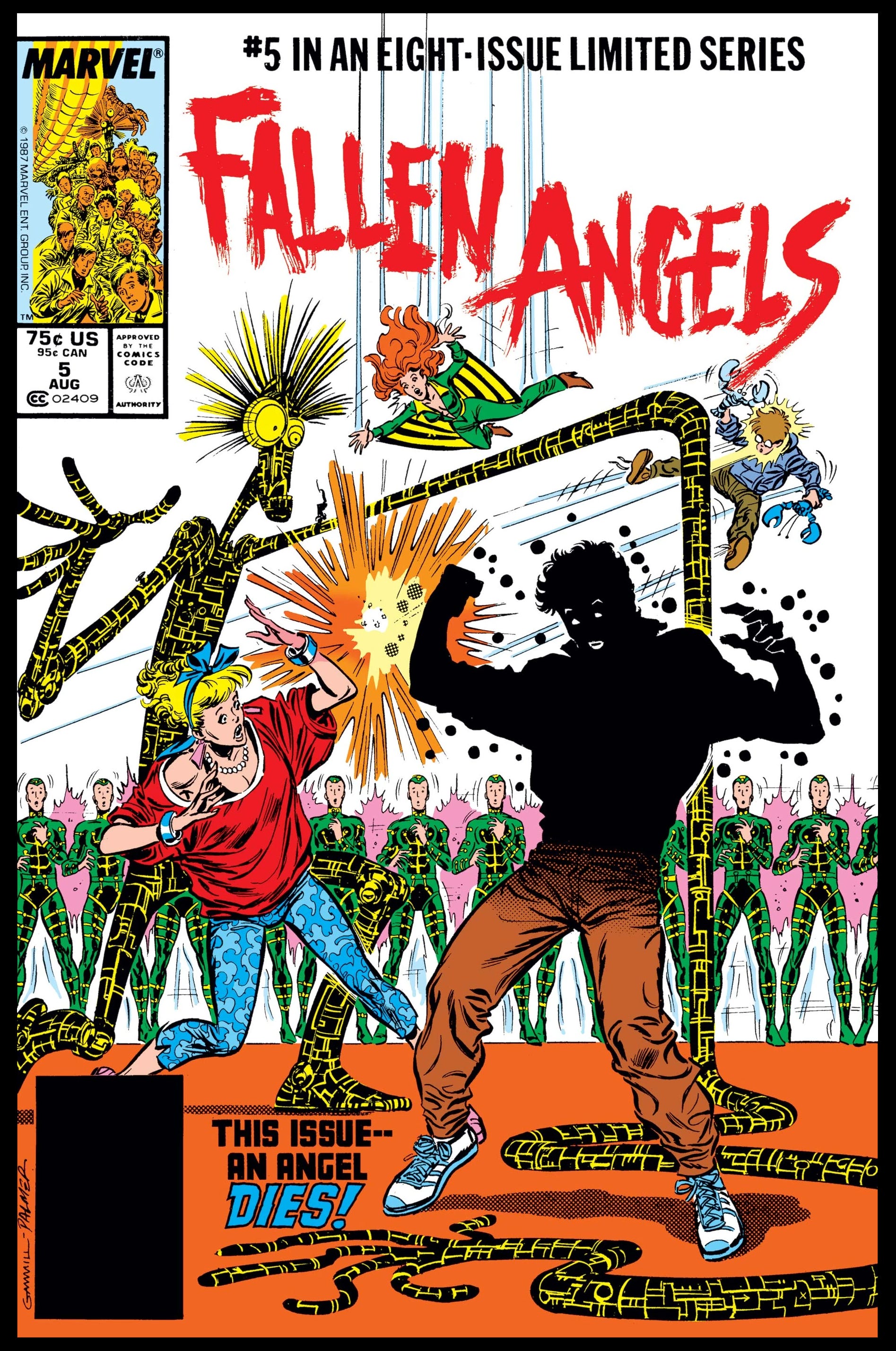
Oh dear. This happened.
Premise: Roberto (Sunspot) from New Mutants gets in hot water and reads something in his file that suggests Professor Xavier is pessimistic about his future prospects. He runs away to Manhattan, and Warlock follows him. They join the Fallen Angels, a crew of misfits and runaways who live with the nuisance villain Vanisher in a secret clubhouse. Stuff happens. There are lobster robots, Moon Boy and Devil Dinosaur, and an alien world called the Coconut Grove. Somehow, it’s all eminently forgettable.
I will try to say three halfway interesting things about Fallen Angels, and then we will be on our way.
(1) Berto and Warlock are temporarily written out of New Mutants so they can be in Jo Duffy’s Fallen Angels. Tabitha briefly disappears from X-Factor for the same reason. It’s nice that Claremont, Simonson, and editor Ann Nocenti took their fictional world seriously enough to observe a simple rule like “characters can’t be in two places at once.” Later on, Wolverine will impale this rule on his adamantium claws and leap out the window with it.
(2) If nothing else, Fallen Angels was an opportunity for Theresa Cassidy (Siryn) and Jamie Madrox (Multiple Man) to strut their stuff. Both characters predate the book, but this is the first time they’ve been members of a superteam (or something like one). In the early 1990s, Jamie joins the cast of Peter David’s X-Factor, and Theresa enlists in X-Force. Both are central characters in David’s new and improved aughts-era X-Factor. Would this have happened without the exposure they got from being in Fallen Angels? Or, better question: is it odd that we’re talking about comic book characters as though they were Hollywood actors? Not really. The consideration that goes into putting together a new serial with a cast of pre-existing characters is roughly analogous to a movie producer’s calculations with regard to selecting stars for a big-budget summer movie. In both cases, it helps to have recognizable names and faces attached to a project.
(3) Someone who began reading X-Men comics at the end of the 1980s or the early 1990s may have encountered allusions to Fallen Angels. Berto, Jamie, Tabitha, or Theresa might mention the group in passing, and a helpful insert (see the Fallen Angels limited series! –Ed.) in the same panel would point readers towards their book. If somebody’s curiosity was stoked, their only recourse was to go looking for Fallen Angels back issues at a comic book shop. There were no wikis or fan sites where they could find plot synopses, and no way of viewing a digitized version of the series on an electronic device from anywhere on the planet. I’m tempted to say that comic books may have been more fun when the lore was more esoteric and mysterious by dint of the source material’s scarcity, and when longtime collectors had a community function as the knowers and explainers of the mythos. As convenient as it is to be able to google “marvel fallen angels” and be brought up to speed, I feel that it cost comic books some of their mystique. (The digital revolution changed comic books much in the same way it changed music, and just about everything else: easy and instantaneous access lead to less depth of engagement and personal investment.)
For the uninitiated: “limited series” in American comic books is analogous to a “miniseries” in television, planned to run for a set number of issues rather than indefinitely. A crossover story runs through two more more existing titles, and is at its core a scheme to get readers to buy more comics than they otherwise would during a given week or month.
“Uncanny” was added to the title in 1981, and that’s what we’ll be calling the post-1975 original series from here on out.
While Stan Lee, in his later years, liked to take credit for writing Professor Xavier and Magneto as comic book analogues to Martin Luther King and Malcolm X, he was pretty much bullshitting and taking credit for somebody else’s work—as was his wont.
The other two, in case you were wondering, were Excalibur and Wolverine, both launched in 1988. The first was a peculiar fusion of X-Men and Marvel UK elements, co-created by Claremont and Alan Davis. The second was, obviously, the most popular X-Man’s solo series. Claremont wrote Excalibur for its first two years, and Wolverine for its first. There are fans who argue that the slip in the quality of Uncanny X-Men during its last couple of years under Claremont should be attributed to overwork and fatigue.
Side note: Claremont was actually against running an ongoing monthly featuring Wolverine, feeling that it risked cheapening the character through overexposure.
Is there a weird cultural dissonance in conjoining a Cheyenne character with Norse myth? Absolutely. Later writers will lampshade it.
Lately the comics have been calling her “Xuân,” but I’m afraid I’ll be sticking with what I know.
Most later writers/editors forget this about Warlock. You’ll see that I balked on doing a writeup of the Fallen Angels limited series—but the only interesting thing that happens in it is Warlock stepping within range of someone who negates mutant powers and turning into a killbot.
Not that there aren’t exceptions—but man, for how many decades were the Teen Titans a thing before the title of their book was changed to just Titans?
John Proudstar was one of the All-New, All-Different X-Men who debuted in Giant-Size X-Men, and got killed in X-Men #95. (He’s the guy we saw Cyclops NO!!!ing about at the instigation of the narration boxes.)
In one memorable instance, he nearly kills a couple of the New Mutants’ friends by using his emotional manipulation powers to make them so horny for each other that they come close to fucking to death off-panel. Incidentally, the 1980s were the years when the Comics Code Authority apparently began rubber-stamping anything so long as it didn’t contain frontal nudity, profane language, or people getting their eyes stabbed out.
She loses the weight in New Mutants Special Edition. How it happens is almost believable.
Blevins guest-penciled an issue during Claremont’s run, and gave the characters more realistic proportions. Whether he shifted to a style that came more naturally to him or was asked/told to draw the New Mutants like rangy cupie dolls is anyone’s guess.
It will suffice to say that both are solid and long-lasting X-characters. Ric has Peter David’s second X-Factor run on his CV, which counts for a lot. Tabitha—a bratty pain in the ass who wore big sunglasses and tossed energy bombs—was, regrettably, overshadowed and made redundant by the introduction of Jubilee in Uncanny X-Men. She later distinguishes herself by growing up to be a superpowered hot mess white girl (whereas Jubilee eventually gets her act together).
He was in a television ad for Levi’s jeans. No marketers ever tapped Jack Kirby or Neal Adams for their star power.
We’ll be touching on this next time, but you might read this very old writeup about the way editor Bob Harras had with his writers—and here’s a podcast interview with Jeph Loeb where, thirty years later, he still speaks angrily about his working relationship with Harras in the mid-1990s.
Click on the cover of New Mutants #100 to enlarge the image. Inspect Warpath’s arms. Contemplate the sense of railroading a reliable workhorse like Louise Simonson for the sake of the illustrator who drew those arms.
Some months ago, a thread in the X-Men subreddit posed the question: which character has been treated the worst by writers? The most upvoted reply was one word: “Rahne.” There was no need to elaborate. Everyone knew.
The title actually ran until 1998, but 1991 was when the late great Peter David took over and soft-relaunched it as a truly fun and novel showcase of minor X-characters.
(1) Yes, that’s correct: the Phoenix entity was retroactively invented for the sole purpose of explaining why a long-dead character wasn’t actually dead—and it went on to became an cornerstone of the X-Men mythos. (Until about 2012, I would have said this was a good development.) The unexpected twists that result from agglutinative, collaborative, on-the-fly storytelling are part of what made American comic books so much fun, in spite of all their bullshit.
(2) It also wasn’t Layton’s idea. Where multiple creators are organizing the goings-on of a shared story universe, the behind-the-scenes stuff gets complicated. I was surprised to learn that the original idea called for keeping Jean dead and casting Dazzler as her replacement.
I don't actually know anything about the X-Men (beyond "Hugh Jackman has pointy fingers" guy), which makes this whole series sort of thrilling.
Warlock in particular -- boy, he looks interesting! Did Sam Kieth ever get to draw an X-Men comic? Feel like he'd have fun with that character...
Very thorough. Probably more than it needs to be. Mission creep? Good times though.
There is one thing I can say about the mysteriousness of all the comic books that are referenced and the reader may never see: They also balanced it against the fact that every issue was someone's first issue. You would get, if not a summary, enough context to roll with it.